
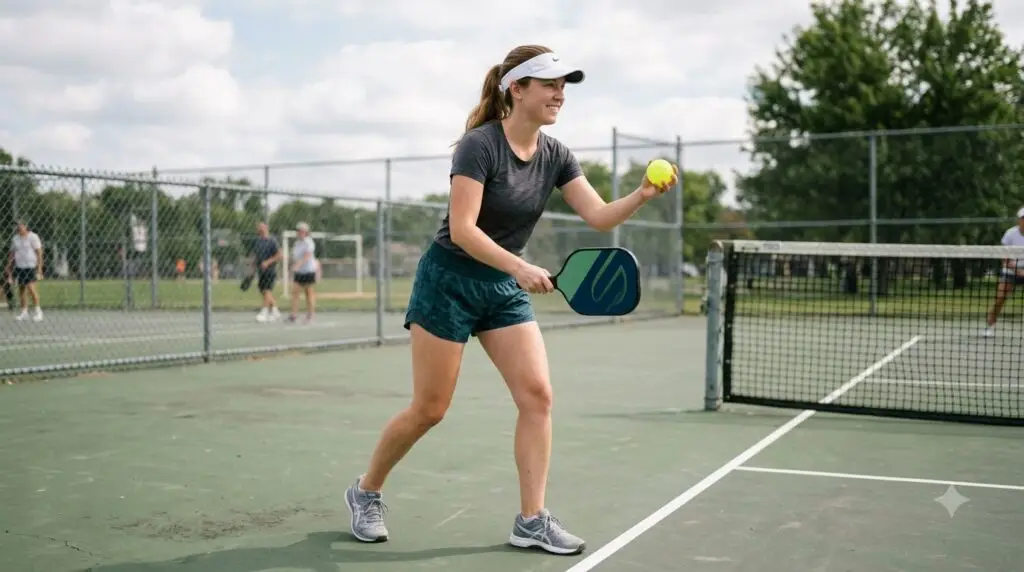
You have taken a beginner pickleball clinic, practiced your serve, learned what the kitchen is, and played a few rallies.
Now comes the awkward question:
Are you actually ready for pickleball open play?
You do not need a powerful third-shot drop, a pickleball rating, tournament experience, or perfect consistency before joining an appropriate beginner-friendly open-play session.
A better test is whether you can do three things:
- Understand the basic rules without constant instruction
- Start and sustain enough rallies to participate
- Move through a doubles game without someone guiding you through every point
If you can do those things, you may be more ready than you think.
This guide gives you a practical nine-point readiness test, explains when another clinic would be more useful, and shows Tampa beginners what to expect when moving from instruction into real open-play games.
Quick Answer: How Do You Know If You Are Ready for Pickleball Open Play?
You are probably ready to try a beginner-appropriate open-play session if you can:
- Keep basic score
- Know whose turn it is to serve
- Serve legally with reasonable consistency
- Return enough serves to start rallies
- Understand the two-bounce rule
- Understand the basic non-volley zone rule
- Sustain short controlled rallies
- Follow basic doubles positioning
- Complete a game without constant coaching
You do not need to win consistently.
Open play is where many of those early skills begin turning into real game awareness.
The key is choosing a session that matches your ability.
The Three Things That Matter Most Before Open Play
Instead of asking whether you are “good enough,” evaluate yourself in three areas.
| Readiness Area | What It Means |
| Rules Ready | You understand scoring, serving, the two-bounce rule, basic faults and kitchen restrictions |
| Rally Ready | You can serve, return and exchange several controlled shots often enough to participate |
| Game-Flow Ready | You can move through a doubles game, communicate and keep playing without constant instruction |
You do not need perfection in all three.
But if one area is almost completely missing, another clinic or practice session will probably be more productive than jumping directly into regular open play.
Clinic vs. Open Play: What Actually Changes?
A clinic and open play solve different problems.
A Beginner Clinic Teaches
During a clinic, an instructor can stop the action and explain:
- How to serve
- How scoring works
- Where to stand
- Why a fault occurred
- How the two-bounce rule works
- How the non-volley zone works
- How to position yourself with a partner
- How to improve a specific stroke
Mistakes become teaching moments.
Open Play Tests
During open play, the game normally keeps moving.
You have to recognize the score, decide where to stand, react to an unfamiliar opponent and communicate with a partner while the rally is happening.
That is why knowing a rule in a clinic and applying it during a game can feel completely different.
Open play is not necessarily more advanced.
It is simply less instructional.
The 9-Point Pickleball Open-Play Readiness Test
This is a practical self-check, not an official USA Pickleball rating.
Use it to identify whether you can participate independently enough to benefit from real games.
1. Can You Keep Basic Score?
You do not have to become the court accountant.
But you should understand the scoring system used in the games you are joining and be able to follow whose serve it is.
Occasionally forgetting the score happens at every level.
The warning sign is needing another player to explain the score or serving sequence after almost every rally.
If scoring still feels mysterious, spend a little more time practicing complete games before open play.
2. Can You Serve Legally Often Enough to Start Points?
A beginner serve does not need speed, spin or clever placement.
Reliability matters more.
You should understand where you serve from and where the serve needs to land.
Missing an occasional serve is completely normal. What matters is that most games are not repeatedly stopping because you cannot initiate the rally.
USA Pickleball states that serves are made from behind the baseline and that the game uses a two-bounce sequence after the serve.
If you can consistently start points, your serve is doing its first job.
3. Can You Return Serves With Basic Control?
Your return does not need to be a winner.
For beginner open play, getting the ball back into the court consistently is far more useful.
Ask yourself:
If someone gives me ten moderate serves, can I return enough of them that we actually get to play?
If yes, you have the foundation you need.
If almost every return goes into the net, long or sideways into another zip code, make this one of your practice priorities before joining a busy session.
4. Do You Understand the Two-Bounce Rule?
This is one rule you should know before open play.
After the serve, the receiving team must let the ball bounce before returning it. The serving team must then let the return bounce before playing it. After those two bounces, players can volley or play the ball after a bounce.
You do not need to recite the rulebook.
You simply need to apply the rule while playing without someone regularly stopping you.
5. Do You Understand the Basic Kitchen Rule?
Beginners frequently think the kitchen is an area they cannot enter.
That is not quite right.
The non-volley zone extends seven feet from the net on each side. The important restriction is that you cannot volley while touching the zone, and your momentum after a volley cannot carry you into it. Players can legally enter the non-volley zone in other situations, such as playing a ball that has bounced.
For open-play readiness, you do not need to know every edge case.
You should simply understand the basic volley restriction well enough that kitchen faults do not happen repeatedly because you are unsure of the rule.
6. Can You Sustain a Short Rally?
Forget twenty-shot highlight-reel rallies.
Can you exchange three, four or five controlled shots with another beginner?
That is enough to begin.
Short rallies show that you have developed enough paddle control to start learning the next layer of pickleball: shot selection, positioning and decision-making.
If virtually every ball flies into the net or out of bounds immediately, another skills session may give you more useful repetitions first.
7. Do You Understand Basic Doubles Positioning?
You do not need advanced stacking, poaching patterns or complicated court strategy.
You should understand that you and your partner have separate responsibilities and need to move in relation to each other.
You should be able to:
- Identify your side of the court
- Avoid standing directly behind your partner
- Move forward when the situation allows
- Recover after hitting a ball
- Avoid leaving huge gaps unnecessarily
- Recognize when both partners should move together
Your positioning will still be imperfect.
That is one of the skills open play helps develop.
8. Can You Communicate With a Partner?
Open play means you may share the court with someone you have never met.
Simple communication matters.
Useful habits include calling:
- “Mine”
- “Yours”
- “Out”
You should also be able to discuss the score, serving order or a questionable ball without turning a casual game into courtroom drama.
You do not need sophisticated partner strategy.
Clear and respectful communication is enough.
9. Can You Play a Full Game Without Constant Coaching?
This is probably the strongest readiness signal.
Imagine playing from the first serve until the final point.
Could you generally follow what is happening?
You may forget a score.
You may stand in the wrong place once.
You may ask a rules question.
None of those mean you are unprepared.
The concern is needing someone to explain what happens next after nearly every rally.
If you can independently participate for most of a game, you are likely ready to test yourself in an appropriate open-play environment.
Your Result: Green, Yellow or Red?
There is no official score for open-play readiness, so avoid treating this like an entrance exam.
Instead, use three practical zones.
Green: Try Open Play
You understand the fundamentals, can serve and return reasonably often, sustain some rallies and play a complete game with only occasional help.
Choose a beginner-friendly or appropriately matched session.
Yellow: Almost Ready
You understand most rules but still struggle with one or two skills such as serving, scoring or positioning.
Do some targeted practice, play several complete games, or take another skills session before trying open play.
Red: Keep Building the Foundation
If scoring, serving, returning, kitchen rules and court positioning are all still unfamiliar, open play may give you less learning value than a clinic.
Learn the game first.
Then use open play to apply what you learned.
Do You Need a Pickleball Rating Before Open Play?
Not necessarily.
The important requirement is whatever the individual facility or session specifies.
Some open-play sessions are categorized by level. Others are mixed. More competitive sessions may use ratings or organizer approval.
A rating should help match players, not become a barrier that stops every new player from participating.
If you do not have one, read the session description and ask the facility which group best fits your current experience.
Do not inflate your ability simply to enter a stronger session.
Better matchmaking creates better rallies for everyone.
Can You Join Open Play After One Beginner Clinic?
Sometimes.
Number of lessons is a poor measurement of readiness.
One player may understand the game quickly after a clinic and several practice games.
Another may need several sessions before scoring and positioning feel natural.
Ask yourself what you can actually do rather than how many lessons you have completed.
If you can play complete beginner games independently, you may be ready.
If you have attended a clinic but never played a full game, play several practice games before making the jump.
Do You Need to Know Dinks and Third-Shot Drops?
You should eventually learn them.
They are not entrance tickets to your first beginner open play.
A new player gets more value initially from:
- A dependable serve
- A controlled return
- Basic paddle control
- Awareness of court position
- Simple communication
- Keeping the ball in play
Dinks, drops, resets, strategic speed-ups and more sophisticated patterns become increasingly important as your level improves.
Do not delay your first appropriate open-play session because your third-shot drop is not yet ready for prime time.
What If You Still Miss Serves?
Missing some serves is normal.
Even experienced players miss.
The question is frequency.
If you usually make enough legal serves to keep games moving, an occasional miss should not stop you from joining open play.
If you currently miss most attempts, fifteen or twenty minutes of focused serving practice will probably benefit you more than repeatedly surrendering points during games.
Use the same standard for returns.
You are looking for functional consistency, not perfection.
What If You Are Nervous About Playing With Strangers?
This is a different kind of readiness.
You can understand every rule and still feel uncomfortable walking into a room where everyone seems to know everyone else.
Choose an appropriate beginner session and tell the organizer or other players that it is your first open play.
That immediately gives people useful context.
Also remember that your first session has a simple purpose:
Learn how open play feels.
You are not auditioning for a professional tour.
How to Choose the Right First Open-Play Session
The words “open play” do not automatically mean “beginner.”
Before registering, check:
- Advertised skill level
- Session time
- Session length
- Registration requirements
- Player capacity
- Rotation system
- Whether paddles or balls are provided
- Whether beginners are specifically welcome
Open play can use paddle queues, rotating foursomes, challenge courts or other systems, depending on the facility.
When you arrive somewhere new, ask how that location handles rotation rather than assuming the system will match another club.
What Should You Practice Before Your First Session?
If you have a final practice session before open play, do not spend it attempting advanced trick shots.
Run a simple readiness workout.
10 Minutes: Serves and Returns
Practice reliable placement rather than power.
10 Minutes: Controlled Rallying
Try to keep the ball alive.
Count consecutive shots.
10 Minutes: Kitchen Awareness
Practice moving toward the non-volley line and controlling simple volleys and bounced balls.
15 Minutes: Complete Doubles Game
Keep the real score.
Follow the serving sequence.
Move after each shot.
Communicate with your partner.
That final game will tell you more about your readiness than isolated drills alone.
What Happens During Your First Open-Play Session?
Exact procedures vary, but a first visit will usually involve some combination of:
- Checking in
- Learning the court or paddle rotation
- Warming up
- Waiting for your group
- Playing a game
- Rotating off or into another group
- Repeating the process
Arrive early enough that you are not trying to understand everything while three other players are waiting for you.
For your first few games, focus on boringly useful pickleball:
Get the serve in.
Return the ball.
Move into position.
Communicate.
Keep playing.
There will be plenty of time later for the spicy stuff.
Should You Stop Taking Clinics Once You Start Open Play?
No.
Clinics and open play work particularly well together.
Think of open play as the diagnostic test.
It reveals what happens to your technique when nobody is feeding you predictable balls.
Maybe your serve disappears under pressure.
Maybe you remain at the baseline too long.
Maybe you struggle with backhand returns.
Maybe fast balls at the kitchen create panic.
Now you have something specific to work on during your next clinic or practice session.
A useful cycle becomes:
Learn → Practice → Play → Identify Weaknesses → Train Them → Play Again
That is far more productive than endlessly taking beginner lessons without playing or endlessly playing games without fixing recurring problems.
When Are You Ready for Intermediate Open Play?
Your first transition is from instruction into beginner or recreational games.
Later, you may face the same question again.
Moving toward intermediate play becomes more reasonable when your fundamentals remain stable against stronger opponents.
Look for improvement in:
- Serve and return consistency
- Rally control
- Court positioning
- Movement with a partner
- Dinking
- Transition play
- Volleys
- Shot selection
- Unforced-error control
- Understanding when to attack and when to reset
Do not move up simply because you occasionally beat intermediate players.
Consistency across many games matters more than one strong afternoon.
Starting Open Play at Pickle Social Lounge in Tampa
For Tampa players making this transition, Pickle Social Lounge in Northdale offers both instruction and open play, which makes it possible to move between learning and game experience without treating them as completely separate stages.
The facility currently lists:
- Beginner clinics covering basics, rules and foundations
- Intermediate sessions focused on technique, shot selection and consistency
- Advanced sessions with competitive drills and match strategy
- Private coaching starting from $40 per hour
- Evening open play from 6:00 PM to 9:00 PM
- Evening open play at $8 per player for a three-hour session
- A five-session open-play package for $32
The website also lists leagues and tournaments for players who later want more structured competition.
Pickle Social Lounge is located at 4417 Northdale Blvd, Tampa, FL 33624 and currently lists operating hours of 7:00 AM to 9:00 PM daily.
Schedules, pricing and program availability can change, so check the current booking information before visiting.
Beginner Clinic, Open Play or League: Which One Fits You?
Use this shortcut.
Choose a beginner clinic if:
You are still learning scoring, serving, kitchen rules or basic positioning.
Choose beginner-friendly open play if:
You understand the rules and can participate independently but need more real-game experience.
Combine clinics and open play if:
You can play complete games but repeatedly struggle with specific technical skills.
Consider intermediate play if:
Beginner games consistently feel comfortable and your fundamentals remain reliable against stronger opponents.
Consider a league if:
You want scheduled matches, more structured competition and repeated play against appropriately matched players.
You do not have to permanently choose one format.
Your best development plan may use several.
Frequently Asked Questions
How do I know if I am ready for pickleball open play?
You are likely ready when you understand basic scoring and rules, can serve and return often enough to start rallies, sustain some controlled exchanges, understand basic doubles positioning and complete a game without constant instruction.
Can complete beginners join pickleball open play?
It depends on the session. Some facilities offer beginner-specific play. If you have never learned the rules or played a complete game, an introductory clinic is usually a more useful starting point.
Do I need a DUPR rating for open play?
Not always. Requirements vary by facility and session. Check the individual session description before registering.
How consistent should my serve be?
There is no universal percentage that determines readiness. You should simply be able to make legal serves often enough that games can flow normally.
Do I need to know how to dink?
Basic dinking is useful, but you do not need advanced dink strategy before your first beginner-friendly open play. Reliable fundamentals matter more initially.
What rules should I know before open play?
At minimum, understand serving, basic scoring, the two-bounce rule, the non-volley zone, common faults and the general flow of a doubles game.
What if everyone at open play is better than me?
Some skill difference is normal. If you can still participate in rallies and learn from the games, that can be useful. If every rally overwhelms you, choose a session closer to your level.
Should I take clinics after starting open play?
Yes, if they help address weaknesses exposed during games. Open play gives you experience while clinics provide focused instruction.
How much is open play at Pickle Social Lounge?
The website currently lists evening open play from 6:00 PM to 9:00 PM at $8 per player for a three-hour session, with a five-session package listed at $32. Check the live schedule and current pricing before attending.
Where is Pickle Social Lounge?
Pickle Social Lounge is located at 4417 Northdale Blvd in Tampa, Florida 33624.
Final Takeaway: You Need a Foundation, Not Perfection
Being ready for pickleball open play does not mean becoming an advanced player before joining your first game.
It means becoming independent enough to participate.
If you understand the main rules, can serve and return with reasonable consistency, sustain short rallies, follow basic doubles positioning and complete a game without constant assistance, an appropriately matched open-play session can become the next stage of your development.
If one area still causes trouble, fix that specific gap rather than starting your entire pickleball education over again.
Learn the fundamentals.
Practice them.
Take them into real games.
Notice what breaks.
Then train that next.
For Tampa beginners, Pickle Social Lounge offers both structured instruction and open play, allowing you to move between learning and playing as your skills develop.
Your first open-play session does not need to prove how good you are.
It simply needs to give you your next set of things to improve.