
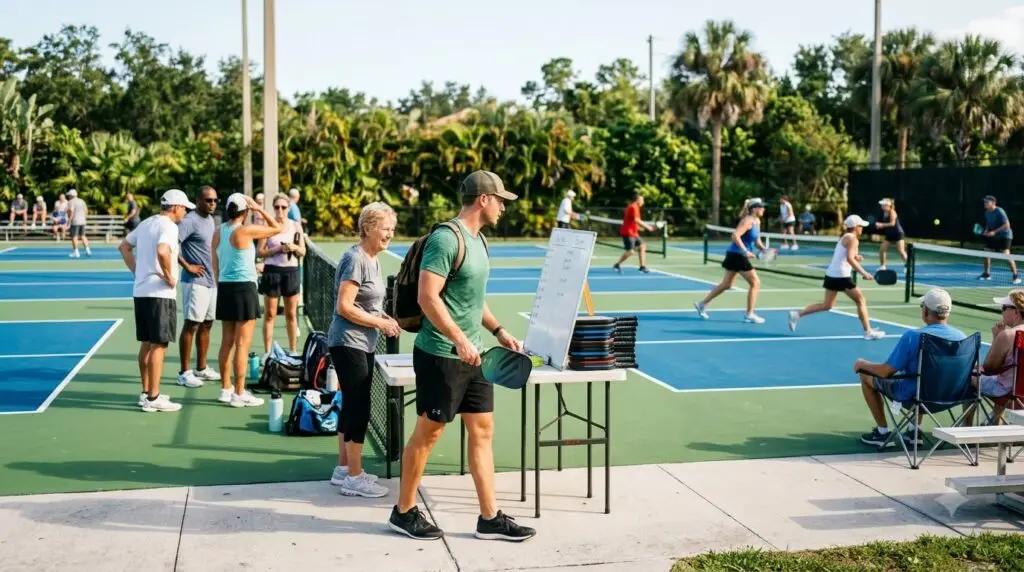
Want to play pickleball but cannot find three other people who are free at the same time?
That is exactly the problem open play is designed to solve.
With pickleball open play in Tampa, you can usually join a scheduled session as an individual rather than organizing your own foursome. Players rotate through games, switch partners and opponents, and get the chance to play with people at different skill levels.
For solo players, that means you can walk in without a regular partner and walk out having played several games and met potential future partners.
The important part is choosing the right session and knowing how open play works before you arrive. If you want competitive games rather than random mismatches, your skill level, rotation etiquette, communication, and choice of opponents all matter.
This guide explains the entire process.
Quick Answer: Can You Join Pickleball Open Play in Tampa Alone?
Yes.
Open play is specifically useful for players who do not have a complete group. Instead of reserving a court for your own foursome, you join other registered players and rotate into games.
At Pickle Social Lounge in Northdale, current website information lists community-focused open play and evening sessions from 6:00 to 9:00 PM for $8 per player, with a five-session package also available. Players should check the current schedule before visiting because session availability can change.
You generally need to bring yourself, your paddle, appropriate court shoes, water, and enough understanding of pickleball to participate in the session you choose.
You do not need to arrive with a permanent doubles partner.
What Is Pickleball Open Play?
Open play is organized court time in which multiple players share courts and rotate through games.
Instead of four friends booking one court and staying together, players enter a rotation. When one game finishes, some or all players rotate off and another group takes the court.
Depending on the facility, rotations may be organized through a paddle rack, queue, staff-managed grouping, challenge court, round-robin system, or another format.
Do not assume every Tampa venue uses the same system.
When you arrive, ask one simple question:
“How does the rotation work here?”
That thirty-second conversation can save a great deal of confusion.
Open play programs commonly create opportunities to play both with and against different people, which is one of the reasons they work particularly well for individual players.
Why Open Play Works So Well When You Do Not Have a Partner
Finding one pickleball partner is easy on some days.
Finding three people who all have the same free evening can feel like solving a tiny scheduling crime scene.
Open play removes that problem.
You are joining a pool of players rather than creating the game yourself. That gives you several advantages.
You can play even when your regular partner is unavailable. You can meet players who are available at the same times you are. You can experience different playing styles. You can test yourself against unfamiliar opponents. You may also meet people who eventually become regular practice partners, league teammates, or tournament partners.
For someone new to Tampa, open play can be particularly useful because you do not need an established local pickleball network before your first session.
The network begins on the court.
Step 1: Choose the Right Open-Play Session
Joining alone is easy.
Joining the right level is more important.
An advanced player entering a beginner session may dominate rallies without getting useful competition. A new player entering a high-level session may struggle to participate meaningfully.
Neither situation is particularly enjoyable.
Before registering, check whether the session is described as:
- Beginner
- Advanced beginner
- Intermediate
- Advanced
- All levels
- Social
- Competitive
- Challenge play
Pickle Social Lounge’s current site describes programming for players from beginner through advanced levels and recommends checking current availability before attending.
If you are unsure where you belong, ask the facility before registration rather than deliberately moving into a stronger or weaker group.
What If You Do Not Have a Pickleball Rating?
You do not automatically need a DUPR or another formal rating simply to understand your playing level.
Requirements differ by program.
For open play, a practical self-assessment is often more useful than guessing a number.
A newer player may still be learning consistent serves, scoring, positioning, returns, and sustained rallies.
An intermediate player will generally have more reliable serves and returns, understand doubles positioning, construct rallies intentionally, and use shots such as dinks, drops, drives, volleys, and resets with increasing consistency.
More advanced players usually expect faster decision-making, fewer unforced errors, stronger court positioning, more purposeful shot selection, and opponents who can handle sustained competitive rallies.
These are not official rating definitions. They are simply useful questions for deciding where to start.
When in doubt, tell the staff how long you have played and describe the type of games you normally play.
Step 2: Register Instead of Simply Assuming a Court Will Be Available
“Open play” does not always mean “walk in at any moment.”
Some facilities allow true drop-in participation. Others require advance booking or limit the number of players in a session.
That distinction matters because overcrowding can produce long waits between games.
Before leaving home, confirm:
- Session time
- Skill level
- Price
- Registration requirement
- Player capacity or waitlist
- Cancellation rules
- What equipment is provided
Pickle Social Lounge currently directs players toward its open-play schedule and lists evening open play as a three-hour session. Because schedules and availability can change, checking the live booking information before your visit is better than relying on an old screenshot or social post.
Step 3: Arrive Early Enough to Understand the Rotation
Your first ten minutes can determine whether the session feels effortless or confusing.
Arrive with enough time to check in, change shoes if necessary, locate the courts, warm up, and understand the rotation.
If you came alone, tell the staff or other players that it is your first open-play session at that facility.
You do not need an elaborate introduction.
A simple “First time here, where do I put my paddle?” usually gets the machinery moving.
Different facilities use different rotation systems, but you may encounter several common formats.
Paddle Stack or Paddle Rack
Players place paddles in a queue. The next group of paddles forms the next game.
Four On, Four Off
After a game, all four players leave the court and another four enter.
This creates more mixing and reduces the tendency for the same group to occupy a court continuously.
Winners Stay or Challenge Court
Winning players or teams may remain while new challengers rotate in.
These courts can produce tougher games, although the exact rules should be confirmed before joining.
Staff-Organized Rotation
The facility may create groups or rotations to balance playing time and skill level.
No system is universally “correct.” What matters is following the system used at that session.
Step 4: Use Your First Few Games to Calibrate the Room
Do not decide after your first five rallies that everyone is too strong or too weak.
Open play naturally contains some variation.
Use your first two or three games to understand:
- How hard people are serving and returning
- Whether rallies regularly reach the kitchen
- How consistently players dink and reset
- How aggressively they attack
- How many unforced errors occur
- Whether partners communicate
- How quickly games move
- Which players appear closest to your level
This is your calibration period.
If you are consistently winning without being tested, you may need stronger opposition.
If you cannot sustain rallies or understand what is happening tactically, the current group may be above your level.
Competitive open play works best when the gap is small enough that every player can influence the game.
How to Get More Competitive Games Without Being “That Player”
There is nothing wrong with wanting stronger games.
The trick is pursuing them without treating everyone else as a human ball machine.
Start by identifying players who appear close to your level.
After a game, you can ask whether they want to rotate into another match later. If the facility has skill-separated courts or a challenge format, move toward the appropriate court according to the facility’s rules.
You can also tell staff that you are looking for competitive games at approximately your level.
What you should avoid is refusing every weaker partner, jumping rotation lines, occupying one court with the same four people during open play, or repeatedly targeting a clearly less experienced player just to win.
Competitive does not have to mean antisocial.
The strongest open-play communities usually combine both.
What Should You Do When Your Partner Is Weaker Than You?
This will happen.
It is also part of what makes open play useful.
Do not attempt to cover the entire court because you assume your partner cannot handle the ball. Overplaying the middle, stealing routine shots, or coaching after every mistake usually makes the partnership worse.
Instead, communicate.
Call balls clearly. Cover your responsibility. Play percentage pickleball. Give your partner room to participate.
If the opponents repeatedly target the weaker player, use it as a tactical exercise rather than becoming frustrated. Work on positioning, middle coverage, resets, patience, and creating opportunities your team can finish.
You will eventually be the weaker player in somebody else’s foursome too.
Good open-play etiquette works in both directions.
What If You Get Matched With Players Much Stronger Than You?
Treat the game as information.
Notice where rallies break down.
Are your returns too short? Are you staying near the baseline while everyone else reaches the kitchen? Are speed-ups catching you unprepared? Are you attacking balls that should be reset?
One difficult game can expose more than five comfortable games.
However, repeatedly entering a session dramatically above your ability does not necessarily accelerate improvement. You need enough rally participation to practice decision-making.
If every rally ends before you can construct a point, choose a slightly more suitable session and develop there.
What If Your Open-Play Games Feel Too Easy?
Do not immediately start hitting every ball harder.
First, make the game difficult in useful ways.
Try returning deeper. Miss fewer serves. Reach the kitchen consistently. Reduce unforced errors. Work on third-shot drops. Reset attacks rather than countering everything. Move efficiently with your partner. Choose smarter speed-ups.
If you remain comfortably ahead of the group even while playing disciplined pickleball, ask whether a stronger session, challenge court, league, or tournament would be more appropriate.
Pickle Social Lounge also promotes leagues and tournaments for players seeking more structured competition. Its competition programming includes different skill divisions and competitive formats, with current league details available by inquiry.
Open Play vs. Court Reservation: Which Is Better When You Are Alone?
If you are solo, open play usually solves your immediate problem better because other players are already part of the session.
A private reservation makes more sense when you already have people to play with or want controlled practice.
For example, a reserved court is useful when you and a partner want to drill third shots for an hour, practice tournament strategy, or play uninterrupted games with a specific foursome.
Open play is better when your main questions are:
Who can I play with tonight?
Who else is around my level?
Can I get several different opponents?
That difference matters.
Do not pay for isolated court time when the real thing you need is a player network.
Your First Open-Play Session: A Simple Game Plan
Imagine you are attending pickleball open play in Tampa alone for the first time.
You register for the appropriate session and arrive around 15 minutes early.
After checking in, you ask how rotation works and where waiting players place their paddles.
You warm up rather than immediately firing full-speed drives.
Your first game gives you a rough sense of the level. The second exposes you to a different partner. By the third, you have identified several players whose pace and consistency are close to yours.
Between games, you introduce yourself and ask when they normally play.
That last step is important.
The goal is not merely to survive one solo visit.
It is to make the next visit easier.
After several sessions, the room that originally looked full of strangers begins to contain familiar opponents and potential partners.
That is how open play turns into a pickleball network.
What to Bring When You Come Alone
Keep the equipment side simple.
Bring a paddle you are comfortable using, supportive court shoes, water, and any personal items you normally need during exercise.
A towel and spare shirt may also be useful for a longer session.
Check whether the facility supplies balls rather than assuming it does.
Your phone is useful for checking the booking confirmation, schedule, or contact information, but once games begin, keep it away from the playing area.
Most importantly, bring enough understanding of the basic game to participate at the level you selected.
If you still need regular help with serving rules, scoring, positioning, or the kitchen, a clinic or lesson may make open play much more enjoyable afterward.
Pickle Social Lounge currently offers beginner, intermediate, and advanced clinics plus private coaching alongside open play.
Five Mistakes Solo Open-Play Players Should Avoid
Joining the wrong level. Competitive games come from similar ability, not from entering the hardest session available.
Ignoring the rotation. Learn the system before taking a court.
Trying to keep the same partner all evening. Open play works because people rotate.
Treating every point like tournament match point. Competitive does not mean reckless or unpleasant.
Leaving without meeting anyone. If you enjoyed playing with someone, introduce yourself. Your future doubles partner may have been standing in the paddle queue beside you.
How Open Play Can Help You Find a Regular Pickleball Partner
Do not choose a partner based only on who hits the hardest ball.
Pay attention to compatibility.
Does the player communicate? Do they arrive reliably? Are they available at similar times? Do they stay composed after mistakes? Is their playing level reasonably close to yours? Do your styles complement each other?
After several sessions, you will naturally notice players you enjoy sharing the court with.
Ask whether they want to practice sometime.
If that works well, reserve a court together.
If your goals become more competitive, try a league or tournament.
Open play therefore becomes more than a substitute for having no partner. It becomes the place where future partnerships are discovered.
When Should You Move From Open Play to a League?
Open play may remain part of your routine indefinitely.
But a league can make sense when you want more consistent competition, recurring matches, standings, or a structured progression.
Consider moving toward league play when:
- You understand your approximate level
- You want opponents near that level consistently
- You enjoy competitive scoring
- You can commit to recurring play
- You want to track improvement over several weeks
Pickle Social Lounge promotes leagues as structured competition for different skill levels and also offers tournaments for players who want to test themselves in an event format.
Open play and leagues are not substitutes for each other.
One builds variety and community. The other adds structure.
Many regular players benefit from both.
Joining Pickleball Open Play at Pickle Social Lounge in Tampa
For players in Northdale and the surrounding Tampa area, Pickle Social Lounge offers a local option designed around both pickleball and community.
The facility is located at 4417 Northdale Boulevard, Tampa, FL 33624 and currently lists daily operating hours from 7:00 AM to 9:00 PM.
Current public information lists evening open play from 6:00 PM to 9:00 PM for $8 per player, plus a five-visit pack for $32. The facility also offers court reservations, clinics, private coaching, leagues, tournaments, and social programming.
Because open-play schedules, capacity, and programming can change, check the current schedule before heading over.
If you are coming alone, that is not a reason to postpone your game.
It may actually be the reason to choose open play.
Frequently Asked Questions About Pickleball Open Play Tampa
Can I go to pickleball open play alone?
Yes. Open play is designed to allow players to join a shared session and rotate through games, so you generally do not need to organize your own foursome.
Do I need a doubles partner before joining?
Not for normal open play. You will usually rotate among other players. Specific leagues, tournaments, or special events may have different partner requirements.
Do I need a DUPR rating?
Not necessarily. Rating requirements vary by facility and session. If you are unsure which level to register for, describe your playing experience to the facility and ask which session is appropriate.
Is open play suitable for beginners?
It can be, provided you choose a beginner-appropriate session and already understand enough basic rules and scoring to participate. Complete first-timers may benefit from an introductory clinic or lesson first.
How do partners get selected during open play?
It depends on the facility. Open play may use paddle stacks, rotating foursomes, staff-created groups, challenge courts, or another system. Ask how rotation works when you check in.
Can I choose who I play with?
Sometimes, but open play is built around rotation. You should not expect to reserve the same foursome for the entire session unless the facility specifically permits it.
How do I find stronger opponents?
Join the correct skill-level session, identify players close to your ability, use challenge courts when available, or ask staff which session provides stronger competition. If open play no longer provides enough structure, consider leagues or tournaments.
How much is open play at Pickle Social Lounge?
The Pickle Social Lounge website currently lists evening open play at $8 per player for a three-hour 6:00–9:00 PM session and a five-session pack for $32. Check the live schedule and current pricing before visiting.
Where is the Pickle Social Lounge?
Pickle Social Lounge is at 4417 Northdale Boulevard, Tampa, Florida 33624.
No Partner Is Not a Pickleball Problem
You do not need three friends with matching calendars to play regularly.
That is one of open play’s biggest advantages.
The right pickleball open play Tampa session lets you arrive individually, rotate through several combinations of players, learn how your game holds up against unfamiliar opponents, and gradually build a local playing network.
Start at the right skill level. Learn the rotation. Give the first few games time to settle. Be competitive without making every rally hostile. Introduce yourself to the people whose games fit yours.
Do that consistently and the original problem changes.
Instead of asking, “Who can I convince to play pickleball with me?”
you begin asking, “Which group am I playing with tonight?”
For Tampa players ready to start, check the current open-play schedule at Pickle Social Lounge and choose the session that fits your level.