
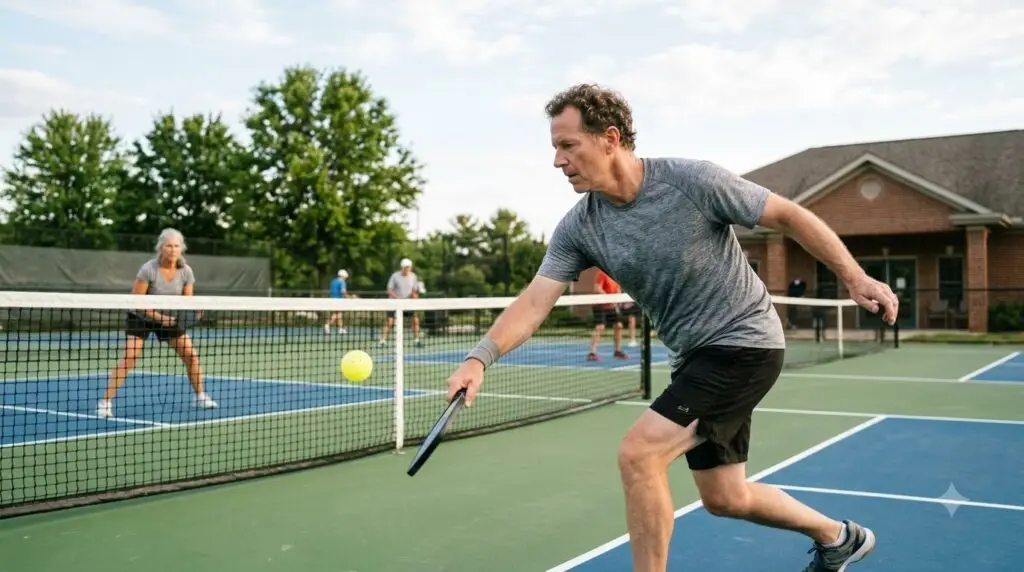
You know the rules.
You can serve and return.
You can sustain rallies.
You understand the kitchen and basic doubles positioning.
Yet your game feels stuck.
You keep making similar mistakes, losing similar points, and wondering why playing more pickleball is not automatically making you a stronger player.
That is the 3.0 plateau.
Moving from 3.0 toward 3.5 is not simply about hitting harder or learning a collection of advanced shots. Development at this stage depends more on:
- Greater consistency
- Better serve and return depth
- Smarter third-shot decisions
- Improved dinking
- Developing blocks and resets
- Better movement with a partner
- Fewer unnecessary errors
- More purposeful shot selection
The key difference is repeatability.
A 3.0 player may know what the correct shot is.
A developing 3.5 player can choose and execute the correct shot more consistently.
If you’re wondering how to go from 3.0 to 3.5 in pickleball, this guide gives you a focused six-week plan built around the skills and decisions most likely to move your game forward.
First, Understand What “3.0 to 3.5” Actually Means
There are two different concepts players often mix together.
Pickleball Skill Level
A skill level describes the type of game you can consistently play.
It considers things such as:
- Shot control
- Consistency
- Strategy
- Positioning
- Dinking
- Third-shot decisions
- Volleys
- Resets
- Partner movement
A developing 3.5-level player generally demonstrates more control and tactical awareness than a typical 3.0 player.
DUPR Rating
DUPR is different.
It is a match-results-based numerical rating that changes according to competitive performance.
That means improving your 3.5-level skills does not automatically mean your DUPR immediately becomes exactly 3.500.
For this guide, moving from 3.0 to 3.5 means developing the skills, consistency, and decision-making associated with stronger intermediate play.
What Is the Difference Between a 3.0 and 3.5 Pickleball Player?
The jump is less about learning brand-new shots and more about improving the shots you already use.
| Area | Typical 3.0 Player | Developing 3.5 Player |
| Serve | Usually consistent | More depth and placement control |
| Return | Gets ball into play | Uses depth to create positional advantage |
| Third Shot | Developing drop | Chooses between drop and drive |
| Dinking | Can sustain basic exchanges | Controls height, depth, and direction |
| Volleys | Handles moderate pace | Develops blocks, counters, and resets |
| Positioning | Understands basic movement | Moves more effectively with partner |
| Strategy | Beginning to think tactically | Builds points more intentionally |
| Errors | Frequent unforced errors | Greater consistency |
| Attack Selection | Often attacks too early | Recognizes better attack opportunities |
The shift is therefore not:
“How do I hit harder?”
It is:
“How do I make better decisions more consistently?”
Why Do Players Get Stuck at 3.0?
Several habits commonly slow improvement.
Playing Games but Rarely Drilling
Open play is valuable, but games mainly test the skills you already have.
Drilling gives you the repetition needed to change a weakness.
If your third-shot drop is unreliable, three hours of games may give you only a limited number of useful drop attempts.
A focused drilling session can give you dozens.
Attacking Too Many Balls
Many developing players attack whenever they see an opportunity to swing.
But attacking from:
- Below net height
- Poor balance
- Difficult angles
- Defensive positions
often creates an easy counterattack.
A stronger intermediate player becomes more selective.
Getting Stuck in the Transition Zone
Players often understand that they should move toward the kitchen but rush forward without reading the next ball.
A better sequence is:
- Hit a quality advancing shot.
- Move forward.
- Split step when the opponent contacts the ball.
- Reset or defend if necessary.
- Continue forward when the next ball allows it.
Avoiding the Soft Game
A player who only drives becomes predictable.
Development toward 3.5 requires being able to choose between:
- Drive
- Drop
- Dink
- Reset
- Block
- Attack
Making Too Many Unforced Errors
Many points at the 3.0 level are lost without the opponent doing anything exceptional.
Examples include:
- Missed routine serves
- Short returns
- Poor third-shot attempts
- Unnecessary speed-ups
- Overhit volleys
- Low-percentage winners
The goal is not mistake-free pickleball.
It is making opponents earn more points.
The Six Skills to Prioritize From 3.0 to 3.5
You do not need twenty new shots.
Focus on six high-value areas.
1. Serve and Return Depth
At 3.0, getting the serve and return into play may feel successful.
At 3.5, placement starts to matter more.
Improve Your Serve
Work on:
- Reliable legal serves
- Deep placement
- Different targets
- Consistency before power
Your serve should help create a more difficult return.
Improve Your Return
A strong return should help:
- Keep the serving team back
- Give you time to move forward
- Make the third shot more difficult
After returning, move toward the non-volley zone instead of staying near the baseline.
2. Third-Shot Decision-Making
The third shot is not about mastering one shot.
It is about choosing the right one.
Use a Third-Shot Drop When
You need to:
- Slow the point
- Neutralize opponents at the kitchen
- Create time to advance
- Reduce attacking opportunities
Consider a Third-Shot Drive When
The return gives you:
- A higher ball
- A shorter ball
- A useful attacking lane
- An opponent who is not established at the kitchen
The goal is to avoid becoming predictable.
3. Dink Control and Patience
At 3.0, maintaining a dink rally may be the challenge.
At 3.5, you should begin controlling:
- Height
- Depth
- Direction
- Pace
Then ask:
“Is this ball actually attackable?”
Patience matters because not every dink should become a speed-up.
4. Transition-Zone Resets
Resets help you survive when opponents attack while you are moving forward.
Instead of hitting hard from a defensive position, a reset attempts to reduce pace and place the ball softly into the opponent’s kitchen.
A successful reset can help you:
- Regain balance
- Neutralize pressure
- Continue moving forward
This is one of the most valuable skills for a developing intermediate player.
5. Volley Control
You should begin recognizing the difference between:
- Blocking
- Countering
- Punch volleys
- Controlled placement
- Attacking a high ball
The goal is no longer simply getting the paddle on a fast ball.
The goal is choosing the right response.
6. Partner Movement and Court Coverage
Doubles pickleball requires two players to move as a unit.
Develop awareness of:
- Your partner’s position
- Open gaps
- Middle-ball responsibility
- When both players should move forward
- When to hold your position
- How to recover after an attack
Better teamwork reduces easy openings for opponents.
Your Six-Week 3.0 to 3.5 Pickleball Plan
Six weeks is enough for a focused improvement block.
It is not a guarantee that every player will become an official 3.5 or gain exactly 0.5 DUPR points.
The goal is to improve the habits associated with stronger intermediate play.
Week 1: Diagnose Your Current Game
Do not start by randomly practicing every shot.
Find out where points are actually being lost.
Track:
- Serve faults
- Short returns
- Third-shot errors
- Transition mistakes
- Dink errors
- Poor speed-ups
- Missed volleys
- Positioning problems
If possible, record some games and review them later.
Ask:
- Which mistake costs me the most points?
- Which shot do I avoid because I do not trust it?
- Where am I standing when rallies usually break down?
Choose your two biggest weaknesses.
Those become your priorities for the next five weeks.
Week 2: Improve Serve and Return Quality
Focus on:
- Serve consistency
- Serve depth
- Return depth
- Moving forward after returning
Serve Drill
Create target zones near the deeper part of the service box.
Practice sets of ten.
Track:
- Serves in
- Deep serves
- Intended target hits
Do not measure success only by whether the ball lands inside the court.
Return Drill
Have a partner serve repeatedly.
Practice:
Deep return → move forward → split step
This trains both the shot and the movement that should follow it.
Week 3: Build a Functional Third-Shot Game
Practice both drops and controlled drives.
Third-Shot Drop Progression
Start closer to the kitchen.
Once you develop control:
- Move backward.
- Repeat from the transition zone.
- Progress toward the baseline.
Drop + Advance Drill
After every drop:
- Move forward.
- Split step.
- Read the next ball.
- Reset or advance again.
Do not treat the third-shot drop as an isolated trick.
Its purpose is to help create better court position.
Drive + Fifth-Shot Drill
Practice:
- Third-shot drive.
- Opponent blocks.
- Fifth-shot drop or controlled follow-up.
This teaches you to think beyond the drive itself.
Week 4: Develop Kitchen Control
Focus on:
- Dinking
- Attack recognition
- Controlled speed-ups
- Counters
Dink Control Drill
Practice:
- Cross-court dinks
- Straight dinks
- Forehand dinks
- Backhand dinks
- Directional targets
Track quality rather than simply counting consecutive shots.
Ask:
- Was the ball low?
- Did I control the direction?
- Did I accidentally create an attackable ball?
Attack-or-Continue Drill
Begin with cooperative dinking.
Attack only when a genuinely attackable ball appears.
Otherwise, continue the rally.
This develops decision-making instead of encouraging automatic aggression.
Week 5: Fix Your Transition Game
Practice defending while moving toward the kitchen.
Reset Drill
One player attacks from the kitchen.
The defender starts in the transition zone and attempts to place a soft reset into the kitchen.
After a good reset:
- Move forward
- Split step
- Reset again if needed
Continue until reaching the non-volley zone.
Block and Counter Drill
Have your partner feed controlled pace.
Alternate between:
- Soft block
- Counterattack
The objective is understanding that different balls require different responses.
Week 6: Test Your New Skills Under Pressure
Drills are only useful if they survive actual games.
During the final week, play skill-appropriate competitive matches.
Give yourself process goals such as:
- Avoid routine serve faults
- Return deep
- Choose the right third shot
- Do not attack low dinks
- Reset when off balance
- Move with your partner
- Track unforced errors
After every game, write down:
One decision that worked
One recurring mistake
One skill that still needs practice
A Practical Weekly Training Schedule
You do not need to spend every evening on a pickleball court.
A useful structure might look like:
| Session | Purpose |
| Session 1 | Focused technical drilling |
| Session 2 | Clinic, coaching, or additional drilling |
| Session 3 | Skill-matched open play |
| Optional Session 4 | Competitive play |
Quality matters more than raw hours.
Three purposeful sessions can be more useful than several hours of casual games where you repeat the same habits.
Five High-Value Drills for the 3.0 Plateau
Drill 1: Serve and Return Depth
Setup
Create target zones near the deeper portion of each service court.
Practice
Complete:
- 10 serves from each side
- 10 returns from each side
Track:
- Balls in
- Balls reaching the deep zone
- Target accuracy
Drill 2: Third-Shot Drop + Advance
Hit a third-shot drop.
Then:
- Move forward.
- Split step.
- Play the next ball.
- Continue toward the kitchen only when your previous shot allows it.
This teaches the purpose of the drop.
Drill 3: Cross-Court Dink Targets
Create targets in:
- Short cross-court area
- Deeper kitchen corner
- Backhand-side zone
Alternate targets rather than simply keeping the ball alive.
Drill 4: Transition Reset Ladder
Begin deeper in the court.
One player feeds controlled attacks.
The defender:
- Resets
- Moves forward
- Split steps
- Resets again
Continue until reaching the kitchen.
Drill 5: Attack-or-Reset Decision Game
Have your partner feed:
- High balls
- Low balls
- Neutral balls
Your job is to choose:
- Attack
- Block
- Reset
- Continue neutral play
This develops one of the biggest differences between 3.0 and 3.5 players:
better decisions.
What Should You Measure During the Six Weeks?
Do not rely only on:
“I think I’m playing better.”
Track several simple metrics.
Serve
Measure:
- Faults
- Depth
- Target accuracy
Return
Measure:
- Short returns
- Deep returns
- Whether you successfully move forward
Third Shot
Classify each attempt as:
- Useful drop
- Useful drive
- Neutral result
- Immediate error
Dinking
Track:
- Unforced errors
- Attackable balls created
- Poor speed-ups attempted
Transition
Track how often you:
- Successfully reset
- Get caught moving
- Rush forward
- Reach the kitchen under control
Match Errors
Keep an approximate count of unforced errors.
You do not need laboratory-level statistics.
You need patterns.
How Do You Know When You Are Approaching 3.5?
Do not decide because you dominated one open-play session.
Look for changes you can repeat.
You are moving toward stronger 3.5-level play when you increasingly:
- Control serve and return depth
- Use both forehand and backhand effectively
- Sustain controlled dink rallies
- Recognize attackable balls
- Choose between third-shot drive and drop
- Block and reset more effectively
- Move with your partner
- Identify opponent weaknesses
- Make fewer unnecessary errors
- Stay patient when the rally does not offer an immediate attack
The key is consistency across multiple games and opponents.
The Mental Shift From 3.0 to 3.5
Better intermediate pickleball is not only technical.
It requires better questions.
Instead of:
“Can I attack this?”
Ask:
“What happens if I attack this?”
Instead of:
“Did my third shot go in?”
Ask:
“Did my third shot help us reach a better position?”
Instead of:
“How do I hit a winner?”
Ask:
“How do I create an easier ball?”
Instead of Watching Your Shot
Recover immediately.
Your position after contact can matter as much as the shot itself.
Start Recognizing Patterns
Look for:
- Opponents avoiding their backhand
- Players staying too deep
- Predictable speed-ups
- Open middle space
- Poor movement after certain shots
Strategy begins with observation.
Common Mistakes That Keep Players at 3.0
Only Playing Open Play
Open play is excellent for testing skills.
It is less efficient for building a weak stroke.
Combine matches with drills.
Practicing Only Your Best Shots
If your forehand drive is already strong, another hundred forehand drives may not solve your biggest problem.
Train the weakness.
Trying to Improve Everything at Once
Choose one or two priority weaknesses.
Trying to rebuild your:
- Serve
- Backhand
- Drop
- Dink
- Reset
- Volley
- Footwork
- Strategy
all at once usually reduces the quality of practice.
Rushing Toward the Kitchen
Reaching the kitchen matters.
Running into an attack before you are ready does not.
Advance according to the quality of your previous shot.
Treating Every Loss as a Rating Problem
Sometimes the real problem is:
- Shot selection
- Positioning
- Communication
- Technique
- Unforced errors
Diagnose the game before worrying about the number.
Where Does DUPR Fit Into Your Improvement?
DUPR can help measure competitive performance, but it should not control every training decision.
Remember:
Drills improve your skills.
Recorded competitive results influence your rating.
That means reaching stronger 3.5-level skills does not automatically guarantee an exact 3.5 DUPR.
Focus on:
- Better decisions
- Improved consistency
- Stronger competition
- Fewer avoidable errors
Then allow competitive results to reflect the progress.
Should You Get Coaching at the 3.0 Plateau?
You can improve without private coaching.
However, coaching can be valuable when you keep repeating the same problem without understanding its cause.
For example, an unreliable third-shot drop could come from:
- Poor contact point
- Grip pressure
- Footwork
- Paddle path
- Target selection
- Balance
Simply hitting hundreds of drops may reinforce the mistake if the underlying issue is not corrected.
A coach can also help identify whether the problem is technical or strategic.
How Pickle Social Lounge Can Support a 3.0 to 3.5 Training Plan
For Tampa players, Pickle Social Lounge offers several types of programming that can fit different parts of an improvement plan.
Current options include:
- Beginner, intermediate, and advanced open play
- Group clinics
- Private coaching
- Round robins
- Challenge courts
- Ladder play
- Tournaments
For a developing intermediate player, these options can serve different purposes.
Use Clinics for Repetition
Clinics can help you work on:
- Technique
- Shot selection
- Consistency
- Strategy
Use Private Coaching for Diagnosis
Private instruction is more useful when you need to understand why one particular skill is failing.
Use Open Play for Application
Open play lets you test a new skill against different opponents.
If a new technique fails during the first few games, do not immediately abandon it and return to the old habit.
Use Competitive Formats for Pressure
Round robins, challenge courts, ladder play, and tournaments can help reveal whether your improved skills hold up when points matter.
Confirm Current League Availability
If you want league play to be part of your training schedule, confirm current availability before planning around it.
Programs and schedules can change.
Example Six-Week Plan at Pickle Social Lounge
Depending on the current schedule, a developing Tampa player might structure training like this:
Week 1
- Skill-matched open play
- Clinic or private assessment
Goal: Identify weaknesses.
Week 2
- Serve and return drilling
- Intermediate clinic
- Open play
Goal: Improve first-two-shot quality.
Week 3
- Third-shot practice
- Coaching or clinic
- Open play
Goal: Improve third-shot decisions.
Week 4
- Dinking and attack-recognition drills
- Clinic
- Open play or round robin
Goal: Improve kitchen control.
Week 5
- Transition and reset practice
- Coaching if needed
- Competitive games
Goal: Defend and advance more effectively.
Week 6
- Skill-based competitive play
- Track unforced errors
- Review progress
Goal: Test whether new habits survive match pressure.
Six-Week Progress Checklist
Serve and Return
- My serve is dependable
- Serve depth is improving
- Return depth is improving
- I move forward after returning
Third Shot
- I can execute a controlled drop
- I recognize when a drive makes sense
- I do not use the same third shot automatically
- I move after hitting the third shot
Kitchen Play
- I can sustain a controlled dink rally
- I vary direction intentionally
- I recognize attackable balls
- I am more patient before speeding up
Transition Game
- I split step instead of running through contact
- I can block pace
- My reset is developing
- I move forward only when the previous shot allows it
Doubles Strategy
- I know where my partner is
- We move together more effectively
- We communicate on middle balls
- I recognize opponent weaknesses
Match Management
- I track unforced errors
- I attack fewer low-percentage balls
- I adjust strategy when needed
- I recover quickly after mistakes
Frequently Asked Questions
What is the biggest difference between a 3.0 and 3.5 pickleball player?
The biggest differences are consistency, control, shot selection, positioning, and strategic awareness. A developing 3.5 player makes better decisions more frequently and relies less on simply reacting to the ball.
Can I go from 3.0 to 3.5 in six weeks?
Six weeks can produce meaningful improvement with focused training, but no fixed timeline guarantees a 3.5 skill level or a 3.5 DUPR.
Use six weeks as a structured improvement block rather than a certification deadline.
Which shot is most important for reaching 3.5?
There is no single magic shot.
Development depends on a combination of:
- Serve and return depth
- Third-shot decisions
- Dink control
- Resets
- Volleys
- Transition movement
- Doubles positioning
Do I need a perfect third-shot drop?
No.
You need a usable third-shot drop and the ability to recognize when a drop or drive is the better choice.
Should a 3.0 player practice drops or drives?
Both.
The important skill is choosing the shot that creates the better next situation.
How much should I drill compared with playing games?
There is no universal ratio.
Include enough drilling to create repeated practice of your weaknesses and enough match play to test those skills under pressure.
If nearly all your pickleball time is casual play, adding focused drills may be the biggest improvement you can make.
Should I play against stronger players?
Yes, when the skill difference still allows useful rallies.
Stronger opponents can expose weaknesses, but playing opponents far above your level every session may provide less useful repetition than balanced competition.
Does reaching 3.5 skill level mean my DUPR will become 3.5?
No.
Skill-level descriptions and DUPR ratings are different systems.
Your DUPR depends on recorded competitive performance.
Should I track my DUPR during the six weeks?
You can, but do not let small rating movements dictate your training.
Track actual skills and match decisions as well.
Can coaching help me move from 3.0 to 3.5?
Yes.
Coaching can be especially useful when you know which shot is failing but cannot identify why.
Does Pickle Social Lounge offer intermediate training?
Pickle Social Lounge offers skill-based open play, clinics, private coaching, and competitive formats that can support intermediate development.
Check the current schedule before choosing a program.
Should a 3.0 player join league or competitive play?
Competitive play can be useful once you are comfortable with the basic game because it tests your skills under pressure.
Choose a division that matches your actual level.
Final Takeaway
Breaking through the 3.0 plateau is not about collecting more advanced-looking shots.
It is about making the fundamentals more dependable.
Focus on:
- Deeper serves and returns
- Better third-shot decisions
- More controlled dinks
- Developing blocks and resets
- Smarter transition movement
- Better partner awareness
- Fewer avoidable errors
Use the six weeks to build repeatable habits instead of treating Week 6 as a deadline for a number.
If you finish the training block making smarter decisions, creating fewer unforced errors, reaching the kitchen more effectively, and understanding why points are being won or lost, you have moved in the right direction.
For Tampa players, Pickle Social Lounge provides several ways to combine skill development and match experience through clinics, coaching, skill-based open play, and competitive programming.
The goal is not to be a 3.0 player who occasionally hits a 3.5-level shot. The goal is to make stronger decisions and execute them often enough that better pickleball becomes your normal game.