
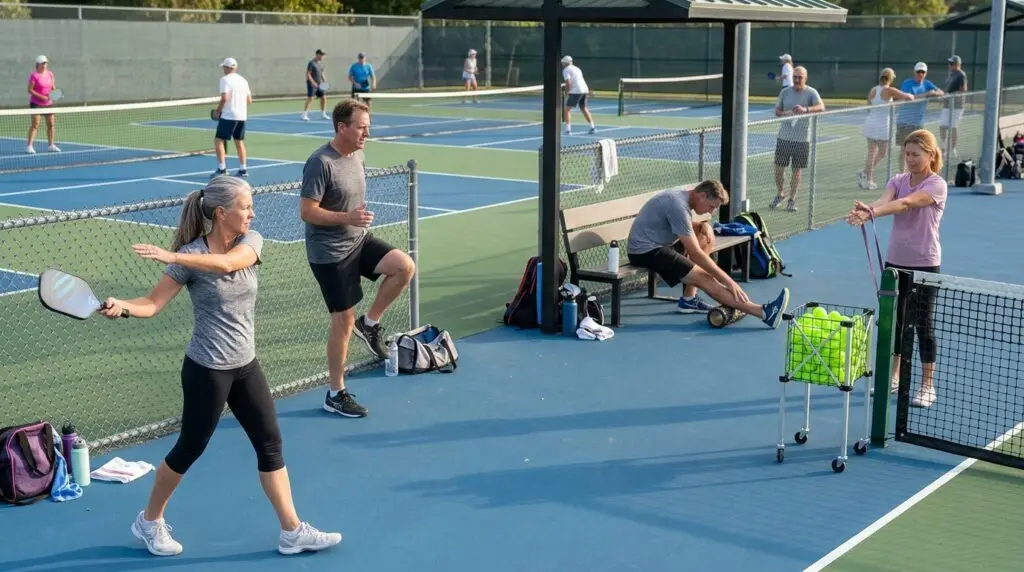
Pickleball may look less physically demanding than tennis, but every rally can involve sudden acceleration, side-to-side movement, quick stops, bending, reaching, rotation, and repeated paddle swings.
Walking directly onto the court and beginning an intense game gives the body little time to prepare for those demands.
A useful pickleball warm-up should gradually:
- Raise body temperature
- Increase blood flow
- Mobilize the ankles, hips, spine, shoulders, and wrists
- Activate the legs and core
- Prepare the body for lateral movement
- Rehearse pickleball-specific footwork and strokes
For most recreational players, a focused warm-up can be completed in approximately 8 to 12 minutes. It should feel progressive rather than exhausting. You should finish feeling warmer, looser, more alert, and ready to move, not tired before the first serve.
Recovery matters as well. A gradual cool-down, gentle mobility work, hydration, nutrition, sleep, and sensible scheduling can help players manage fatigue and prepare for their next session.
At Pickle Social Lounge in Tampa, players can reserve indoor courts, participate in community-focused open play, explore lessons and clinics, and join social or competitive activities. Preparing properly before court time can help players make better use of every session.
Important: Warm-ups and recovery exercises cannot guarantee injury prevention. Players with an existing injury, recent surgery, balance problem, heart condition, or other medical concern should follow guidance from an appropriate healthcare professional.
What Is the Best Pickleball Warm-Up?
The most effective general warm-up moves from simple activity to sport-specific movement.
A practical sequence is:
- Two minutes of brisk walking or light jogging
- Ankle, hip, spine, shoulder, and wrist mobility
- Leg swings and controlled lunges
- Lateral shuffles and split-step practice
- Shadow swings
- Gentle dinks, volleys, and groundstrokes
Dynamic warm-ups use controlled movement to prepare the body for the activity ahead. Research across sports suggests that structured dynamic or neuromuscular warm-ups can support performance and may help reduce lower-extremity injury risk.
USA Pickleball also encourages players to warm up, stretch appropriately, strengthen the body, and improve balance as part of safer participation.
Why Pickleball Players Should Warm Up Before Playing
1. Pickleball Requires Fast Directional Changes
Players rarely move in one straight line. A point may require:
- A split step
- A short sprint
- A lateral shuffle
- A sudden stop
- A backward recovery step
- A forward reach near the kitchen line
These movements place demands on the ankles, calves, knees, hips, and core.
Preparing those areas before competitive play can improve movement readiness and help players avoid feeling stiff during the opening games.
2. Falls Are a Meaningful Injury Concern
Pickleball-related emergency department injuries have increased as participation has grown. Research examining United States injury data found that falls were a leading injury mechanism, particularly among older players.
A warm-up cannot eliminate falls, but it can include elements that prepare the body for quick reactions, balance adjustments, and controlled changes of direction.
Players should also:
- Wear court-specific footwear
- Keep the playing surface clear
- Avoid playing on wet or unsafe courts
- Move forward for difficult balls rather than running backward whenever possible
- Allow adequate space between neighboring games
- Avoid diving for balls beyond their safe reach
3. Paddle Strokes Require More Than the Arm
Serves, volleys, drives, overheads, and dinks involve coordinated movement through the:
- Legs
- Hips
- Core
- Upper back
- Shoulder
- Forearm
- Wrist
Relying only on the arm can increase fatigue and make stroke mechanics less efficient. A complete warm-up should therefore prepare the entire movement chain rather than stretching only the hitting shoulder.
4. The First Game Should Not Be the Warm-Up
Some players use their opening game to gradually loosen up. That approach becomes risky when the first few points immediately involve hard drives, overheads, wide reaches, or sudden sprints.
The body should be prepared before competitive movement begins.
Dynamic Stretching vs. Static Stretching Before Pickleball
Dynamic and static stretching serve different purposes.
Dynamic Stretching
Dynamic stretching involves controlled movement through a comfortable range of motion.
Examples include:
- Arm circles
- Torso rotations
- Leg swings
- Walking lunges
- Ankle rocks
- Lateral shuffles
These movements are appropriate before play because they prepare the body for motion rather than holding it in one position.
Static Stretching
Static stretching involves holding one position, usually for 20 to 30 seconds or longer.
Examples include:
- Holding the ankle during a quadriceps stretch
- Leaning into a calf stretch
- Holding an arm across the chest
- Reaching toward the toes for the hamstrings
Long, intense static stretches are generally better placed after activity or during a separate mobility session. Before pickleball, prioritize movement-based preparation. A brief, gentle static stretch may be appropriate for an area that feels restricted, but it should not replace the active warm-up.
Which Muscles Does Pickleball Use?
Pickleball uses the entire body, although certain areas work especially hard.
Lower Body
The lower body creates movement, absorbs force, and helps players maintain court position.
Important areas include:
- Calves
- Ankles
- Quadriceps
- Hamstrings
- Glutes
- Hip flexors
- Inner and outer hip muscles
Core and Trunk
The trunk helps transfer force between the lower and upper body.
Important areas include:
- Abdominals
- Obliques
- Lower back
- Muscles surrounding the spine
- Deep stabilizing muscles
Upper Body
The upper body controls paddle position and supports repeated strokes.
Important areas include:
- Shoulders
- Rotator cuff
- Upper back
- Chest
- Forearms
- Wrists
- Hands
A useful warm-up should touch each of these regions without turning into a full workout.
A Complete 10-Minute Pickleball Warm-Up
This routine is designed for generally healthy recreational players. Modify the speed, range of motion, and number of repetitions according to your fitness level.
Minute 1 to 2: Brisk Walk or Light Jog
Begin with easy movement around the court or beside it.
Choose one of the following:
- Brisk walking
- Light jogging
- Gentle marching
- Easy side steps
Start slowly and gradually increase the pace.
Purpose
This phase raises body temperature and transitions the body from rest to activity.
Form Tips
- Keep the shoulders relaxed.
- Land softly.
- Breathe normally.
- Do not sprint.
- Keep enough energy for the match.
Players who are new to exercise or have joint sensitivity can use brisk walking instead of jogging.
Minute 3: Ankle Rocks and Calf Raises
Pickleball requires repeated pushing off, stopping, and changing direction. The ankles and calves should be prepared before faster footwork begins.
Ankle Rocks
- Stand facing a fence or wall.
- Place one foot slightly forward.
- Keep the heel on the floor.
- Gently move the knee forward over the toes.
- Return to the starting position.
- Complete 8 to 10 controlled repetitions per side.
The movement should feel smooth and should not cause pinching or sharp pain.
Calf Raises
- Stand tall with feet approximately hip-width apart.
- Rise slowly onto the balls of the feet.
- Pause briefly.
- Lower with control.
- Complete 10 repetitions.
Use a wall or fence for balance when needed.
Minute 4: Arm Circles and Shoulder Preparation
Repeated serves, volleys, and overhead shots require shoulder mobility and control.
Arm Circles
Perform:
- 10 small forward circles
- 10 small backward circles
- 10 larger forward circles
- 10 larger backward circles
Increase the circle size gradually rather than forcing the shoulder into its maximum range immediately.
Shoulder Blade Squeezes
- Stand tall.
- Draw the shoulder blades gently back and down.
- Hold for one second.
- Relax.
- Repeat 8 to 10 times.
Avoid shrugging the shoulders toward the ears.
Minute 5: Torso Rotations and Side Reaches
Pickleball strokes use rotation through the hips and trunk.
Standing Torso Rotations
- Stand with feet slightly wider than hip-width.
- Bend the knees softly.
- Hold the arms comfortably in front of the body.
- Rotate gently from side to side.
- Allow the hips and upper back to move together.
- Complete 10 rotations per side.
Do not force the lower back.
Controlled Side Reaches
- Reach one arm overhead.
- Lean slightly toward the opposite side.
- Return to the center.
- Alternate sides for 6 to 8 repetitions.
Keep the movement active rather than holding the position.
Minute 6: Leg Swings
Leg swings prepare the hips for reaching, lunging, and lateral movement.
Use a fence or wall for balance.
Forward and Backward Swings
- Stand tall on one leg.
- Swing the opposite leg forward and backward.
- Begin with a small range.
- Gradually increase the movement while remaining controlled.
- Perform 8 to 10 swings per leg.
Side-to-Side Swings
- Face the fence or wall.
- Swing one leg gently across the body and out to the side.
- Keep the upper body stable.
- Perform 8 to 10 repetitions per leg.
The movement should come from the hip rather than twisting through the knee.
Minute 7: Reverse Lunges With Reach
Reverse lunges prepare the hips, glutes, thighs, and core with less forward knee momentum than an aggressive walking lunge.
- Stand tall.
- Step one foot backward.
- Lower only as far as you can comfortably control.
- Reach the arms forward or overhead.
- Push through the front foot to return.
- Alternate sides for 5 repetitions per leg.
Form Tips
- Keep the front knee aligned with the foot.
- Keep the chest lifted.
- Use a short range when balance is limited.
- Hold a fence for support when necessary.
Players with knee pain can replace lunges with shallow sit-to-stand repetitions from a secure bench.
Minute 8: Lateral Shuffles and Split Steps
Side-to-side movement is central to court coverage.
Lateral Shuffles
- Begin in an athletic stance.
- Bend the knees slightly.
- Shuffle three or four steps to one side.
- Reverse direction.
- Continue for approximately 20 seconds.
- Rest briefly and repeat.
Keep the feet from crossing.
Split-Step Practice
- Stand with the feet comfortably apart.
- Perform a small, light hop or quick unweighting movement.
- Land softly on both feet.
- Move one step to the left or right.
- Reset and repeat for 6 to 8 repetitions.
A split step should be small and responsive, not a high jump.
Players who should avoid jumping can perform a quick heel lift followed by a controlled side step.
Minute 9: Shadow Pickleball Movements
Practice court movements without hitting a ball.
Perform several controlled repetitions of:
- A serve
- A forehand drive
- A backhand drive
- A forehand volley
- A backhand volley
- A dink
- An overhead preparation
- A movement toward and away from the kitchen line
Focus on balance and smooth mechanics rather than power.
This phase connects the general warm-up to the movements used during play.
Minute 10: Progressive Paddle Warm-Up
Finish with a partner when possible.
Begin close to the net and gradually increase movement and stroke intensity.
A useful sequence is:
- Gentle dinks
- Controlled volleys
- Soft resets
- Mid-court shots
- Groundstrokes
- Several easy serves and returns
Do not make the first ball an overhead smash.
Start at approximately 50 percent effort and build gradually. The goal is to establish timing, touch, footwork, and paddle control before competitive scoring begins.
A Three-Minute Warm-Up When Time Is Limited
Ten minutes is preferable, but a short warm-up is still better than stepping onto the court completely cold.
Use this condensed sequence:
Minute 1
- Brisk walk or march
- Arm circles
- Torso rotations
Minute 2
- Ankle rocks
- Leg swings
- Shallow reverse lunges
Minute 3
- Lateral shuffles
- Split steps
- Shadow swings
Follow it with several gentle dinks and volleys before playing at full intensity.
A rushed schedule should not turn the opening rally into a surprise exam for cold ankles and sleepy shoulders.
How Hard Should a Pickleball Warm-Up Feel?
A warm-up should gradually raise effort without creating fatigue.
Using a simple 1-to-10 effort scale:
- Beginning: 2 to 3
- Middle: 3 to 4
- Final sport-specific phase: 4 to 5
- Competitive play: Gradually progresses beyond that level
You should generally still be able to speak in complete sentences during the warm-up.
Stop and seek appropriate assistance when exercise causes:
- Chest pain
- Severe shortness of breath
- Faintness
- Sudden weakness
- Loss of balance
- Sharp joint or muscle pain
- New numbness
- A feeling that something is tearing or giving way
Ordinary stiffness may ease as the body warms. Sharp, worsening, or unusual pain should not be treated as something to “push through.”
Warm-Up Adjustments for Players Over 40
Age alone does not determine ability, but many players benefit from a more gradual start as recovery needs, joint history, balance, or training background change.
Players over 40 may benefit from:
- Extending the general warm-up by two or three minutes
- Using a smaller range of motion initially
- Adding extra ankle and hip preparation
- Including balance and strength training outside court sessions
- Building weekly playing volume gradually
- Allowing more recovery between demanding sessions
- Avoiding repeated intense games after a long break from activity
Warm-up needs should be based on the individual rather than a birthday alone. A well-conditioned 65-year-old player may tolerate more activity than a sedentary 35-year-old beginner.
Warm-Up Adjustments for Beginners
Beginners often concentrate so heavily on rules and paddle contact that they forget court positioning and body control.
A beginner warm-up should emphasize:
- Starting and stopping safely
- Moving without crossing the feet
- Maintaining balance while reaching
- Returning to a ready position
- Avoiding uncontrolled backward running
- Learning stroke mechanics at moderate speed
Pickle Social Lounge offers Tampa players access to lessons and clinics with coaching options designed for different schedules and skill levels. Guided instruction can help beginners learn movement patterns and technique before poor habits become deeply planted.
Warm-Up Mistakes to Avoid
Performing Only Static Stretches
Holding several long stretches without raising body temperature does not fully prepare a player for quick multidirectional movement.
Use dynamic movement first.
Turning the Warm-Up Into a Workout
Long sprints, exhausting jumping drills, or heavy strength exercises may reduce the energy available for play.
Warm up to perform, not to collect fatigue.
Ignoring the Ankles and Hips
Players frequently focus on shoulders because they hold a paddle. However, many court movements begin at the feet and transfer through the hips and core.
Prepare the full body.
Practicing Only Paddle Swings
Standing still and swinging the paddle does not prepare the legs for lateral shuffles, sudden stops, lunges, or balance corrections.
Include footwork.
Using Painful Ranges of Motion
A warm-up should not require forcing a joint into discomfort.
Use controlled movement and modify exercises when necessary.
Beginning at Full Speed
The first several dinks, serves, and groundstrokes should gradually build intensity.
Even experienced players benefit from a progressive start.
Prepare Before You Play at Pickle Social Lounge
Pickle Social Lounge provides indoor pickleball in Tampa with court reservations, community-focused open play, lessons, clinics, leagues, tournaments, social experiences, and a lounge where players can relax and enjoy food and drinks between activities.
Whether you are arriving for your first lesson, a casual game, open play, or a competitive match, reserve enough time to prepare before stepping onto the court.
A focused warm-up can help you:
- Move more confidently
- React more comfortably
- Establish paddle timing
- Improve early-game coordination
- Prepare common problem areas
- Enjoy more productive court time
The routine does not need to be complicated. It needs to be consistent, progressive, and appropriate for your body.
The Best Post-Game Recovery Routine for Pickleball Players
Recovery should begin when the final rally ends, not several hours later when stiffness has already settled in.
An effective post-game routine should help the body transition gradually from fast court movement to rest. It does not need complicated equipment or a long sequence of painful stretches.
For most recreational players, a practical recovery routine includes:
- Three to five minutes of slow walking
- Gentle static stretches for the lower and upper body
- Fluids and an appropriate post-game meal or snack
- Rest, sleep, and lighter activity between demanding sessions
- Attention to pain or symptoms that feel different from ordinary fatigue
USA Pickleball recommends cooling down with slow walking and stretching after play to help the body return gradually toward its resting state.
A Complete 10-Minute Pickleball Cool-Down
Use the following routine after open play, a lesson, league games, or a competitive session.
The stretches should create mild tension, not sharp pain. Breathe normally and avoid bouncing.
Minutes 1 to 3: Slow Walking
Do not stop moving immediately after an intense final point.
Walk slowly around the court area or nearby space for approximately three minutes.
Purpose
Slow walking allows:
- Breathing to settle gradually
- Heart rate to move toward its resting level
- The legs to continue moving after repeated starts and stops
- Players to notice unusual pain, dizziness, or weakness
Keep the shoulders relaxed and take steady breaths.
Players who feel faint, unusually weak, confused, or severely short of breath should stop activity and seek appropriate assistance rather than treating the symptoms as ordinary post-game fatigue. The CDC specifically advises athletes who feel faint or weak to stop activity and move to a cool location.
Minute 4: Standing Calf Stretch
The calves work repeatedly during split steps, pushes toward the kitchen line, lateral movement, and sudden stops.
- Stand facing a wall or fence.
- Place one foot behind the other.
- Keep the back heel on the floor.
- Point both feet generally forward.
- Bend the front knee and lean forward gently.
- Hold for 20 to 30 seconds.
- Switch sides.
You should feel the stretch through the back of the lower leg.
Do not force the heel down if it creates pain in the Achilles tendon or ankle.
Minute 5: Standing Quadriceps Stretch
The quadriceps help players lower into an athletic stance, step into lunges, and recover from low shots.
- Stand beside a stable wall or fence.
- Bend one knee and bring the heel toward the glutes.
- Hold the ankle or pant leg when comfortable.
- Keep the knees relatively close together.
- Stand tall without arching the lower back.
- Hold for 20 to 30 seconds.
- Switch sides.
Players who cannot comfortably reach the ankle can place the foot on a secure bench or use a strap.
The stretch should be felt through the front of the thigh, not inside the knee.
Minute 6: Hamstring Stretch
The hamstrings support bending, lunging, deceleration, and court movement.
Standing Version
- Place one heel slightly forward.
- Keep that knee softly bent rather than locked.
- Shift the hips backward.
- Keep the chest lifted.
- Lean forward slightly from the hips.
- Hold for 20 to 30 seconds.
- Switch legs.
Avoid aggressively reaching toward the toes or rounding the lower back.
A small, well-controlled movement is more useful than forcing a dramatic stretch for the highlight reel.
Minute 7: Hip Flexor Stretch
The hip flexors help lift the legs and support movement between the baseline and kitchen line.
Supported Standing Version
- Stand in a staggered position.
- Place one foot forward and the other behind.
- Bend the front knee slightly.
- Gently tuck the pelvis.
- Shift the body forward without arching the lower back.
- Hold for 20 to 30 seconds.
- Switch sides.
Players who are comfortable kneeling may use a half-kneeling version, but a folded towel or pad should be placed under the knee.
Do not use the kneeling version when kneeling causes discomfort or makes standing back up unsafe.
Minute 8: Figure-Four Glute Stretch
The glutes help stabilize the hips and generate force during lunges, shuffles, and changes of direction.
Seated Version
- Sit near the front of a stable chair or bench.
- Place one ankle across the opposite thigh.
- Keep the spine long.
- Lean forward slightly from the hips.
- Hold for 20 to 30 seconds.
- Switch sides.
Avoid pressing forcefully on the raised knee.
Players with hip or knee replacements, recent surgery, or movement restrictions should follow guidance from their healthcare professional.
Minute 9: Shoulder and Upper-Back Stretch
Pickleball strokes involve repeated reaching, rotation, and paddle control.
Cross-Body Shoulder Stretch
- Bring one arm across the chest.
- Use the opposite arm to support it gently.
- Keep the shoulder away from the ear.
- Hold for 20 to 30 seconds.
- Switch sides.
Upper-Back Reach
- Interlace the fingers in front of the body.
- Turn the palms away.
- Reach the hands forward gently.
- Allow the upper back to round slightly.
- Hold for 20 seconds.
Do not pull aggressively on the shoulder or stretch through sharp pain.
Minute 10: Wrist and Forearm Stretch
Gripping the paddle repeatedly can leave the forearms feeling tight, particularly after long sessions or hard drives.
Forearm Flexor Stretch
- Extend one arm forward with the palm facing up.
- Keep the elbow softly straight.
- Use the other hand to draw the fingers gently downward.
- Hold for 15 to 20 seconds.
- Switch sides.
Forearm Extensor Stretch
- Extend one arm with the palm facing down.
- Bend the wrist so the fingers point toward the floor.
- Use the other hand to add gentle pressure.
- Hold for 15 to 20 seconds.
- Switch sides.
Use only enough pressure to create mild tension.
Tingling, numbness, burning, or sharp elbow and wrist pain should not be stretched aggressively.
Should You Stretch After Every Pickleball Game?
A short cool-down is useful after most playing sessions, especially when:
- Several games were played
- The session was more intense than usual
- The player has been inactive recently
- The legs or shoulders feel tight
- The player has another session scheduled soon
- Court time lasted an hour or longer
Stretching may improve the temporary feeling of flexibility or relaxation, but it should not be presented as a guaranteed method for preventing every injury or eliminating next-day soreness.
Long-term mobility is developed through consistent activity, strength training, movement practice, and regular mobility work, not one heroic hamstring stretch after the final point.
Foam Rolling After Pickleball
Foam rolling is optional. It can be used as a short self-massage technique when muscles feel tight after playing.
Players may focus on:
- Calves
- Quadriceps
- Hamstrings
- Glutes
- Upper back
Spend approximately 30 to 60 seconds on each area.
How to Foam Roll Safely
- Move slowly.
- Use moderate pressure.
- Breathe normally.
- Pause briefly on a tight area without grinding into it.
- Avoid rolling directly over bones or joints.
- Do not roll over swelling, bruising, open wounds, or a suspected injury.
- Stop when the pressure creates sharp, electrical, or radiating pain.
Foam rolling should leave the area feeling looser or more comfortable. It should not feel like punishment administered by a foam cylinder.
Should You Foam Roll the IT Band?
Players commonly roll directly along the outside of the thigh and refer to it as “rolling the IT band.”
That area can be highly sensitive. Rather than applying excessive pressure directly to the side of the knee or forcing the entire outer thigh against the roller, players may find it more comfortable to work gently around the surrounding glute and outer-thigh muscles.
Persistent pain along the outside of the knee or hip should be evaluated instead of repeatedly attacked with harder rolling.
Hydration Before, During, and After Pickleball
Fluid needs vary according to:
- Session duration
- Exercise intensity
- Body size
- Sweat rate
- Indoor or outdoor temperature
- Humidity
- Health conditions
- Medications
- Individual tolerance
Players should begin sessions reasonably hydrated and keep water available during play.
After playing, continue drinking fluids gradually rather than consuming an extreme amount all at once.
ACSM notes that fluids and electrolytes are lost through sweat and breathing and recommends replacing fluids after exercise. Longer or sweat-heavy sessions may also require attention to electrolyte replacement.
When Water Is Usually Sufficient
For many recreational sessions of moderate duration, water combined with regular meals may be adequate.
When Electrolytes May Be Useful
Electrolyte-containing fluids or foods may be worth considering when:
- Play lasts longer than approximately one hour
- Several matches are played
- Sweating is heavy
- The environment is hot or humid
- The player has visible salt marks on clothing
- Another session is scheduled later that day
Players with kidney disease, heart conditions, high blood pressure, diabetes, fluid restrictions, or medication-related concerns should follow individualized medical guidance rather than automatically increasing fluids, sodium, or electrolyte products.
Signs That Should Not Be Ignored
Possible warning signs of dehydration or heat-related illness can include:
- Dizziness
- Weakness
- Headache
- Unusual fatigue
- Nausea
- Muscle cramping
- Confusion
- Fainting
Although Pickle Social Lounge provides indoor courts, players can still arrive dehydrated, play for extended periods, or become overheated before and after court time. Indoor play removes direct sun from the equation, but it does not turn hydration into an optional side quest.
What Should You Eat After Pickleball?
Recovery nutrition does not require an elaborate supplement stack.
A balanced meal or snack after play can include:
- A source of protein
- Carbohydrate-rich food
- Fruits or vegetables
- Fluids
Protein supports muscle repair, while carbohydrates help replace energy used during activity. ACSM emphasizes adequate nutrition, hydration, sleep, and recovery as important parts of adapting to exercise.
Simple Post-Game Meal Ideas
- Grilled chicken, rice, and vegetables
- Eggs with whole-grain toast and fruit
- Greek yogurt with berries and oats
- A turkey sandwich with fruit
- Rice or quinoa with beans and vegetables
- A smoothie containing fruit, milk or yogurt, and another protein source
When a Smaller Snack May Be Enough
A light snack may be appropriate when:
- A regular meal will be eaten soon
- The session was short or moderate
- The player is not particularly hungry
- The next demanding activity is several hours away
Examples include:
- Yogurt and fruit
- Chocolate milk
- A banana with nut butter
- Cheese and whole-grain crackers
- A small sandwich
- Fruit with a protein-containing snack
Individual nutritional requirements vary. Players managing diabetes, kidney disease, digestive conditions, allergies, or other health concerns should use guidance appropriate to their condition.
Sleep and Pickleball Recovery
Sleep is one of the least flashy recovery tools and one of the most important.
Adequate sleep supports physical recovery, attention, reaction time, mood, and readiness for future activity. ACSM notes that sleep plays an important role in restorative processes and muscle recovery.
Useful habits include:
- Keeping a reasonably consistent sleep schedule
- Avoiding very late intense sessions when they disrupt sleep
- Allowing time to cool down after evening play
- Limiting heavy meals and excessive alcohol close to bedtime
- Creating a dark, quiet, comfortable sleeping environment
Alcohol may feel relaxing after a social session, but it should not replace water, food, or sleep.
Players can enjoy the social side of pickleball while still treating recovery as part of tomorrow’s game plan.
Is Next-Day Soreness Normal?
Mild muscle soreness can appear after:
- Returning after a break
- Playing longer than usual
- Increasing intensity
- Participating in several consecutive games
- Learning unfamiliar footwork
- Playing against faster opponents
Ordinary post-exercise soreness often feels:
- Diffuse rather than sharply localized
- Similar on both sides
- More noticeable when first moving
- Better after gentle activity
- Manageable during normal daily tasks
Signs That May Indicate an Injury
Pain deserves closer attention when it is:
- Sharp or sudden
- Located directly in a joint
- Accompanied by swelling or bruising
- Associated with a pop or tearing sensation
- Causing limping
- Worsening during ordinary movement
- Preventing normal use of an arm or leg
- Producing numbness, tingling, or weakness
- Persisting or worsening instead of gradually improving
Do not use stretching, foam rolling, or pain medication merely to hide an injury and return to play immediately.
When to Seek Urgent Medical Care
Seek prompt medical evaluation after pickleball when a player experiences:
- Chest pain or pressure
- Severe difficulty breathing
- Fainting
- Confusion
- Signs of stroke
- A suspected fracture
- A visible joint deformity
- Inability to bear weight
- A serious head impact
- Repeated vomiting
- Severe swelling
- Sudden weakness or numbness
- Symptoms of severe heat illness
Call emergency services when symptoms appear life-threatening.
After a fall or collision, a player should not automatically return to the game because the score is close. The scoreboard is not licensed to clear injuries.
Active Recovery vs. Complete Rest
Recovery does not always require remaining completely still.
Light activity may be appropriate on the day after a demanding session when the player has ordinary fatigue but no injury.
Active recovery may include:
- Easy walking
- Gentle cycling
- Light swimming
- Relaxed mobility work
- Beginner-level yoga
- Balance exercises
- Low-intensity strength work
ACSM describes active recovery as lower-impact activity that maintains movement without adding excessive strain. It also recommends including genuine rest during periods of heavy training or competition.
A complete rest day may be more appropriate when:
- Sleep has been poor
- The player feels unusually fatigued
- Several difficult sessions occurred consecutively
- Muscles remain heavily sore
- Joint discomfort is developing
- Movement quality has declined
- Motivation and concentration feel unusually low
Rest is not lost training. It is part of the invoice the body sends after workload.
How Often Should Pickleball Players Schedule Rest Days?
There is no universal schedule.
A beginner playing twice per week may have several natural recovery days. A competitive player participating in leagues, drills, tournaments, and strength training will need more deliberate planning.
A balanced week may include:
- Two or three pickleball sessions
- Two strength or mobility sessions
- One lighter active-recovery day
- At least one genuine rest day
The exact structure should reflect:
- Age
- Training history
- Fitness level
- Injury history
- Match intensity
- Sleep quality
- Work demands
- Other forms of exercise
Rapidly increasing from one casual weekly game to daily competitive play is a common route into overuse pain.
Increase playing volume gradually.
Recovery Tips for Pickleball Players Over 40
Players over 40 do not need a completely different sport, but many benefit from more deliberate recovery.
Helpful priorities include:
- Warming up before every session
- Avoiding multiple intense days in a row
- Strengthening the legs, hips, core, shoulders, and forearms
- Maintaining balance and ankle mobility
- Eating adequately after long sessions
- Staying hydrated
- Protecting sleep
- Addressing recurring pain early
- Using lighter sessions between tournaments or leagues
Chronological age matters less than total workload, injury history, conditioning, and recovery capacity.
The goal is not to play cautiously forever. It is to build enough recovery into the schedule that the next match does not feel like it was booked by the previous match’s sore muscles.
Common Recovery Mistakes
Stopping Abruptly
Moving directly from a hard final game to sitting for a long period may leave players feeling stiff.
Walk for a few minutes first.
Stretching Through Pain
A stretch should create manageable tension, not stabbing, burning, or electrical pain.
Modify or stop.
Treating Every Ache With Aggressive Foam Rolling
More pressure is not automatically more effective.
A painful or swollen area may need assessment rather than repeated compression.
Waiting Until Thirst Becomes Intense
Bring fluids to the court and drink periodically instead of trying to repair the entire deficit afterward.
Replacing Water With Alcohol
Alcohol does not provide the same recovery function as water, food, and sleep.
Playing Hard Every Day
Pickleball is social and easy to schedule, which can quietly turn “one more game” into excessive weekly volume.
Alternate harder sessions with lighter activity or rest.
Ignoring Technique
Recurring shoulder, elbow, knee, or back discomfort may be related to movement patterns, paddle grip, positioning, strength, equipment, or workload.
A lesson may address technique problems that stretching cannot solve.
Build Better Movement Through Lessons and Clinics
Recovery helps the body tolerate activity, but efficient technique can also reduce unnecessary strain.
Pickle Social Lounge offers indoor Tampa pickleball opportunities that include court reservations, open play, lessons, clinics, leagues, events, and community-focused sessions. Players can use structured instruction to improve footwork, positioning, paddle mechanics, and match awareness rather than relying only on repeated uncoached games.
Beginners may benefit from learning:
- A stable ready position
- Safe movement toward the kitchen line
- Controlled stopping
- Balanced reaching
- Efficient paddle preparation
- When to let an unreachable ball go
More experienced players may focus on:
- Reducing unnecessary swing size
- Improving recovery position
- Using the legs and trunk more effectively
- Managing tournament workload
- Building consistency under pressure
Better preparation plus better mechanics creates a sturdier foundation than stretching alone.
The Pickleball Recovery Checklist
Before leaving the court, ask:
- Did I walk for several minutes?
- Did I stretch the areas that feel tight?
- Have I started replacing fluids?
- Do I need a meal or snack?
- Did I notice any sharp pain or swelling?
- Am I playing again before I have recovered?
- Does tomorrow need to be a lighter day?
A useful recovery routine should be simple enough to repeat consistently.
The winning formula is not a cupboard full of recovery gadgets. It is a dependable rhythm of movement, hydration, nutrition, sleep, rest, and early attention to problems.
How to Prevent Common Pickleball Injuries
No warm-up, shoe, stretch, or exercise can guarantee that a player will never be injured.
However, many avoidable problems begin with a familiar pattern:
- Playing too much too quickly
- Skipping the warm-up
- Using inefficient footwork
- Continuing through worsening pain
- Wearing unsuitable or worn footwear
- Ignoring strength and balance training
- Treating every game as maximum effort
- Returning before an earlier injury has recovered
Pickleball combines repeated paddle swings with short sprints, lunges, sudden stops, lateral movement, and rapid changes of direction. Those demands can affect the shoulders, elbows, wrists, back, hips, knees, calves, ankles, and Achilles tendons.
Falls are also a major concern, particularly for older players. CDC data identify falls as the leading cause of injury among adults age 65 and older, while pickleball injury research has found falls to be an important injury mechanism among older participants.
The goal of injury prevention is not to make players fearful or stiff. It is to build enough preparation, strength, technique, and recovery into the week that the body can keep pace with enthusiasm.
Common Pickleball Injuries and How to Reduce the Risk
Pickleball Elbow and Forearm Pain
Pain near the outside or inside of the elbow may develop after repeated gripping, forceful paddle swings, late contact, or a sudden increase in playing volume.
Players sometimes call every elbow problem “tennis elbow,” but elbow pain can have different causes and should not be self-diagnosed solely from location.
Common Contributing Factors
- Gripping the paddle too tightly
- Using an oversized or unsuitable grip
- Swinging mainly with the wrist and forearm
- Repeatedly hitting late
- Playing several long sessions without recovery
- Increasing paddle weight without adaptation
- Returning too quickly after pain begins
Prevention Habits
- Keep the grip firm enough to control the paddle without squeezing continuously.
- Use the legs, hips, trunk, and shoulder to support the stroke.
- Contact the ball in front of the body when possible.
- Build playing time gradually.
- Strengthen the wrist and forearm outside court sessions.
- Review technique with a qualified coach when pain repeatedly follows serves, drives, or backhands.
USA Pickleball’s instructional guidance emphasizes moving into position, contacting the ball in front, keeping the wrist controlled, and returning to a balanced ready position.
Stop Playing When
- Pain becomes sharp
- Grip strength noticeably decreases
- The paddle feels difficult to hold
- Numbness or tingling develops
- Pain worsens with ordinary tasks
- Symptoms continue across several sessions
A wrist stretch may temporarily feel pleasant, but it cannot correct excessive workload or inefficient mechanics by itself.
Shoulder Pain
The shoulder contributes to serves, volleys, drives, reaches, and overhead shots. Repeated high or forceful strokes may irritate the area when mobility, strength, timing, or workload is inadequate.
Common Contributing Factors
- Skipping shoulder preparation
- Repeated overhead smashes
- Contacting the ball too far behind the body
- Using an unnecessarily large backswing
- Weak upper-back and rotator-cuff muscles
- Playing through pain
- Sudden increases in serving or drilling volume
Prevention Habits
- Warm up the shoulders, upper back, and trunk before playing.
- Use controlled arm circles and shoulder-blade movements.
- Rotate through the hips and torso rather than forcing every shot with the arm.
- Reduce unnecessary swing size at the kitchen line.
- Strengthen the upper back and shoulder-supporting muscles.
- Avoid repeatedly practicing painful overheads.
- Learn when to allow an unreachable lob to land rather than forcing an unstable backward reach.
Stop Playing When
- Lifting the arm becomes difficult
- Pain is sharp during serving or overhead motion
- The shoulder feels unstable
- Weakness develops suddenly
- Pain interrupts sleep
- A fall or collision produces immediate pain
Continuing to smash through worsening shoulder pain is not toughness. It is an expensive disagreement with the joint.
Wrist and Hand Discomfort
The hand and wrist control paddle angle, grip pressure, touch, and spin.
Problems may develop from gripping too tightly, using excessive wrist movement, receiving hard shots with poor paddle stability, or playing for longer than the hand and forearm are prepared to tolerate.
Prevention Habits
- Use an appropriate grip size.
- Avoid constant maximum grip pressure.
- Keep the wrist stable during volleys.
- Use the shoulder and trunk to support larger strokes.
- Strengthen the forearms gradually.
- Replace a slippery or damaged grip.
- Rest when hand fatigue changes paddle control.
Pain accompanied by swelling, bruising, loss of motion, numbness, or weakness should be evaluated rather than stretched aggressively.
Knee Pain
Pickleball requires repeated knee bending, lunging, stopping, and pushing back toward the ready position.
Knee discomfort may reflect workload, weakness, mobility restrictions, technique, a previous injury, or another underlying condition.
Common Contributing Factors
- Reaching instead of moving the feet
- Allowing the knee to collapse inward during lunges
- Playing in a very low stance for prolonged periods
- Sudden increases in games or tournaments
- Weak hips and thighs
- Poorly controlled stops
- Worn footwear
- Limited ankle or hip mobility
Prevention Habits
- Strengthen the quadriceps, hamstrings, glutes, and calves.
- Practice controlled sit-to-stands, step-ups, and split squats.
- Keep the knee aligned generally with the foot during lunges.
- Use shorter steps when reaching wide.
- Recover to court position instead of remaining stretched out.
- Schedule recovery between demanding sessions.
- Avoid playing through increasing joint swelling.
Stop Playing When
- The knee locks or gives way
- Swelling appears
- Weight-bearing becomes difficult
- A twisting movement causes sharp pain
- The player cannot walk normally
- Pain continues to worsen during the session
Ankle Sprains
An ankle sprain can occur during a sudden direction change, awkward landing, collision, or step near another player.
Prevention Habits
- Warm up the ankles and calves.
- Practice lateral movement at controlled speed.
- Use small adjustment steps near the ball.
- Keep adequate space between players.
- Avoid stepping onto neighboring courts.
- Strengthen the calves and muscles around the ankle.
- Include balance exercises in weekly training.
- Use footwear with secure fit and appropriate court traction.
Players should not attempt to “walk off” an ankle injury when swelling, bruising, instability, or difficulty bearing weight develops.
Achilles Tendon and Calf Problems
The calf and Achilles tendon work repeatedly during split steps, acceleration, jumping, and pushing toward the kitchen line.
Sudden explosive movement can be particularly demanding for players returning after inactivity.
Common Contributing Factors
- Beginning at full speed
- Increasing playing volume rapidly
- Limited calf strength
- Repeated jumping
- Tight or fatigued lower legs
- Inadequate recovery
- A sudden push-off for a difficult ball
Prevention Habits
- Begin each session with walking or light jogging.
- Perform controlled calf raises.
- Add calf strength gradually during the week.
- Avoid maximum-effort sprints before warming up.
- Increase weekly playing time slowly.
- Alternate difficult sessions with lighter days.
- Address persistent tendon stiffness early.
A sudden pop, severe pain, inability to push off, or difficulty walking may indicate a significant injury and requires prompt medical evaluation.
Lower-Back Discomfort
Pickleball places the body in a partially bent athletic position and uses frequent rotation, reaching, and quick recovery movements.
Back discomfort may develop when players remain hunched, rotate mostly through the lower back, or lack hip and core strength.
Prevention Habits
- Bend through the hips and knees rather than rounding the spine for every low ball.
- Use the hips and upper back during rotation.
- Strengthen the glutes and trunk.
- Return to a taller neutral position between rallies.
- Avoid repeated off-balance reaching.
- Warm up the hips and thoracic spine.
- Take breaks during long sessions.
Back pain accompanied by leg weakness, numbness, loss of bladder or bowel control, or severe symptoms after a fall requires urgent medical attention.
Falls and Collision Injuries
Some of the most serious pickleball injuries result from falls rather than repetitive swinging.
Falls may occur when players:
- Run backward for a lob
- Cross their feet while moving laterally
- Reach beyond their balance
- Collide with a partner
- Step on a ball
- Enter another court
- Play on an unsafe surface
- Lose balance after sudden stopping
For adults age 65 and older, the CDC recommends regular aerobic, muscle-strengthening, and balance activities. Balance-focused activity can help maintain function and reduce fall risk.
Safer Court Habits
- Communicate clearly with your partner.
- Call “mine,” “yours,” or “switch” early.
- Move toward the ball instead of reaching whenever possible.
- Avoid uncontrolled backward running.
- Turn and use appropriate recovery footwork for deep lobs.
- Stop play immediately when a loose ball enters the court.
- Keep bags, bottles, and equipment outside the playing area.
- Leave enough room before entering a neighboring court.
- Avoid diving during recreational play.
- Let an unsafe ball go.
USA Pickleball footwork instruction emphasizes positioning, controlled movement, balance, and returning to the ready position. Its split-step guidance also explains how the movement can help a player absorb momentum and prepare to change direction.
Winning one rally is rarely worth turning the next six weeks into a conversation with an orthopedic waiting room.
Choosing Appropriate Pickleball Footwear
Running shoes are primarily designed for forward movement. Pickleball includes frequent lateral movement, stopping, and direction changes.
A suitable court shoe should generally provide:
- A secure fit
- Stable lateral support
- Appropriate traction
- Comfortable cushioning
- Enough room for the toes
- A sole designed for the playing surface
- Minimal movement of the heel inside the shoe
The best shoe is not automatically the most expensive model. It is the shoe that fits securely, supports the player’s movement, and remains comfortable during real court use.
Signs Shoes May Need Replacing
Consider replacing footwear when:
- The outsole has become smooth
- Traction feels inconsistent
- The shoe leans visibly to one side
- Cushioning feels compressed
- The upper no longer holds the foot securely
- The heel slips
- New foot, ankle, or knee discomfort appears
- The shoe has separated or cracked
Players should avoid assuming that a shoe remains safe simply because the upper still looks clean.
Indoor Court Considerations
Indoor courts remove rain and direct sunlight from play, but players should still inspect footwear and the court area.
Before starting:
- Confirm that the soles are clean and dry.
- Remove dirt or debris that could reduce traction.
- Tie laces securely.
- Check for loose balls.
- Keep drinks and bags away from the playing surface.
- Report any wet or damaged area to staff.
Pickle Social Lounge offers indoor pickleball in Northdale, Tampa, including court reservations, open play, lessons, clinics, leagues, tournaments, and private coaching.
Strength Training for Pickleball Players
Warm-ups prepare the body for one session. Strength training helps build the capacity required across many sessions.
The CDC recommends that older adults include aerobic, muscle-strengthening, and balance activity each week. ACSM also supports regular resistance training, including work for the major muscle groups, with exercises adapted to individual ability.
For pickleball, useful strength areas include:
- Calves and ankles
- Quadriceps
- Hamstrings
- Glutes
- Hips
- Core
- Upper back
- Shoulders
- Forearms
A Simple Pickleball Strength Routine
Complete this routine one or two times per week on nonconsecutive days.
Beginners can start with one set. More experienced players may gradually use two or three sets.
Chair Squat or Sit-to-Stand
Repetitions: 8 to 12
Builds strength for lowering, lunging, and returning to position.
- Stand in front of a secure chair.
- Push the hips backward.
- Lower with control.
- Touch or sit briefly.
- Stand by pressing through the feet.
Step-Ups
Repetitions: 6 to 10 per side
Supports leg strength and single-leg control.
Use a low, stable step and a nearby support when necessary.
Calf Raises
Repetitions: 10 to 15
Builds lower-leg strength for pushing off and stopping.
Rise slowly and lower with control.
Supported Split Squat
Repetitions: 6 to 10 per side
Builds strength for reaching and lunging.
Use a wall or stable support for balance.
Glute Bridge
Repetitions: 8 to 12
Supports hip extension and trunk stability.
Lie on the back with knees bent, tighten the glutes, and lift the hips without forcing the lower back.
Resistance-Band Row
Repetitions: 10 to 15
Strengthens the upper back and supports shoulder control.
Keep the shoulders relaxed and draw the elbows backward.
Band External Rotation
Repetitions: 8 to 12 per side
Supports the muscles around the shoulder.
Keep the elbow close to the body and use light resistance.
Forearm Strength Exercise
Repetitions: 10 to 15
Use a very light dumbbell or resistance band for controlled wrist flexion, extension, or rotation.
Avoid heavy resistance when elbow or wrist pain is present.
Core Stability Exercise
Choose one:
- Bird dog
- Dead bug
- Standing band press
- Supported plank
Use controlled breathing and avoid movements that increase back pain.
The routine should feel challenging without causing joint pain or destroying the next day’s court session.
Balance Training for Pickleball
Balance is not a fixed trait. It can be practiced.
CDC guidance identifies balance activity as an important part of physical activity for older adults and notes that strengthening the legs, back, and abdomen can also support balance.
Basic Balance Exercises
Tandem Stand
Stand with one foot directly in front of the other.
Hold a wall or counter when needed.
Single-Leg Stand
Lift one foot slightly from the floor and hold briefly.
Begin with fingertip support.
Heel-to-Toe Walk
Walk slowly along an imaginary line.
Lateral Step and Hold
Step to the side, regain control, and pause before returning.
Controlled Direction Change
Walk forward, stop, turn safely, and walk in another direction.
Balance exercises should be performed near a stable support, particularly by players with previous falls, dizziness, neuropathy, vision problems, or mobility limitations.
Mobility Work Between Pickleball Sessions
A separate mobility session can address movement quality without rushing through exercises five minutes before a game.
Focus on:
- Ankle movement
- Hip rotation
- Hip flexor mobility
- Hamstring mobility
- Thoracic spine rotation
- Shoulder mobility
- Wrist and forearm comfort
A 10-to-15-minute routine two or three times per week is more useful than an occasional hour-long stretching expedition inspired by guilt.
Mobility work should remain gentle when a joint is swollen, unstable, or recently injured.
How to Manage Weekly Pickleball Workload
Overuse problems often develop because the player’s schedule grows faster than the body’s capacity.
A player may move from one recreational session per week to:
- Open play twice weekly
- A league
- A private lesson
- Weekend tournaments
- Additional drills
- Strength training
Each activity may feel manageable alone while the combined workload becomes excessive.
Use the One-Change Rule
Increase only one major training variable at a time:
- Number of weekly sessions
- Duration
- Intensity
- Tournament frequency
- Drilling volume
- Strength-training load
Avoid increasing several of these simultaneously.
Separate Hard Sessions
Whenever possible, avoid scheduling several maximum-effort sessions on consecutive days.
A demanding league night may be followed by:
- Rest
- Gentle walking
- Mobility work
- Light drilling
- Easy recreational play
It should not automatically be followed by another three-hour battle because someone sent an enthusiastic group chat message.
Monitor Recovery Signals
The body may need additional recovery when:
- Normal soreness does not improve
- Sleep quality declines
- Motivation drops
- Movement feels slower
- Grip strength feels reduced
- Joint pain appears earlier in each session
- Technique deteriorates
- Fatigue remains throughout the day
Training plans should be adjusted before these signals become a full injury.
Sample Weekly Plan for Recreational Players
| Day | Activity |
|---|---|
| Monday | Pickleball session with warm-up and cool-down |
| Tuesday | Light walking and mobility |
| Wednesday | Strength and balance routine |
| Thursday | Pickleball lesson, clinic, or controlled play |
| Friday | Rest |
| Saturday | Open play or league session |
| Sunday | Gentle active recovery or rest |
This is an example, not a universal prescription.
Players should adjust the schedule according to:
- Fitness level
- Age
- Medical conditions
- Injury history
- Match intensity
- Work demands
- Sleep
- Other exercise
Sample Weekly Plan for Beginners
A new player may begin with:
- Two pickleball sessions
- One short strength session
- One mobility or balance session
- Several recovery days
Beginners do not need to play daily to improve. Skill often develops faster when practice is structured and fatigue does not repeatedly distort technique.
Sample Weekly Plan for Tournament Players
A competitive week may include:
- One technical drilling session
- One strength session
- One match-play session
- One lighter practice
- Planned recovery
- Reduced workload before a tournament
The week before competition is generally not the ideal time to introduce exhausting new exercises or double total court volume.
When Coaching Can Help Reduce Unnecessary Strain
Poor movement habits often waste energy and place the player in unstable positions.
Examples include:
- Reaching instead of moving
- Standing too upright before the opponent hits
- Taking oversized swings
- Remaining off balance after contact
- Running through the kitchen line
- Backpedaling for lobs
- Gripping too tightly
- Hitting every ball at maximum power
A coach can help players improve:
- Ready position
- Split-step timing
- Court recovery
- Shot selection
- Paddle preparation
- Partner communication
- Safe movement toward the kitchen line
- Balanced contact
Pickle Social Lounge offers group clinics, private coaching, lessons, open play, leagues, and competitive opportunities for Tampa-area players at different skill levels.
Instruction is not only for beginners. Experienced players may also benefit when recurring discomfort appears alongside a specific stroke or movement pattern.
When Should a Player Take Time Away From Pickleball?
Consider pausing play and obtaining appropriate medical guidance when:
- Pain changes normal movement
- Swelling is present
- The player is limping
- A joint locks or gives way
- Grip strength is reduced
- Pain worsens every session
- Symptoms interrupt sleep
- A fall caused a head impact
- Numbness or tingling develops
- A previous injury has not healed
- Medication is being used simply to tolerate play
Returning should be based on function and recovery, not only enthusiasm.
A player should generally be able to:
- Walk normally
- Move in several directions
- Stop with control
- Perform sport-specific movements
- Swing without sharp pain
- Tolerate gradual practice
- Recover without worsening symptoms
A healthcare professional or physical therapist may provide individualized return-to-play guidance after significant injury or surgery.
The Pickleball Injury-Prevention Checklist
Before playing:
- Complete a progressive warm-up.
- Check footwear and laces.
- Remove loose balls and equipment.
- Review pain or fatigue honestly.
- Begin strokes at moderate intensity.
During play:
- Move the feet instead of overreaching.
- Communicate with your partner.
- Avoid uncontrolled backward running.
- Stop when a ball enters the court.
- Take water and rest breaks.
- Do not play through sharp or worsening pain.
After playing:
- Walk for several minutes.
- Cool down gradually.
- Replace fluids.
- Eat appropriately.
- Assess unusual pain or swelling.
- Plan enough recovery before the next hard session.
During the week:
- Include strength work.
- Practice balance.
- Maintain mobility.
- Increase workload gradually.
- Use lessons or clinics to improve movement efficiency.
- Schedule genuine rest.
The strongest injury-prevention strategy is not a single stretch or gadget. It is a repeatable system that combines preparation, technique, strength, balance, recovery, and sensible decisions on court.
Frequently Asked Questions About Pickleball Warm-Ups and Recovery
How Long Should I Warm Up Before Playing Pickleball?
Most recreational players should spend approximately 8 to 12 minutes warming up before competitive play.
A complete warm-up should include:
- Light walking, marching, or jogging
- Ankle and hip mobility
- Shoulder and upper-back preparation
- Controlled lunges or sit-to-stands
- Lateral footwork
- Shadow swings
- Gentle dinks, volleys, serves, and returns
Players who are older, returning after a break, recovering from an injury, or playing in cooler conditions may benefit from a slightly longer and more gradual warm-up.
USA Pickleball recommends warming up, stretching appropriately, improving balance, and using strength training as part of safer participation.
Should I Use Dynamic or Static Stretches Before Pickleball?
Dynamic movements are generally more useful before playing because they prepare the body for motion.
Examples include:
- Arm circles
- Torso rotations
- Leg swings
- Ankle rocks
- Reverse lunges
- Lateral shuffles
- Split-step practice
Long static stretches are usually better placed after playing or during a separate mobility session.
A brief static stretch may be appropriate when a particular area feels restricted, but it should not replace movement-based preparation.
What Is the Best Cool-Down After Pickleball?
A practical cool-down begins with three to five minutes of slow walking.
Follow the walk with gentle stretches for:
- Calves
- Quadriceps
- Hamstrings
- Hip flexors
- Glutes
- Shoulders
- Wrists
- Forearms
Hold each stretch for approximately 20 to 30 seconds without bouncing or forcing the movement.
The purpose is to help the body transition gradually from active play to rest. A cool-down should feel calming rather than becoming another workout.
Should I Stretch After Every Pickleball Session?
A short stretching routine can be useful after most sessions, especially when you played several games, increased your intensity, or noticed muscle tightness.
Stretching may temporarily improve comfort and range of motion, but it cannot correct:
- Poor technique
- Excessive weekly workload
- Inadequate recovery
- Weakness
- Unsuitable footwear
- An existing injury
Consistent mobility, strength, balance, and recovery habits matter more than one long stretching session after occasional play.
Should I Foam Roll After Playing?
Foam rolling is optional.
Some players find that gentle rolling helps their calves, quadriceps, hamstrings, glutes, or upper back feel less tight.
Use moderate pressure for approximately 30 to 60 seconds per area. Avoid rolling directly over:
- Bones
- Joints
- Swelling
- Bruising
- Open wounds
- A suspected muscle or tendon injury
Stop when rolling causes sharp, burning, electrical, or radiating pain.
Foam rolling should make movement feel more comfortable. It should not turn recovery into a wrestling match with a cylinder.
What Should I Do When I Am Sore After Pickleball?
Mild muscle soreness can occur after playing longer or harder than usual, returning from a break, or learning unfamiliar movement patterns.
When soreness is mild:
- Take an easier day
- Walk gently
- Perform comfortable mobility work
- Eat regular balanced meals
- Replace fluids
- Prioritize sleep
- Avoid another maximum-effort session immediately
Do not treat every painful area as ordinary soreness.
Seek appropriate medical guidance when pain is sharp, worsening, located directly in a joint, accompanied by swelling, causing a limp, or preventing normal movement.
How Often Should Pickleball Players Strength Train?
Many recreational players benefit from one or two short strength sessions each week, depending on their current fitness, playing schedule, and health.
Useful exercises may include:
- Sit-to-stands or squats
- Step-ups
- Calf raises
- Split squats
- Glute bridges
- Resistance-band rows
- Shoulder external rotations
- Forearm exercises
- Core stability work
Strength sessions should support pickleball rather than leave the player too fatigued to move safely on court.
Players who are new to resistance training or managing a medical condition should begin gradually and obtain individualized guidance when necessary.
What Are the Best Balance Exercises for Pickleball?
Simple balance exercises include:
- Tandem standing
- Single-leg standing with support
- Heel-to-toe walking
- Lateral stepping and holding
- Controlled stopping and turning
- Step-ups
- Split-step practice
Perform balance work near a stable wall, rail, or counter when needed.
Balance training is particularly valuable for players who have experienced previous falls, reduced confidence, neuropathy, vision changes, or difficulty changing direction. USA Pickleball specifically identifies balance and strength work as useful parts of injury prevention.
Can I Play Pickleball Every Day?
Some conditioned players may tolerate frequent play, but daily maximum-intensity sessions are not appropriate for everyone.
The body may need additional recovery when:
- Soreness continues for several days
- Joint pain appears
- Sleep quality declines
- Movement feels slower
- Grip strength decreases
- Technique deteriorates
- Fatigue affects everyday activities
- Pain begins earlier during each session
Playing more frequently does not automatically produce faster improvement. Structured practice performed with good movement quality is often more productive than accumulating tired games.
What Shoes Should I Wear for Pickleball?
Choose shoes designed to support multidirectional court movement.
Look for:
- Secure heel fit
- Lateral stability
- Suitable court traction
- Comfortable cushioning
- Adequate toe space
- Secure laces
- A sole appropriate for the playing surface
Running shoes are primarily designed for forward movement and may not provide the same lateral support as court shoes.
Replace shoes when the outsole becomes smooth, the upper no longer holds the foot securely, traction becomes inconsistent, or the shoe begins leaning noticeably to one side.
Can Beginners Use the Same Warm-Up as Experienced Players?
Yes, but beginners should perform the movements more slowly and focus on control.
A beginner warm-up should emphasize:
- Safe starting and stopping
- Lateral movement without crossing the feet
- Balanced reaching
- Returning to the ready position
- Controlled paddle swings
- Avoiding uncontrolled backward running
Beginners do not need complex agility drills. They need a repeatable routine that prepares the body while reinforcing safe movement habits.
Pickle Social Lounge offers beginner, intermediate, and advanced clinics as well as private coaching, allowing players to develop technique and movement at an appropriate level.
Can Warming Up Prevent Every Pickleball Injury?
No.
A proper warm-up may improve movement readiness and prepare muscles and joints for activity, but it cannot eliminate every injury risk.
Injuries can still result from:
- Falls
- Collisions
- Unsafe court conditions
- Previous injuries
- Excessive workload
- Poor technique
- Sudden movements
- Medical conditions
- Accidental contact
The strongest injury-prevention approach combines warm-ups with suitable footwear, strength, balance, recovery, controlled workload, and sensible court decisions.
Final Takeaway: Prepare, Play, and Recover Consistently
The best pickleball warm-up and recovery plan is not the longest or most complicated one.
It is the routine you can perform consistently.
Before playing:
- Raise your body temperature.
- Mobilize the ankles, hips, spine, shoulders, and wrists.
- Activate the legs and core.
- Practice lateral movement.
- Rehearse pickleball-specific strokes.
- Increase intensity gradually.
After playing:
- Walk for several minutes.
- Stretch tight areas gently.
- Replace fluids.
- Eat an appropriate meal or snack.
- Review any unusual pain.
- Allow enough recovery before the next hard session.
During the week:
- Include strength work.
- Practice balance.
- Maintain mobility.
- Increase playing time gradually.
- Use coaching to improve inefficient movement.
- Schedule lighter days and genuine rest.
A good routine will not make every muscle permanently silent. It will help you arrive on court better prepared, move with more control, and recover without repeatedly borrowing energy from tomorrow.
Play, Learn, and Improve at Pickle Social Lounge
Pickle Social Lounge brings pickleball and social play together in Northdale, Tampa.
Players can:
- Reserve a court
- Join community-focused open play
- Attend clinics and skill sessions
- Schedule private coaching
- Participate in leagues
- Enter tournaments
- Plan group outings and private events
- Relax with food and drinks between games
Its clinics include options for beginners learning the foundations, intermediate players improving shot selection and consistency, and advanced players working on competitive drills and strategy. Private coaching is also available for players who want instruction tailored to their individual goals.
Whether you are preparing for your first game or sharpening your performance for league and tournament play, build enough time into your visit for a proper warm-up.
Reserve your court or contact Pickle Social Lounge to explore open play, clinics, private coaching, leagues, tournaments, and group events in Tampa.
Medical Disclaimer
This article provides general educational information and is not a substitute for medical diagnosis, treatment, rehabilitation, or individualized exercise advice.
Consult an appropriate healthcare professional before beginning or changing an exercise program when you have an existing injury, recent surgery, heart condition, balance problem, chronic illness, or other medical concern.
Stop playing and seek prompt medical attention for severe pain, chest pressure, serious breathing difficulty, fainting, confusion, sudden weakness, a suspected fracture, significant head impact, or inability to bear weight.