
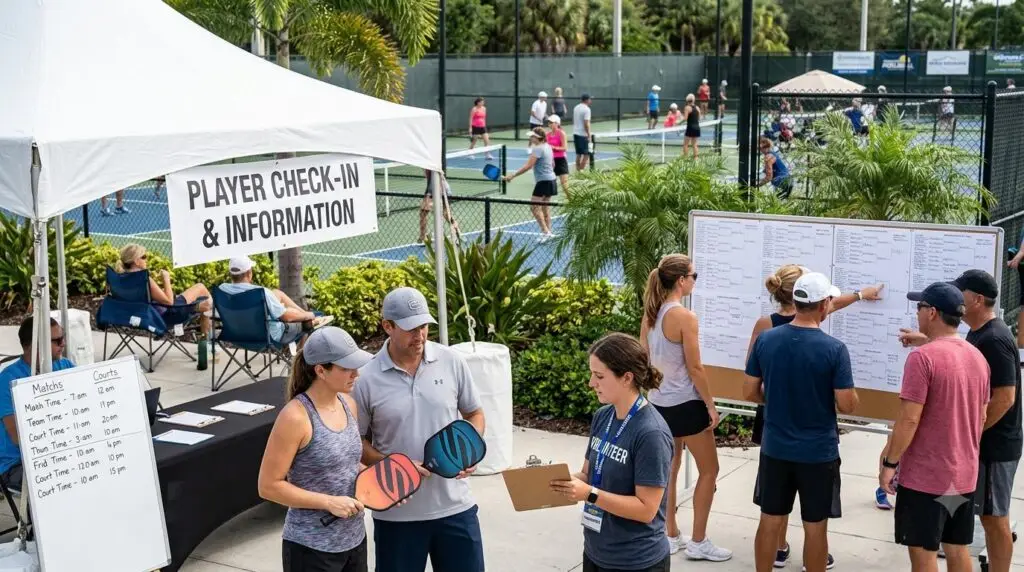
Entering your first pickleball tournament in Tampa can feel like a big jump from open play. Suddenly, you are thinking about ratings, divisions, partners, brackets, check-in times, tournament rules, and whether your normal game will hold up under pressure.
The good news is that you do not need to be an advanced player to start competing.
A first tournament is an opportunity to understand where your game stands, experience structured competition, meet other players, and discover what you want to improve next. The key is choosing the right event and arriving prepared.
This guide walks you through the full process, from deciding whether you are ready and choosing your division to registering, finding a partner, understanding tournament formats, preparing for match day, and playing smarter once the first ball is served.
Are You Ready for Your First Pickleball Tournament?
You do not need perfect third-shot drops or tournament-level nerves of steel before entering your first event.
You are probably ready to consider a beginner or appropriate skill-level tournament if you can:
- Serve consistently and understand the basic rules
- Keep score without constant assistance
- Maintain short rallies
- Understand basic court positioning
- Play safely with different partners and opponents
- Recover from mistakes without losing focus for the rest of the game
Your first tournament does not have to prove how good you are. It should give you a clearer picture of your current game.
Competitive matches expose things that casual play sometimes hides. You may discover that your serve becomes less reliable under pressure, your returns are too short, you rush attacks, or you and your partner leave too much space through the middle.
That information is valuable because it gives your future practice a purpose.
Understand Your Skill Level, Rating, and Tournament Division
One of the most confusing parts of entering a first tournament is figuring out where you belong.
Three ideas are worth separating:
Skill Level
A skill level is a general description of your current abilities, consistency, positioning, and strategy.
For example, players often informally describe themselves as beginner, intermediate, 3.0, 3.5, or advanced based on the level of game they can consistently play.
USA Pickleball notes that its skill-level descriptions are guides rather than official player ratings.
Player Rating
A player rating is a numerical measurement based on competitive or organized match results.
USA Pickleball currently describes pickleball ratings on a scale from 2.0 to 8.0, with higher numbers representing higher levels of competitive ability.
DUPR Rating
DUPR is one rating system commonly encountered in competitive pickleball. New players can initially be unrated, and DUPR currently uses a 2.000 to 8.000 scale. Singles and doubles are tracked separately because performance can differ between the two formats.
That means your casual estimate of being a “3.0 player” and an established competitive rating are not necessarily the same thing.
What Do Common Skill Levels Look Like?
These descriptions are useful as a starting point, but the tournament’s own eligibility rules should always determine which division you enter.
2.0 to 2.5: Beginner
Players are generally developing:
- Consistent serves and returns
- Basic rules knowledge
- Court awareness
- Rally control
- Basic doubles positioning
A beginner-friendly event can be a logical introduction to tournament play.
Around 3.0: Developing Competitive Player
A developing player can usually:
- Serve and return with reasonable consistency
- Sustain rallies
- Understand basic positioning
- Move toward the non-volley zone appropriately
- Begin using intentional shot placement and strategy
Many recreational players consider tournament play once they can perform these skills with some consistency.
Around 3.5: Intermediate Competitive Player
At this level, players typically begin showing more control over:
- Dinks
- Third shots
- Resets
- Shot placement
- Transition-zone play
- Partner movement
- Attacking opportunities
Matches tend to become more tactical because simply keeping the ball in play is no longer enough.
4.0 and Above: Advanced Competition
Higher-level players generally demonstrate stronger consistency, better shot selection, quicker decision-making, more effective resets and attacks, and greater control under pressure.
For a first tournament, your goal should not be to register at the highest level you think you might survive. Choose the division that most accurately represents the level you currently play.
How Do You Choose the Right Division?
Before registering, check four things.
1. Your Current Playing Level
Ask yourself:
- Who do I normally play against?
- Am I competitive with players at the level I plan to enter?
- Can I serve, return, and maintain rallies reliably?
- Do I understand doubles positioning and basic strategy?
- Can I perform these skills when the score becomes close?
2. Your Rating, If the Tournament Uses One
If the event requires DUPR or another rating, use the rating required by the tournament rather than relying only on self-assessment.
3. Age and Skill Requirements
Some tournaments divide players by skill, age, or a combination of both. USA Pickleball-approved formats can include combined age-and-skill events, and tournament directors may sometimes merge divisions when registration numbers require it. Rules about playing above your rating can also depend on the event and tournament director.
4. The Event’s Specific Rules
Never assume every tournament handles divisions the same way.
Read the event listing before paying. If anything is unclear, contact the tournament organizer.
How to Find and Register for a Pickleball Tournament in Tampa
Finding an event is only the beginning. Before clicking “register,” review the complete event information.
Check the Event Type
Tournaments can range from relaxed local competitions to more formal sanctioned events.
A community tournament may be designed primarily for recreation and local competition, while a sanctioned tournament may have additional rating, membership, equipment, or procedural requirements.
For example, players entering USA Pickleball-sanctioned tournaments currently need an eligible USA Pickleball membership.
For any event, confirm its own requirements rather than assuming rules from a previous tournament will apply.
Review the Registration Details
Look for:
- Tournament date
- Registration deadline
- Entry fee
- Event categories
- Skill divisions
- Age divisions
- Singles or doubles format
- Partner requirements
- Check-in instructions
- Refund or cancellation policy
- Equipment requirements
- Rules or scoring format
- Weather or delay procedures for outdoor events
If the tournament uses a registration platform, create your account early instead of waiting until the deadline.
Understand What Your Entry Fee Includes
Some tournaments charge one overall registration fee, while others may add fees for each event or division.
Know the full amount before registering, especially if you plan to enter more than one category.
Watch for Schedule Updates
Your exact bracket or start time may not be available when you first register.
Monitor the tournament’s official communication channel as match day approaches so you do not miss:
- Bracket releases
- Start-time changes
- Court assignments
- Weather notices
- Check-in instructions
Do You Need a Partner Before Registering?
For doubles, it depends on the event.
Some tournaments require both players to complete registration before the team is confirmed. Others may provide a partner search, player pool, or organizer assistance.
Never assume you can arrive without a confirmed partner.
Check:
- Whether a partner must already be named
- Whether both players must register separately
- Whether both players need qualifying ratings
- What happens if your partner withdraws
- Whether a partner-matching option is available
If you do not have a partner yet, there are several ways to find one.
How to Find a Pickleball Tournament Partner in Tampa
Start With Open Play
Open play gives you a chance to evaluate potential partners before committing to a tournament.
Do not choose only by skill level. Pay attention to:
- Communication
- Reliability
- Playing style
- Court movement
- Emotional control
- Competitive goals
Two individually strong players do not automatically make the best doubles team.
A slightly less aggressive player who communicates well and understands positioning may be a better tournament partner.
Use Leagues and Structured Play
Leagues and organized sessions allow you to play repeatedly with the same people and identify players whose game complements yours.
Ask the Tournament Organizer
If an event offers partner matching, the organizer may be able to connect unpaired players.
Discuss Expectations Before You Register
Before becoming a tournament team, agree on:
- Your target division
- Whether the goal is experience or competing for a medal
- Preferred side of the court
- Who takes certain middle balls
- How you communicate during points
- How you respond when one player is struggling
A five-minute conversation before registration can prevent five matches of confusion.
Understanding Pickleball Tournament Brackets and Formats
The bracket tells you who you play and how teams move through the event.
Tournament formats vary, so read the event description carefully.
Common formats include:
Round Robin
In round robin play, teams play multiple opponents within a group.
Results may then determine:
- Final standings
- Seeding
- Advancement into playoffs
- Medal positions
Round robin formats can be comfortable for first-time tournament players because one early loss does not necessarily end the day.
Single Elimination
Single elimination is straightforward.
Lose a match and your run in that bracket is over.
Because every match can be decisive, there is less room for a slow start.
Double Elimination
In a double-elimination structure, one loss does not necessarily eliminate you immediately.
The exact advancement system depends on the tournament, so check how the winner’s and consolation sides of the bracket operate.
Pool Play Followed by Playoffs
Some tournaments place teams into smaller groups or pools first. Results from pool play determine which teams advance or how they are seeded for the next stage.
Divisions Can Change
If a division receives too few entries, an organizer may combine groups or adjust the format.
Do not build your entire match-day plan around an assumed number of games until the final bracket and schedule are published.
What Actually Happens on Tournament Day?
Knowing the sequence of tournament day removes a lot of first-event anxiety.
1. Arrive With Extra Time
Do not plan to park five minutes before your scheduled match.
Your event may require time for:
- Parking
- Check-in
- Waivers
- Finding the courts
- Bathroom breaks
- Warm-up
- Last-minute announcements
USA Pickleball’s event-operator guidance for sanctioned tournaments recommends that players check in at least 30 minutes before their bracket starts. Your specific tournament may give different instructions, so follow the event’s stated check-in time.
2. Check In
Confirm that you and your partner are properly registered and find out how matches will be called.
Depending on the event, you may receive information about:
- Bracket location
- Court assignment
- Match order
- Score reporting
- Officials or referees
- Warm-up procedure
3. Warm Up With Purpose
A tournament warm-up is not the time to rebuild your game.
Focus on getting comfortable with:
- Serves
- Returns
- Dinks
- Drops
- Drives
- Volleys
- Court movement
You want rhythm, not exhaustion.
4. Listen for Your Match
Know how the organizer announces or assigns matches. Some events use apps or digital brackets, while others may use a tournament desk or court monitor.
Stay close enough that you do not miss your call.
5. Confirm the Match Format
Before starting, make sure you understand:
- Scoring format
- Number of games
- Win condition
- Timeouts
- Side changes
- Any event-specific procedures
USA Pickleball publishes an official rulebook, but non-sanctioned events can use modified tournament procedures, so the rules of your specific tournament matter.
6. Report the Result Correctly
After the match, follow the organizer’s procedure for confirming or submitting the score.
Then immediately check:
- Whether you have another match
- Your next opponent
- Approximate wait time
- Whether you remain in the same bracket or move to another stage
Match-Day Strategy for Your First Tournament
Your first tournament is rarely won by suddenly producing shots you do not normally make.
A better goal is to make your normal game more dependable.
Prioritize Consistency Before Power
Tournament nerves often tempt players into attacking too early.
Avoid turning every ball into a highlight attempt.
Focus on:
- Getting serves in
- Hitting deep, controlled returns
- Choosing high-percentage targets
- Moving with your partner
- Staying patient when the rally becomes uncomfortable
Make opponents earn points rather than donating them through avoidable errors.
Win the First Three Shots Before You Worry About the Highlight Reel
The opening of a rally strongly influences who gains position.
Serve
Your first priority is a legal, reliable serve.
A controlled serve that starts the point is more valuable than a risky attempt that produces unnecessary faults.
Return
A deeper return can make it harder for the serving team to move forward immediately and can give your team more time to establish position.
Third Shot
The best third shot depends on the ball you receive and the position of your opponents.
A controlled drop may help you move forward.
A drive can be useful when the ball is attackable or when pressure is the better option.
Do not choose the shot because it is your favorite. Choose it because the situation calls for it.
Communicate With Your Partner
Many first-time doubles teams lose points that have little to do with technique.
Before the match, decide:
- Who usually handles middle balls
- Which player prefers each side
- How you call switches
- When to stay back or move forward
- How you will adjust if opponents repeatedly target one player
During rallies, keep communication short and useful.
Calls such as:
- “Mine”
- “Yours”
- “Switch”
- “Stay”
can prevent hesitation and collisions.
Communication between points matters too.
If a strategy is failing, discuss the adjustment instead of silently hoping the next rally will be different.
Manage Tournament Pressure One Point at a Time
You will probably make mistakes you rarely make in open play.
That is normal.
The dangerous mistake is allowing one error to become three.
After a bad rally:
- Identify anything useful from it.
- Let the frustration go.
- Decide what you want on the next point.
- Reset before serving or receiving.
Avoid rebuilding your entire strategy because of one missed shot.
Common First-Tournament Mistakes to Avoid
Entering the Wrong Division
Choose the level that represents your current game, not the rating you hope to reach soon.
Playing Too Aggressively
Tournament adrenaline can make every ball look attackable.
It is not.
Changing Your Technique at the Last Minute
The week before a tournament is a poor time to replace your serve, change your grip, or completely redesign your third shot.
Use the game you trust.
Ignoring Defense and Resets
Not every rally gives you an attacking opportunity.
Learning to survive a difficult ball can be more valuable than forcing offense from a bad position.
Failing to Communicate With Your Partner
Two players guessing who will take the middle ball is an invitation for free points.
Forgetting the Event Rules
Do not assume the format, scoring, warm-up procedure, or timeout rules will match another tournament you played or watched.
Burning Too Much Energy Early
Tournament days can involve multiple matches and periods of waiting.
Treat energy like another part of your equipment.
One-Week Tournament Preparation Plan
You do not need to cram more pickleball into seven days than you normally play in a month.
Prepare deliberately.
7 to 5 Days Before
Focus on:
- Consistent serves
- Deep returns
- Third-shot decisions
- Dinks and resets
- Doubles movement
- Communication with your partner
Play practice games using the same level of focus you expect during the tournament.
4 to 3 Days Before
Work on specific patterns that have caused problems.
For example:
- Short returns
- Transition-zone errors
- Attacking balls that should be reset
- Leaving the middle open
- Communication on lobs or switches
2 Days Before
Reduce the urge to make major technical changes.
Check your equipment and tournament information instead.
Confirm:
- Registration
- Partner status
- Start time
- Venue
- Parking instructions
- Event rules
- Weather plan if applicable
Day Before
Keep preparation light.
Hydrate normally, eat familiar foods, charge your phone, organize your bag, and get adequate rest.
The goal is to arrive ready to compete, not already tired from preparation.
First Pickleball Tournament Packing Checklist
Pickleball Gear
- Primary paddle
- Backup paddle if available
- Court shoes
- Extra grip or overgrip
- Pickleballs if the event asks players to bring them
Hydration and Fuel
- Water
- Electrolyte drink
- Easy-to-digest snacks
- Food appropriate for a longer tournament day
Personal Items
- Towel
- Change of shirt or clothes
- Sunscreen for outdoor events
- Hat or sunglasses if needed
- Any personal medical essentials
Tournament Information
- Registration confirmation
- Schedule
- Venue details
- Partner contact information
- Any membership or identification required by the organizer
Pack the night before instead of performing a frantic paddle hunt on tournament morning.
How Pickle Social Lounge Can Help You Prepare for Tournament Play
Tournament confidence is built before match day.
At Pickle Social Lounge in Northdale, Tampa, players can use open play, court reservations, clinics, private coaching, leagues, and competitive events to get more comfortable with structured pickleball. The facility currently lists beginner, intermediate, and advanced clinic options, along with open play and tournament opportunities.
If you are not ready to register for a tournament yet, start by identifying what is holding you back.
If You Need More Match Experience
Use open play to face different styles of opponents and become comfortable adapting during games.
If You Need Technical Improvement
A clinic or coaching session can give you focused work on serving, returning, third shots, positioning, consistency, or match strategy.
If You Need Competitive Repetitions
Structured leagues and stronger practice games can help you become comfortable with score pressure before tournament day.
If You Are Ready to Compete
Pickle Social Lounge currently promotes tournaments throughout the year, including singles or doubles play and mixed doubles, women’s, men’s, and open categories. Event details can vary, so check the current tournament information before registering.
The goal is to create a progression:
Learn → Practice → Compete → Evaluate → Improve
Your first tournament becomes much less intimidating when it is simply the next stage of your regular pickleball routine.
Frequently Asked Questions About Your First Pickleball Tournament in Tampa
How good do I need to be before entering a pickleball tournament?
You do not need to be an advanced player. Look for an event with a division appropriate to your current ability and confirm any rating requirements before registering.
The more important question is whether you understand the game well enough to participate safely, keep score, follow the rules, and compete at the selected level.
Do I need a DUPR rating to enter?
Not every tournament has the same rating requirements.
Some events may use DUPR or another system, while local recreational events may use self-rating or their own division criteria.
Read the tournament listing before registering.
What if I do not have a doubles partner?
Check whether the event offers partner matching or allows players to register without a confirmed partner.
If it does not, use open play, leagues, local pickleball communities, or the organizer’s network to look for someone at a compatible level.
Should I play singles or doubles in my first tournament?
Choose the format you actually play and enjoy.
Doubles may feel more familiar to many recreational players and reduces the amount of court each player must cover, but it also requires communication, coordinated positioning, and shared decision-making.
Singles places much more responsibility on your movement, endurance, shot selection, and court coverage.
Neither format is automatically the correct first choice.
How long will my tournament day last?
There is no universal answer.
The length depends on:
- Number of teams
- Tournament format
- Number of guaranteed matches
- Court availability
- Scheduling
- Delays
- Weather for outdoor events
Do not schedule something important immediately after the time you expect to finish unless the tournament publishes a reliable completion schedule.
Can I play above my rating?
That depends on the tournament.
Some formats may allow players to enter a higher skill division, while others have stricter eligibility rules. For USA Pickleball-approved age/skill formats, playing above your rating can be allowed at the tournament director’s discretion.
Always check before registering.
What should I focus on if I get nervous?
Simplify your game.
Get the serve in, make a controlled return, communicate with your partner, choose high-percentage shots, and concentrate on the current point instead of the final score.
Your First Tournament Is a Starting Point, Not a Final Exam
Your first pickleball tournament in Tampa does not need to end with a medal to be worthwhile.
A successful first event can tell you:
- How your game responds to pressure
- Whether your current rating or division feels appropriate
- Which shots remain dependable in competition
- Where your partnership works well
- What breaks down when matches become tight
- What you should practice before entering again
You may leave with a win, a medal, a list of lessons, or all three.
What matters is that your next practice session will no longer be based on guesswork.
If you want to prepare through open play, clinics, coaching, leagues, or competitive events, Pickle Social Lounge gives Tampa-area players several ways to move from recreational play toward more confident competition.
Ready for your next challenge? Build your game, find your competition, and prepare for tournament play at Pickle Social Lounge.