
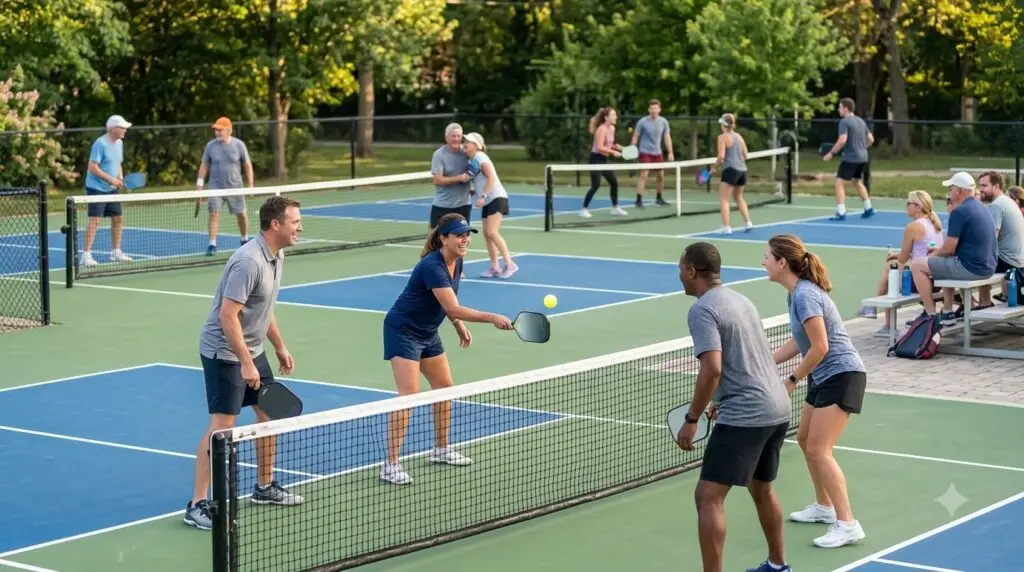
Pickleball has grown from a casual backyard game into one of America’s largest recreational sports.
The Sports & Fitness Industry Association reports that 24.3 million Americans played pickleball in 2025, up from 4.2 million in 2020. That represents more than fivefold growth in five years. Pickleball has now ranked as the country’s fastest-growing sport for five consecutive years.
So, why is pickleball so popular?
Its appeal comes from a rare combination of qualities. The basic game is approachable enough for newcomers, but the strategy is deep enough to keep experienced players improving. It supports fitness without requiring an elite athletic background, works for casual and competitive play, and naturally creates opportunities for people to meet.
Modern venues have expanded that appeal through open play, coaching, leagues, tournaments, food, drinks, and group events. Pickleball is no longer only something people play. For many, it becomes part of their weekly social routine.
Quick Answer
Pickleball is popular because it is:
- Relatively easy to learn
- Social by design
- Suitable for casual and competitive players
- Played across a broad range of ages
- Flexible enough for singles, doubles, indoor, and outdoor play
- Accessible with limited starting equipment
- Active without requiring a large field or court
- Easy to organize through open play and club programs
- Deep enough strategically to remain interesting over time
Its popularity does not come from one advantage. It comes from how effectively the sport combines movement, connection, competition, convenience, and fun.
What Is Pickleball?
Pickleball is a paddle sport that blends elements of tennis, badminton, and table tennis.
It is played on a 20-by-44-foot court using a solid paddle, a perforated plastic ball, and a net. It can be played as singles or doubles, although doubles is especially common in recreational play.
Important rules include:
- An underhand serve
- A two-bounce rule after the serve
- A non-volley zone near the net, commonly called the kitchen
- Games commonly played to 11 points, with a two-point winning margin
The rules are straightforward enough for new players to begin rallying quickly. The kitchen, two-bounce rule, positioning, and shot selection create the deeper strategy that regular players continue developing.
1. Beginners Can Start Playing Quickly
Many sports require significant instruction before a newcomer can participate comfortably.
Pickleball has a shorter entry ramp.
A beginner can often learn the basic serve, scoring system, court boundaries, and kitchen rule during an introductory session. USA Pickleball describes the sport as easy to learn while still challenging to master.
This early sense of progress matters.
New players do not necessarily need to:
- Develop a powerful serve
- Cover a tennis-sized court
- Join a permanent team
- Learn complex formations
- Purchase a large collection of equipment
They can begin with a paddle, a ball, suitable shoes, a court, and a basic understanding of the rules.
That does not mean every beginner immediately plays well. It means they can participate meaningfully before mastering the sport.
2. The Game Is Social by Design
Pickleball naturally creates interaction.
Doubles places four people on a relatively compact court. Players communicate with partners, exchange sides, rotate between games, and often meet new opponents during a single session.
Open play strengthens this social structure. Instead of bringing a complete group, an individual can register for a designated session and rotate into games with other players.
This makes pickleball useful for:
- People new to an area
- Adults looking for an active social activity
- Players whose friends have different schedules
- Retirees seeking a regular community
- Young professionals looking for after-work recreation
- Families wanting an activity they can share
Social connection is associated with stronger health and well-being, including better stress management, healthier behaviors, and improved sleep. Pickleball does not guarantee those outcomes, but organized play can create regular opportunities for meaningful interaction.
3. Pickleball Appeals Across Age Groups
Pickleball was once commonly associated with older adults, but participation has broadened significantly.
SFIA’s 2026 report found that players ages 13 to 24 had the highest participation rate of any age segment. Women also represented 42.9% of participants in 2025, up from 38.6% in 2020.
The sport works for different age groups for different reasons:
| Player Group | Common Appeal |
| Teens and young adults | Social play, competition, and quick learning |
| Young professionals | After-work activity and group events |
| Families | Mixed-age recreation |
| Regular adult players | Fitness, leagues, and skill development |
| Older adults | Smaller court and doubles opportunities |
| Competitive athletes | Strategy, speed, ratings, and tournaments |
Not every game should mix dramatically different abilities. Skill-based sessions, coaching, and appropriate pairings help create safer and more enjoyable play.
The important point is that pickleball is not owned by one generation.
4. The Starting Equipment Barrier Is Relatively Low
A player can try pickleball with a relatively short equipment list:
- One paddle
- A pickleball
- Court shoes
- Access to a net and court
Many clubs, recreation centers, event packages, and introductory programs may also provide equipment, although availability and fees differ by venue.
This allows people to try the sport before investing heavily.
Costs can increase when players purchase advanced paddles, take private lessons, enter tournaments, or join paid facilities. Pickleball should therefore be described as having a low basic equipment barrier, not as universally inexpensive.
5. Pickleball Makes Physical Activity Feel Like Play
Pickleball involves walking, short bursts of movement, reaching, reacting, balancing, and coordinating with a partner.
The amount and intensity of activity vary according to:
- Singles versus doubles
- Player ability
- Match length
- Playing speed
- Number of games
- Court conditions
- Individual mobility
CDC guidance states that physical activity can help people feel, function, and sleep better, while regular activity may also support long-term physical and mental health.
Pickleball’s advantage is motivational rather than magical.
People may be more likely to repeat an activity when it also includes:
- Games
- Friends
- Competition
- Skill progress
- Scheduled sessions
- Immediate feedback
Players should still warm up, use suitable court shoes, increase intensity gradually, stay hydrated, and play within their physical capacity.
6. It Is Easy to Learn but Difficult to Master
The basic goal is simple: serve the ball, keep it in play, and win rallies.
The deeper game contains many layers:
| Beginner Focus | Advanced Development |
| Get the serve in | Control serve depth and placement |
| Return the ball | Return deep and establish court position |
| Avoid kitchen faults | Control the non-volley line |
| Keep rallies alive | Build points patiently |
| Hit the ball firmly | Choose between drives, drops, and resets |
| Stand near a partner | Move together as a doubles team |
| React to each shot | Anticipate patterns and openings |
Regular players may spend years improving:
- Dinks
- Third-shot drops
- Resets
- Drives
- Lobs
- Speed-ups
- Footwork
- Shot selection
- Partner communication
- Defensive positioning
This balance is central to the sport’s popularity.
Beginners receive an accessible first experience, while advanced players continue finding new tactical problems to solve.
7. Open Play Removes the “I Need a Group” Problem
Many recreational activities become difficult to organize because participants need a complete team or fixed group.
Open play reduces that friction.
Players can register individually, rotate through games, and meet people with similar schedules or playing levels.
A useful open-play program should clearly explain:
- Skill level
- Registration requirements
- Session duration
- Player capacity
- Rotation format
- Cost
- Equipment rules
- Cancellation policy
Pickle Social Lounge currently offers beginner, intermediate, and advanced open play along with social formats such as Dinks & Drinks, Coffee & Pickleball, and Family Pickleball.
For many players, open play is the bridge between trying pickleball once and developing a regular routine.
8. Players Can Choose Casual or Competitive Experiences
Pickleball can be played as:
- A relaxed family game
- A social evening
- A regular workout
- A weekly league
- A rated competition
- A structured tournament
- A private coaching session
- A corporate activity
This range keeps the sport from being trapped in one identity.
Someone can play casually for years without entering a tournament. Another player can track ratings, join competitive divisions, and train for events.
Pickle Social Lounge currently promotes round robins, challenge courts, ladder play, tournaments, group clinics, and private lessons. Its competition page also lists divisions from beginner through advanced, while advising players to inquire about upcoming league plans.
Players should check the live schedule rather than assuming every format operates continuously.
9. Modern Venues Turn Pickleball Into a Complete Outing
The growth of social pickleball venues has expanded what a court visit can include.
Players may now combine a game with:
- Food and drinks
- Music
- Lounge seating
- Social nights
- Birthday parties
- Corporate outings
- Fundraisers
- Mini-tournaments
- Coaching
- Team-building activities
Pickle Social Lounge offers group outings, birthday parties, corporate events, food-and-beverage options, event coordination, flexible play formats, lounge time, catering, music, and themed add-ons.
This makes pickleball appealing even to mixed groups in which some people are experienced players and others have never held a paddle.
The game provides the shared activity. The venue builds the social experience around it.
Is Pickleball Popular Only Because It Is New?
The participation numbers suggest deeper engagement than a one-time novelty.
SFIA reports that “core” players, defined as those playing at least eight times per year, increased from 1.4 million in 2020 to 7.5 million in 2025.
That growth indicates that many people are not simply trying pickleball once. They are returning.
The sport’s long-term strength is supported by:
- Repeat participation
- Skill development
- Organized open play
- Dedicated facilities
- Coaching
- Leagues and tournaments
- Social programming
- Broad age participation
No recreational trend is guaranteed to grow forever. However, pickleball now has a substantial base of repeat players and organized infrastructure.
Why Pickleball Works for Young Professionals
Pickleball fits naturally into many young professionals’ schedules because a session can function as both activity and social plan.
It can offer:
- After-work recreation
- Friendly competition
- A group outing that does not revolve only around eating
- An activity for mixed experience levels
- A setting for meeting people naturally
- Corporate team-building
- Food or drinks after play
Unlike formal networking events, pickleball gives people a shared task and an immediate conversation point.
It should not be treated as a guaranteed career-building tool. Its practical advantage is that it creates repeated, low-pressure interaction.
Why Pickleball Works for Families
Families often struggle to find activities suitable for multiple generations and ability levels.
Pickleball can work because:
- Basic rules can be taught relatively quickly
- Doubles encourages cooperation
- Games can be shortened
- Partners can be adjusted
- Coaching can support first-time players
- A private court allows the family to control the pace
A family session still needs thoughtful pairing. A young beginner and an advanced adult may not enjoy the same competitive format.
Social games, introductory clinics, and flexible scoring can keep the activity inclusive.
Common Myths About Pickleball
Myth 1: Pickleball Is Only for Older Adults
Current participation spans generations, with ages 13 to 24 recording the highest participation rate in SFIA’s latest report.
Myth 2: Pickleball Is Too Easy to Be Competitive
The entry rules are approachable. Advanced positioning, patience, speed, placement, and doubles strategy are not.
Myth 3: You Need Three Friends to Start
Open play, clinics, round robins, and leagues can allow individual players to join without organizing a complete group.
Myth 4: Pickleball Is Always Cheap
Basic equipment can be relatively accessible, but court rentals, coaching, leagues, tournaments, and premium paddles can increase the cost.
Myth 5: Pickleball Automatically Provides a Low-Impact Workout
The smaller court can make the game feel approachable, but quick direction changes, falls, repetitive movement, and competitive intensity still place physical demands on the body.
Players should select a suitable level and prepare as they would for any court sport.
How to Try Pickleball for the First Time
Option 1: Beginner Clinic
Choose a clinic when you want help learning scoring, serving, the kitchen, positioning, and safety before joining games.
Option 2: Private Lesson
A private lesson may suit someone who wants individual attention or has a specific skill or mobility concern.
Option 3: Private Court With Friends
Reserve a court when your group wants to learn together at its own pace.
Option 4: Beginner Open Play
Try beginner open play after understanding the basic rules and rotation system.
Option 5: Group Event
A structured birthday, work outing, or social event can introduce several beginners at once, especially when equipment and instruction are included.
Starting at Pickle Social Lounge in Tampa
Pickle Social Lounge is located at 4417 Northdale Boulevard in Tampa and currently operates daily from 7:00 a.m. to 9:00 p.m.
As of July 2026, its public website lists:
| Activity | Publicly Listed Price |
| Evening open play, three hours | $8 per player |
| Five-session open-play pack | $32 |
| Off-peak court rental | $20 per hour per court |
| Prime-time court rental | $25 per hour per court |
| Private coaching | From $40 per hour |
| Six-to-eight-week league | $60–$80 per player |
The separate competition page notes that weekly league match play is coming soon, so players should confirm current availability before registering.
Frequently Asked Questions
Why is pickleball so popular in America?
Pickleball combines an approachable learning curve, social doubles play, broad age appeal, physical activity, flexible formats, and long-term competitive depth. SFIA reports that 24.3 million Americans played in 2025.
Is pickleball easy for beginners?
The basic rules are relatively easy to learn, and beginners can often begin rallying during an introductory session. Consistent serving, positioning, kitchen control, and strategy require continued practice.
Is pickleball only for older adults?
No. Players participate across age groups, and ages 13 to 24 currently have the highest participation rate of any age segment in the United States.
Is pickleball a good social activity?
Yes. Doubles, open play, partner rotation, leagues, and events create regular opportunities for players to interact and meet others.
Do I need a full group to play?
No. Open-play sessions allow individuals to register and rotate into games without bringing a complete group.
Is pickleball good exercise?
Pickleball involves physical activity, but intensity varies by format and player. General physical activity can support physical and mental health, although individual results and suitability differ.
Is pickleball expensive?
Basic equipment needs are limited, but total cost depends on paddles, court access, coaching, leagues, tournaments, and the type of facility used.
Why do experienced players continue playing?
Advanced strategy includes dinking, drops, resets, drives, positioning, anticipation, shot selection, and partner coordination. The game becomes more complex as players improve.
What is the easiest way to try pickleball in Tampa?
A beginner clinic, private lesson, private court reservation, or beginner open-play session can provide a structured introduction. Pickle Social Lounge offers each of these types of experiences, subject to the current schedule.
The Real Reason Pickleball Keeps Growing
Pickleball succeeds because it removes several barriers at the same time.
It does not require years of training before a player can enjoy the first session. It gives people an activity they can share with others. It supports casual games and serious competition. It can be played indoors or outdoors, through public recreation or dedicated clubs.
Most importantly, the sport creates a clear reason to return.
A player can return to meet friends, improve a shot, join open play, enter a tournament, take a lesson, attend a social event, or simply move after a long day.
That combination of accessibility, progression, competition, and connection is why pickleball has grown beyond a passing recreational curiosity.
For Tampa players ready to experience the sport, Pickle Social Lounge offers court reservations, open play, coaching, competitive programs, tournaments, and group events in one community-focused setting.