
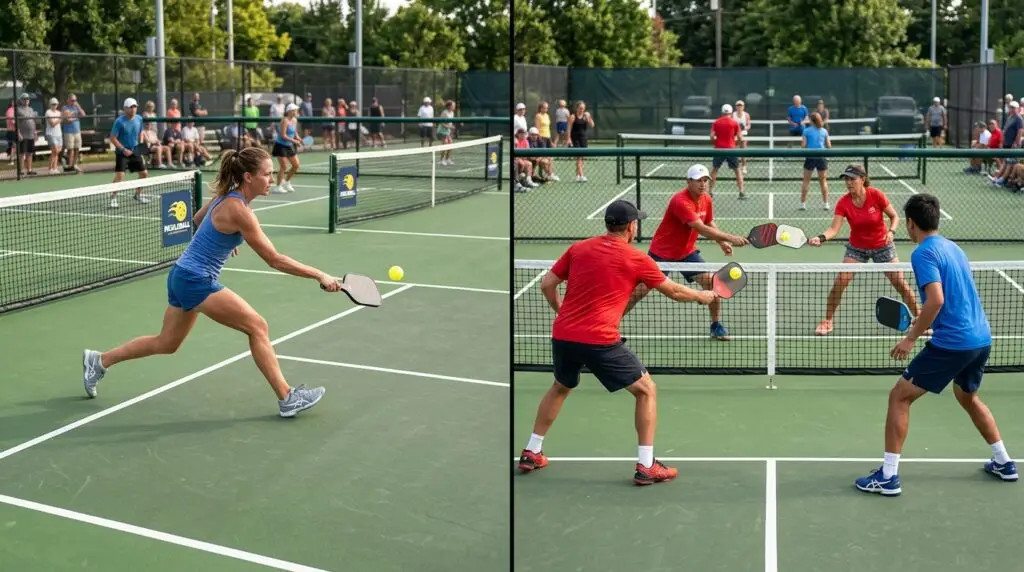
Singles and doubles pickleball use the same court, paddles, ball, non-volley zone, and two-bounce rule, but they reward very different skills.
In singles, one player must cover the entire court. Success depends heavily on movement, deep serves and returns, passing shots, recovery position, and the ability to create open space.
In doubles, two partners share the court. Positioning, communication, kitchen-line control, patient shot selection, and coordinated movement become more important than covering maximum distance.
Players who use an identical strategy in both formats often struggle because:
- A safe doubles shot may leave too much open court in singles.
- An aggressive singles attack may create unnecessary errors in doubles.
- Singles recovery is based on the opponent’s available angles.
- Doubles positioning depends on both partners moving as a connected unit.
- Serving and scoring procedures differ between the two formats.
Understanding these differences helps players choose better shots, conserve energy, and train for the demands of each game.
Pickle Social Lounge gives Tampa players opportunities to build both individual and partner-based skills through indoor court reservations, open play, clinics, private coaching, leagues, and tournaments.
Quick Comparison: Singles vs. Doubles Pickleball
| Category | Singles Pickleball | Doubles Pickleball |
|---|---|---|
| Players | One player per side | Two players per side |
| Court size | Full standard court | Full standard court |
| Score call | Two numbers | Three numbers in traditional side-out scoring |
| Court coverage | One player covers the full court | Partners share coverage |
| Physical demand | Generally higher running and recovery demand | Less court coverage but faster exchanges |
| Primary tactical goal | Create and attack open space | Control the non-volley line as a team |
| Common strengths | Speed, endurance, passing shots, deep returns | Communication, dinking, resets, volleys |
| Partner communication | Not applicable | Essential |
| Beginner accessibility | More physically and tactically demanding | Usually easier for new recreational players |
| Typical style | Open-court and attacking play | Positional, patient, and partnership-based play |
Neither format is universally harder.
Singles usually places greater demands on court coverage and conditioning. Doubles can be more complex tactically because players must coordinate positioning, shot selection, middle coverage, and communication with a partner.
What Stays the Same in Singles and Doubles?
The core game remains consistent in both formats.
The Same Court Is Used
Singles and doubles use the same pickleball court. Unlike tennis, singles pickleball does not reduce the playable width.
A singles player must therefore defend the entire court alone.
The Non-Volley Zone Still Applies
The seven-foot area on each side of the net is the non-volley zone, commonly called the kitchen.
Players cannot volley while standing in the non-volley zone or while momentum from a volley carries them into it.
The kitchen remains strategically important in both formats, although players approach and defend it differently.
The Two-Bounce Rule Applies
After the serve:
- The receiving side must allow the serve to bounce.
- The serving side must allow the return to bounce.
- Either side may then volley or play the ball after a bounce.
USA Pickleball identifies this as the two-bounce rule, formerly called the double-bounce rule.
Standard Games Commonly Use the Same Winning Score
Traditional side-out games are commonly played to 11 points and must be won by two. Tournament or alternative formats may use different scoring targets or rally scoring, so players should confirm the event rules before beginning.
The Biggest Rule Difference: Serving and Scoring
The most important procedural difference between singles and doubles is the service sequence.
Singles Scoring and Serving
A singles score contains two numbers:
Server’s score – receiver’s score
The server’s score determines the serving position.
- When the server’s score is even, the serve begins from the right side.
- When the server’s score is odd, the serve begins from the left side.
- The server changes sides after winning a point.
- A fault results in a side-out, and the opponent receives the serve.
Example:
If the score is 4–3, the server stands on the right because four is even.
If the score is 5–3, the server stands on the left because five is odd.
This even-right, odd-left pattern helps players track the score and correct position.
Doubles Scoring and Serving
Under traditional side-out scoring, a doubles score contains three numbers:
Serving team’s score – receiving team’s score – server number
The final number identifies whether the player serving is the team’s first or second server during that service turn.
A typical score call may sound like:
6–4–2
This means:
- The serving team has six points.
- The receiving team has four points.
- The team’s second server is serving.
Both partners normally receive an opportunity to serve before a side-out. The exception occurs at the beginning of a traditional game, when the opening team starts with only one service turn.
Players should confirm whether a league or event uses traditional side-out scoring or another approved format.
What Is Singles Pickleball?
Singles pickleball places one player on each side of the court.
Because no partner is available to cover open space, every shot affects where the player must move next.
Singles rewards:
- Deep and accurate serving
- Strong returns
- Efficient footwork
- Fast recovery
- Passing shots
- Controlled aggression
- Shot placement
- Endurance
- Anticipation
The objective is not merely to hit harder. It is to create space and place the next ball where the opponent cannot recover comfortably.
What Is Doubles Pickleball?
Doubles places two players on each side.
Although each player covers less total ground, the format introduces partnership responsibilities such as:
- Calling balls
- Covering the middle
- Moving forward together
- Avoiding large gaps
- Coordinating shot selection
- Supporting a partner under pressure
- Deciding when to switch or poach
Doubles rallies often involve more kitchen-line exchanges, dinks, blocks, resets, speed-ups, and quick counterattacks.
USA Pickleball’s strategy guidance emphasizes deep serving and returning, controlled advancement, kitchen-line positioning, communication, and patience in doubles play.
Singles Strategy: Use Space as a Weapon
The singles court contains more open space because only one opponent is defending it.
Effective singles strategy begins by moving the opponent away from a balanced recovery position.
1. Serve Deep
A deep serve can:
- Keep the opponent behind the baseline
- Reduce aggressive return angles
- Create additional time for server recovery
- Make the returner move before establishing control
Serving near the center or “T” can also reduce the opponent’s available angles, while serving wider may create open space for the next shot. The right choice depends on the opponent’s position, movement, and stronger return side.
Avoid This Mistake
Do not sacrifice consistency merely to create maximum power.
A serve that lands deep with reliable placement usually creates more pressure than a harder serve that frequently misses.
2. Return Deep and Move Forward
The returner has a positional advantage because the serving team must allow the return to bounce.
A deep return can:
- Keep the server near the baseline
- Provide more time to advance
- Limit the server’s passing angles
- Create a stronger position near the non-volley line
USA Pickleball recommends a deep return and forward movement toward the non-volley line when the situation allows.
The returner should not admire the shot from the baseline. The return creates time, and that time should be used to improve position.
3. Recover According to the Available Angle
Returning automatically to the exact center after every singles shot is not always correct.
Recovery position should depend on:
- Where the ball was hit
- Where the opponent will contact it
- Whether the opponent is under pressure
- Which angles remain available
- Whether the player is approaching the net
After hitting a wide crosscourt shot, the opponent may have a sharp crosscourt response and a down-the-line option. The player should recover toward a position that covers the most likely reply rather than blindly standing on the center line.
Efficient recovery uses small adjustment steps and maintains a balanced ready position.
4. Attack Open Court, Not Just the Sideline
A winner does not need to land one inch from the line.
The safer target is often several feet inside the open court.
High-percentage targets reduce unforced errors while still forcing the opponent to move.
Look for open space created by:
- A wide serve
- A short return
- An opponent moving in one direction
- A weak approach
- A slow recovery
- A ball contacted off balance
The goal is to make the opponent play another difficult ball, not to produce a cinematic winner on every rally.
5. Use Passing Shots When the Opponent Approaches
When an opponent moves toward the non-volley line, possible targets include:
- Down the line
- Crosscourt
- Behind the moving opponent
- Low toward the feet
- Into the space created by an early commitment
Passing shots should remain low enough to make volleying difficult.
Repeatedly hitting directly at a well-positioned opponent may be less effective than using width, pace changes, or a shot behind their movement.
6. Approach the Net Selectively
The non-volley line remains a strong attacking position in singles, but approaching behind a weak shot can expose passing lanes.
Move forward after creating pressure with:
- A deep return
- A low approach
- A wide shot
- A short opponent reply
- A ball that forces the opponent off balance
Avoid charging forward automatically behind a high or central ball that gives the opponent time to choose a passing target.
7. Use Lobs Carefully
A singles lob can be effective when an opponent stands close to the non-volley line.
A successful lob may:
- Force the opponent away from the net
- Reverse attacking positions
- Create time for recovery
- Open the next passing shot
A short lob can be attacked immediately, while an unnecessarily high lob gives the opponent time to recover.
Use the shot selectively rather than treating every net approach as an invitation to launch the ball toward the ceiling.
Physical Demands of Singles Pickleball
Singles generally involves:
- More total court coverage
- Longer recovery runs
- Repeated acceleration
- Wider defensive movement
- Greater reliance on individual conditioning
- Fewer opportunities to rest during a rally
Players should prepare with:
- Aerobic conditioning
- Short acceleration drills
- Lateral movement
- Controlled stopping
- Lower-body strength
- Balance work
- Adequate recovery
Singles players should not interpret fatigue as permission to abandon positioning. As movement quality declines, shot selection should become more controlled rather than more reckless.
Is Singles Pickleball Only for Highly Athletic Players?
No, but it should be matched to the player’s ability and conditioning.
Recreational singles can be adapted through:
- Shorter games
- Longer rest periods
- Controlled pace
- Skill-matched opponents
- Reduced weekly volume
Players with significant joint pain, balance concerns, recent injury, or low conditioning may find doubles a more manageable starting point.
The right format should challenge the player without turning every wide ball into a rescue mission.
Learn and Practice Both Formats at Pickle Social Lounge
Pickle Social Lounge provides indoor pickleball in Northdale, Tampa, with court reservations, open play, clinics, private coaching, leagues, and tournaments for different experience levels.
Players can use:
- Court reservations for singles practice
- Clinics to develop foundational technique
- Private coaching for format-specific feedback
- Open play to gain doubles experience
- Leagues and tournaments for structured competition
The venue is located at 4417 Northdale Boulevard, Tampa, Florida 33624, and currently lists operating hours of 7:00 a.m. to 9:00 p.m. daily. Program schedules and court availability should be confirmed before visiting.
Learning both formats can create a more complete game.
Singles exposes movement and shot-placement weaknesses quickly. Doubles reveals whether a player can communicate, maintain position, control pace, and make decisions that help a partner rather than only themselves.
Doubles Pickleball Strategy: Positioning, Communication, and Kitchen Control
Doubles pickleball requires less individual court coverage than singles, but it introduces an extra tactical layer: every movement and shot affects a partner.
Strong doubles teams do not simply divide the court into two fixed halves. They adjust together according to:
- Ball position
- Opponent position
- Shot quality
- Available angles
- Each player’s strengths
- Whether the team is attacking, defending, or transitioning
The central doubles objective is usually to reach the non-volley line together and maintain a balanced position from which both players can attack high balls, defend speed-ups, and protect open space.
USA Pickleball’s doubles guidance identifies non-volley-line control, deep serves and returns, communication, patience, and coordinated movement among the format’s core strategic principles.
What Is the Best Doubles Pickleball Strategy?
A reliable doubles strategy follows this sequence:
- Serve deep enough to restrict the return.
- Stay behind the baseline until the return bounces.
- Choose a third-shot drop or drive based on ball quality.
- Advance only behind a shot that gives the team time.
- Reach the kitchen line together.
- Keep the ball low and difficult to attack.
- Move with the partner to close angles.
- Attack balls that rise above a comfortable defensive height.
- Reset or defend when the team loses its advantage.
The most common mistake is attempting to finish the point before earning an attacking ball.
Doubles rewards patience, but patience does not mean passivity. It means waiting until the ball, positioning, and opponent create a high-percentage opportunity.
Starting Positions in Doubles Pickleball
Correct starting positions give each team the best chance to handle the first three shots safely.
Serving Team Position
The server stands behind the baseline in the correct service area.
The server’s partner should also remain behind or near the baseline because the serving team must allow the return to bounce under the two-bounce rule.
Standing too far inside the court creates several problems:
- A deep return may land at the player’s feet.
- The player may need to retreat awkwardly.
- The team may become unbalanced before the third shot.
- A ball may be volleyed illegally before the required bounce.
Both serving players should prepare for the return from behind the baseline and move forward only after the third shot creates enough time.
Receiving Team Position
The returner generally stands behind the baseline to handle a deep serve.
The returner’s partner can begin near the non-volley line because that player is not responsible for receiving the serve.
USA Pickleball recommends that the returner allow room behind the baseline while the partner begins at the kitchen line, giving the receiving team an early positional advantage.
After returning, the returner should move forward as quickly as balance and shot quality allow.
The receiving team’s goal is to establish both players at the non-volley line before the serving team can do the same.
Why Kitchen-Line Control Matters in Doubles
The non-volley line is valuable because it reduces the distance between the player and the opponent.
From this position, a team can:
- Contact the ball before it drops too low
- Reduce opponents’ reaction time
- Attack high balls
- Create sharper angles
- Protect more court with smaller movements
- Apply pressure without hitting maximum power
USA Pickleball notes that many doubles points are decided near the kitchen and advises partners to move forward once the two-bounce requirement has been satisfied and the shot permits safe advancement.
Kitchen Control Does Not Mean Charging Forward Blindly
Players should advance behind a shot that is:
- Low
- Deep
- Difficult to attack
- Placed away from an opponent’s strongest position
- Slow enough to provide transition time
A high third shot gives opponents an easy volley. Running forward behind it reduces reaction time and can trap both players in the transition zone.
The correct decision may be to stop, defend the next ball, and continue advancing gradually.
Move With Your Partner as One Unit
Strong doubles teams maintain spacing while shifting according to the ball.
Imagine that an invisible rope connects the partners. The rope should stretch slightly when needed, but it should not snap into two unrelated court adventures.
When the Ball Moves Wide
When the ball is hit toward one sideline:
- The player closest to that side shifts toward the ball.
- The partner also moves in the same direction.
- The team protects the line and middle based on the new angle.
- The far sideline may be left more open because it is harder for the opponent to reach safely.
The ball’s location determines the opponent’s realistic angles. Teams should defend those angles rather than standing permanently on fixed court markers.
When the Ball Returns Toward the Middle
Both partners should shift back toward a balanced central formation.
The goal is to avoid:
- A large gap between partners
- One player remaining outside the court
- Both players covering the same narrow space
- An open middle created by delayed movement
Maintain Functional Spacing
Partners should usually remain close enough to protect the middle but far enough apart to cover their respective sides.
Standing too far apart creates an obvious central gap.
Standing too close together exposes both sidelines and may cause paddle collisions.
The ideal distance changes according to court position, ball location, player reach, and opponent tendencies.
Who Covers the Middle Ball?
“Who takes the middle?” is one of the most common doubles questions.
There is no single rule that works in every rally, but teams can use clear priorities.
Forehand-in-the-Middle Principle
When one partner’s forehand is in the middle and the other partner’s backhand is there, the forehand player may take more middle balls because forehands are often stronger and provide greater reach.
This is a strategy agreement, not an official rule.
Exceptions may include:
- One player has a stronger backhand.
- The ball is clearly closer to the other player.
- One partner is moving forward while the other is balanced.
- The team is stacking.
- A lob, poach, or switch changes responsibility.
- One player has called the ball early.
The Player With the Better Angle
The player who can contact the ball:
- Earlier
- Higher
- In front of the body
- Without crossing awkwardly
- Without opening a large gap
may be the better choice, even when the other player technically has a forehand.
Communication Overrides Assumption
Call the ball early with simple language:
- “Mine”
- “Yours”
- “Leave”
- “Switch”
- “Stay”
Late communication often creates hesitation, collisions, or two paddles performing a brief and expensive handshake.
Avoid Overreaching Into a Partner’s Zone
A player should not take every middle ball merely because their forehand is present.
Overreaching may:
- Pull the player out of position
- Expose the sideline
- Crowd the partner
- Produce weaker contact
- Cause paddle collisions
The best middle strategy combines partner agreement, early communication, and balanced positioning.
Third-Shot Drop vs. Third-Shot Drive
The serving team’s third shot is important because the receiving team often already controls the non-volley line.
The serving team must decide whether to neutralize that advantage with a drop or challenge it with a drive.
Third-Shot Drop
A third-shot drop is a soft, controlled ball intended to land in or near the opponents’ kitchen.
Its purpose is to:
- Keep the ball below attacking height
- Reduce the opponents’ volley options
- Create time for the serving team to advance
- Begin a softer exchange
- Neutralize the receiving team’s positional advantage
USA Pickleball describes the third-shot drop as a transition shot designed to land softly in the non-volley zone and help the serving team move toward the net.
Use a Drop When:
- The return is deep.
- The ball is below net height.
- The opponents are established at the kitchen.
- The player is balanced.
- There is enough control to place the ball softly.
- The team needs time to move forward.
A Good Drop Should:
- Clear the net safely
- Descend into the kitchen
- Remain difficult to volley aggressively
- Give both partners time to advance
The drop does not need to be a winner. It needs to prevent the opponent from attacking comfortably.
Third-Shot Drive
A third-shot drive is a faster ball hit toward or through the receiving team.
Its purpose may be to:
- Pressure a weak volley
- Attack an opponent who is still moving
- Force a defensive block
- Create a higher fifth shot
- Exploit an open middle
- Punish a short return
Use a Drive When:
- The return is short.
- The ball can be contacted above or near net height.
- An opponent has not reached the kitchen.
- The opponents leave a visible gap.
- The player can drive with control.
- The team expects to attack the next ball rather than finish immediately.
A strong drive does not automatically win the rally. Experienced opponents may block it back low.
The serving team should prepare for a fifth-shot drop, reset, or controlled continuation.
Third-Shot Decision Table
| Situation | Better Initial Choice |
|---|---|
| Deep return landing near the baseline | Drop or controlled drive |
| Short return with a high contact point | Drive |
| Both opponents established at the kitchen | Drop |
| One opponent still moving forward | Drive toward their feet or open space |
| Player is stretched or off balance | Safer drop, reset, or controlled shot |
| Opponents struggle with pace | Drive selectively |
| Opponents counter drives effectively | Drop more frequently |
| Wind or conditions make soft shots unreliable | Controlled drive may be practical |
| Team needs time to approach | Drop |
The decision should be based on the incoming ball and opponent position, not on a rule that every third shot must be identical.
Advancing Through the Transition Zone
The area between the baseline and kitchen is often called the transition zone.
Players are vulnerable there because balls can arrive near their feet while they are moving.
Use a Split Step
As the opponent prepares to contact the ball:
- Stop advancing.
- Establish balance.
- Widen the stance slightly.
- Prepare the paddle in front.
- Play the next ball.
- Continue forward only when the shot allows.
Hitting while running makes control more difficult.
Advance in Stages
The team does not need to reach the kitchen in one sprint.
A common progression is:
- Hit the third-shot drop.
- Advance several steps.
- Stop before the opponent contacts the ball.
- Reset the next shot.
- Advance again.
- Reach the line together.
Several controlled advances are better than one heroic charge into a ball aimed at the shoelaces.
Do Not Leave Your Partner Behind
When one partner reaches the kitchen while the other remains near the baseline, opponents gain a large gap and several attacking angles.
The advanced partner may become vulnerable to:
- Hard shots at the body
- Balls through the middle
- Angled volleys
- Shots behind the player
Partners should transition together unless a specific rally requires temporary separation.
Dinking Strategy in Doubles
A dink is a soft shot played into the opponent’s non-volley zone.
Its purpose is not simply to slow the game. It is to keep the ball below attackable height while creating a weaker reply.
USA Pickleball advises players to keep kitchen exchanges low and unattackable until an opponent produces a ball that can be attacked safely.
Crosscourt Dinks
Crosscourt dinks offer:
- More distance over the net
- A lower central net height
- Wider angles
- Opportunities to move an opponent outside the court
They are useful for creating space but must be controlled to avoid hitting wide.
Middle Dinks
A middle dink can:
- Reduce attacking angles
- Create partner confusion
- Target both players’ backhands
- Make poaching decisions more difficult
- Provide a safer target
USA Pickleball recommends the middle as a practical drop target when a player is uncertain because it can limit angles and create decision pressure.
Move the Opponents
A purposeful dink pattern may:
- Move one opponent wide.
- Return the ball toward the middle.
- Make the player recover.
- Create an opening or high reply.
Do not attack solely because several dinks have already been exchanged. The rally does not owe anyone excitement on a schedule.
Recognizing an Attackable Ball
A ball may be attackable when it:
- Sits above net height
- Bounces high enough for controlled acceleration
- Arrives near a player’s dominant side
- Leaves an open target
- Catches an opponent moving or leaning
- Can be contacted in front of the body
Possible targets include:
- The opponent’s paddle-side hip
- The feet
- The space between opponents
- An open sideline
- The area behind a moving player
Avoid attacking low balls from below net height unless the player can create a controlled roll or another high-percentage shot.
Hitting upward with maximum force often sends the ball long or directly into an opponent’s counterattack zone.
Speed-Ups, Counters, and Resets
Speed-Up
A speed-up changes a soft exchange into a faster attack.
Use it when:
- The ball is high enough.
- The player is balanced.
- A target is available.
- The partner is ready for the counterattack.
- The shot can remain inside the court.
A speed-up should not surprise the player’s own partner more than the opponents.
Counterattack
After an opponent speeds up:
- Keep the paddle in front.
- Use a compact motion.
- Avoid a large backswing.
- Direct the ball toward open space or the opponent’s feet.
- Expect another fast ball.
Quick exchanges at the kitchen usually reward preparation and control more than a dramatic swing.
Reset
A reset is a soft defensive shot used to reduce pace and return the rally to a neutral state.
Use a reset when:
- The team is caught in transition.
- The ball arrives near the feet.
- The opponents are attacking.
- A hard counter would be low percentage.
- The team needs more time to establish position.
Resets are not signs of weakness. They are tactical brakes applied before the rally drives through the living-room wall.
Doubles Communication That Prevents Errors
Communication should be brief, early, and useful.
Before the Point
Partners can discuss:
- Who covers the middle
- Return direction
- Third-shot target
- Whether stacking will be used
- Opponent weaknesses
- Possible poaching
- How to handle lobs
During the Rally
Useful calls include:
- “Mine”
- “Yours”
- “Out”
- “Bounce”
- “Switch”
- “Stay”
- “Go”
- “Back”
Avoid long explanations while the ball is moving.
Between Points
Use short observations:
- “They are targeting the middle.”
- “Let us return deeper.”
- “I will cover the lob.”
- “Their backhand dink is rising.”
- “Let us slow the next rally.”
Communicate Constructively
Good partners:
- Take responsibility for mistakes
- Give useful information
- Maintain calm body language
- Avoid visible blame
- Encourage smart decisions
- Adjust without turning every point into a staff meeting
Partner confidence can disappear quickly when every missed ball receives a technical autopsy.
What Is Stacking in Doubles Pickleball?
Stacking is a positioning strategy in which both partners begin or temporarily stand on the same side of the court so they can finish the service or return sequence in preferred positions.
It is commonly used to:
- Keep both forehands or preferred shots in the middle
- Protect a weaker side
- Maintain a left-handed and right-handed partnership formation
- Place the stronger player on a specific side
- Create consistent matchup patterns
USA Pickleball identifies stacking as an intermediate strategic concept and notes that players should understand when it can be useful.
Basic Serving-Team Stack
A simplified serving stack may work like this:
- The correct server stands in the legally required service area.
- The partner stands nearby outside the serving path.
- The server completes the serve.
- Both partners move into their preferred left-right formation.
- The team still allows the return to bounce before playing the third shot.
Stacking does not change the correct server or legal serving position.
Return-Team Stack
On the receiving side:
- The correct receiver stands in the required receiving position.
- The partner may position closer to the receiver’s side.
- After the return, the players move into their preferred formation.
- Clear movement and communication prevent both partners from occupying the same space.
When Stacking May Help
Stacking can be useful when:
- One partner is left-handed and the other is right-handed.
- Both players want forehands in the middle.
- One player performs better on a specific side.
- The team wants a stronger crosscourt matchup.
- A particular opponent is targeting one player’s weakness.
When Stacking Creates Problems
Stacking may hurt the team when:
- Players forget the correct server or receiver.
- Movement after the serve is slow.
- Partners collide while switching.
- The formation leaves a sideline open.
- Players focus more on stacking than on the ball.
- The strategy is used without practice.
Beginners do not need stacking to play effective doubles.
Reliable serving, returning, positioning, and communication should be established first.
Poaching and Switching
Poaching occurs when one player crosses into the partner’s usual space to intercept a ball.
USA Pickleball describes both planned and opportunistic poaching as advanced doubles options that can disrupt predictable patterns when partners coordinate clearly.
A Poach May Work When:
- The opponent repeatedly returns crosscourt.
- One player has a strong forehand in the middle.
- The partner expects the move.
- The poaching player can contact the ball early.
- The team has a recovery plan.
Risks of Poaching
A poorly timed poach may:
- Leave the sideline open
- Crowd the partner
- Produce a weak off-balance shot
- Create confusion about the next ball
- Expose the team if the opponent redirects
After a poach, partners may need to switch sides temporarily rather than scrambling back immediately.
Call “switch” early when the formation changes.
Most Common Doubles Pickleball Mistakes
Staying at the Baseline Too Long
The baseline is necessary during the serve sequence, but remaining there after a successful drop or weak opponent return gives away positional control.
Advance when the shot creates time.
One Partner Advancing Alone
This creates a front-back formation that opponents can exploit through the gap or at the advanced player’s body.
Move forward together.
Leaving the Middle Open
Partners who remain glued to their sidelines create a central runway.
Shift with the ball and maintain practical spacing.
Both Players Chasing the Same Ball
This often results from late calls or unclear middle responsibility.
Communicate early and trust the call.
Attacking Balls Below Net Height
Low balls usually require upward contact, increasing the chance of hitting long or into the net.
Reset, dink, or roll the ball instead.
Hitting Every Third Shot as a Drive
Predictable drives allow opponents to prepare their blocks.
Mix drives and drops according to the incoming ball and opponent positioning.
Attempting a Perfect Drop From Poor Balance
A defensive or controlled shot may be safer when the return pulls the player wide.
Regain balance before attempting precision.
Standing Too Close to the Kitchen Line
Players may crowd the line and become vulnerable to balls aimed at their feet.
Leave enough space to react while avoiding unnecessary retreat.
Retreating After Every Lob
One partner should identify the lob early while the other adjusts court coverage.
Running backward without turning safely increases fall risk.
Blaming the Partner
Visible frustration usually damages communication faster than one technical error damages the score.
Fix the pattern, not the person.
Five Doubles Drills That Build Better Team Play
1. Partner Shadow Movement
Without a ball:
- Stand side by side.
- Have one player move left, right, forward, and backward.
- The partner mirrors the movement.
- Maintain consistent spacing.
This builds awareness of connected positioning.
2. Drop-and-Advance Drill
- Begin at the baseline.
- Hit a controlled drop.
- Advance several steps.
- Stop before the next ball.
- Reset and continue toward the kitchen.
This teaches staged movement through the transition zone.
3. Middle-Ball Communication Drill
Feed balls toward the center while partners call:
- “Mine”
- “Yours”
- “Switch”
Agree beforehand whether forehand or proximity receives priority.
4. Cooperative Dink Pattern
Alternate between:
- Crosscourt dink
- Middle dink
- Wide dink
- Reset to the middle
The objective is control and movement, not winning the rally immediately.
5. Drive-Drop Decision Drill
Feed varied returns:
- Short and high
- Deep and low
- Wide
- Central
- Off-speed
The player must call “drive” or “drop” before striking.
This develops decision-making rather than rehearsing one automatic third shot.
Improve Doubles Strategy at Pickle Social Lounge
Pickle Social Lounge offers indoor pickleball in Northdale, Tampa, with open play, group clinics, private coaching, court reservations, leagues, and tournament opportunities. Its programs are designed for players who want to learn foundational skills or refine more advanced strategy.
Players can use:
- Open play to experience different partners
- Court reservations for team practice
- Clinics to improve drops, dinks, volleys, and positioning
- Private coaching for partnership-specific feedback
- Leagues to develop communication under competitive pressure
- Tournaments to test formations and strategy
A strong doubles team is not simply two good singles players occupying the same rectangle.
It is a coordinated partnership that moves together, protects space, chooses the right pace, communicates early, and knows when the smartest attack is one more patient shot.
Singles vs. Doubles Training: Fitness, Mental Game, and Skill Development
Singles and doubles pickleball should not be trained in exactly the same way.
Singles demands greater individual court coverage, repeated recovery movement, and the ability to create points without partner support. Doubles requires faster reactions in smaller spaces, precise positioning, soft-game control, communication, and coordinated decision-making.
A complete player should understand which physical and technical qualities each format develops instead of assuming that general match play will fix every weakness.
Physical Demands: Is Singles Harder Than Doubles?
Singles is generally more physically demanding because one player must cover the entire width and depth of the court.
A singles player frequently performs:
- Short sprints
- Wide lateral recovery
- Forward approaches
- Rapid stopping
- Repeated changes of direction
- Baseline-to-kitchen movement
- Individual coverage of lobs and passing shots
Doubles usually involves less total running, but it is not physically effortless.
Doubles places greater emphasis on:
- Low athletic positioning
- Quick hand exchanges
- Repeated split steps
- Short lateral adjustments
- Reaction speed
- Balance during kitchen play
- Sustained concentration
- Shoulder and forearm endurance
The difference is best summarized this way:
Singles tests how efficiently one player can cover space. Doubles tests how efficiently two players can control space together.
Fitness Comparison
| Fitness Demand | Singles | Doubles |
|---|---|---|
| Aerobic endurance | High | Moderate |
| Short acceleration | High | Moderate |
| Court coverage | High | Shared |
| Recovery running | Frequent | Less frequent |
| Reaction speed | Important | Extremely important near the kitchen |
| Lateral movement | Wide and repeated | Short and precise |
| Lower-body endurance | High | Moderate to high |
| Partner coordination | Not required | Essential |
| Mental recovery after mistakes | Individual | Shared with a partner |
Players should select the format and session intensity according to their conditioning, movement ability, injury history, and recovery capacity.
Conditioning for Singles Pickleball
Singles players need enough endurance to maintain movement quality throughout the match.
Fatigue often causes:
- Shorter recovery steps
- Late contact
- Poor serve placement
- Weak passing shots
- Reduced balance
- More unforced errors
- Riskier shot selection
Conditioning should therefore develop both general endurance and short bursts of court movement.
Useful Singles Conditioning
Court Movement Intervals
- Begin near the center baseline.
- Move toward one sideline.
- Recover toward the center.
- Move toward the opposite sideline.
- Return to the center.
- Rest briefly.
- Repeat with controlled speed.
Use proper footwork rather than touching lines at maximum speed with poor balance.
Baseline-to-Kitchen Movement
- Begin behind the baseline.
- Move forward toward the kitchen.
- Perform a split step.
- Retreat with controlled footwork.
- Repeat for short intervals.
Avoid uncontrolled backward running.
Short Aerobic Sessions
Walking, cycling, swimming, or another suitable aerobic activity can help build general conditioning without requiring additional high-intensity court sessions.
Singles Conditioning Rule
Movement quality matters more than fatigue.
A drill should stop when the player can no longer recover with balance, control the feet, or maintain safe posture.
Training exhaustion is not useful when it teaches the body to move badly.
Training Reaction Speed for Doubles
Doubles exchanges near the kitchen can become fast because players are separated by a short distance.
Reaction training should focus on:
- Paddle preparation
- Compact swings
- Reading the opponent’s paddle
- Maintaining balance
- Blocking pace
- Recovering the paddle after every contact
Rapid Volley Drill
- Two players stand at their respective kitchen lines.
- Begin with controlled volleys.
- Keep the paddle in front.
- Use a short motion.
- Gradually increase pace.
- Stop when control disappears.
The objective is not to strike every ball harder. It is to control increasingly faster exchanges.
Block-and-Reset Drill
- One player drives from the baseline.
- The kitchen player blocks the ball softly.
- The ball should land low in the transition zone or kitchen.
- Repeat from different targets.
This trains the player to absorb pace rather than returning every hard ball with more force.
Paddle Recovery Drill
After every volley:
- Return the paddle toward a neutral ready position.
- Maintain a relaxed grip.
- Expect the next ball immediately.
- Avoid allowing the paddle to remain behind the body.
Fast hands usually begin with efficient preparation, not supernatural reflexes.
Mental Approach in Singles Pickleball
Singles places every tactical decision, error, and adjustment on one player.
There is no partner to:
- Cover an open side
- Encourage after an error
- Correct positioning
- Change the pace
- Take responsibility for the middle
A strong singles mental approach requires independence without emotional overreaction.
Focus on Patterns, Not Individual Errors
After losing a point, ask:
- Was the serve too short?
- Did I recover toward the wrong position?
- Was the approach shot attackable?
- Did I choose too small a target?
- Was I late because of fatigue?
- Did the opponent repeatedly exploit one side?
This is more useful than thinking:
“I am playing badly.”
One statement identifies a correctable pattern. The other releases a cloud of fog onto the court.
Use Controlled Aggression
Singles rewards attacking open space, but aggression should not become impatience.
A high-percentage singles player:
- Serves with depth
- Returns with purpose
- Moves forward behind pressure
- Targets open court with margin
- Accepts that some points require several shots
- Avoids attempting a perfect winner from poor balance
Manage Energy Across the Match
Not every point requires maximum pace.
Players can conserve energy through:
- Deep central serves
- Controlled returns
- Efficient recovery steps
- Higher-margin targets
- Selective net approaches
- Shorter preparation swings
- Strategic use of time between points
Poor shot selection often wastes more energy than the opponent.
Mental Approach in Doubles Pickleball
Doubles requires players to manage both their own performance and the partnership.
A technically skilled player can weaken the team through negative reactions, unclear communication, or constant correction.
Strong Partners Do the Following
- Communicate before confusion occurs.
- Accept responsibility for their own errors.
- Keep body language constructive.
- Share useful observations.
- Adapt strategy without blaming.
- Recognize when the partner needs encouragement.
- Avoid giving unsolicited instruction after every point.
Reset Emotion Between Points
After an error:
- Acknowledge it briefly.
- Identify one adjustment.
- Confirm the next plan.
- Return attention to the score and serve sequence.
Useful responses include:
- “My mistake. I will keep the next return deeper.”
- “Let us protect the middle.”
- “I will slow the next ball.”
- “We are fine. One point at a time.”
A partnership rarely improves when one player becomes an unpaid documentary narrator for every mistake.
Adapt to the Partner
Different partners may prefer:
- More verbal communication
- Less discussion between points
- Forehand control in the middle
- A particular left-right formation
- More drops
- More drives
- Conservative or aggressive play
Discuss these preferences before the game rather than discovering them through six avoidable collisions.
Common Singles Pickleball Mistakes
Staying at the Baseline Too Long
Singles players who remain deep after hitting a strong return may surrender the non-volley line.
Move forward when the return creates enough time and pressure.
Recovering to the Exact Center Automatically
The best recovery position depends on where the player hit the ball and which angles remain available.
Recover according to the opponent’s likely contact point.
Trying to Hit Winners From Defensive Positions
A player stretched wide or contacting the ball below net height should usually prioritize recovery and depth.
Attempting a sideline winner from poor balance creates unnecessary errors.
Serving Only With Power
Depth, placement, and consistency usually matter more than maximum speed.
A hard serve that frequently misses produces no tactical pressure.
Approaching Behind a Weak Shot
Moving forward behind a high central ball exposes both passing lanes.
Approach behind depth, width, low trajectory, or an opponent under pressure.
Ignoring Conditioning
Technical skills deteriorate when fatigue prevents balanced movement.
Singles players should train recovery steps, endurance, and controlled stopping outside matches.
Running Backward for Lobs
Turn safely, use appropriate footwork, or allow an unreachable ball to go.
Protecting one rally is not worth donating several future matches to an avoidable fall.
Common Doubles Pickleball Mistakes
Playing as Two Singles Players
Partners who independently chase shots, change sides, and select pace create gaps and confusion.
Doubles requires shared movement and shared decisions.
Overusing Power
Repeated drives may work against an unprepared team but become predictable against players who block effectively.
Use drops, dinks, resets, and pace changes.
Avoiding the Kitchen
Teams that remain near the baseline give opponents control of time and angles.
Advance together behind an appropriate shot.
Attacking Low Balls
Balls below net height usually require upward contact.
A controlled reset or dink is often safer than a full attack.
Failing to Change Strategy
If opponents consistently:
- Counter drives
- Target one player
- Win crosscourt dink exchanges
- Exploit the middle
- Lob over one side
the team should adjust rather than repeating the same unsuccessful pattern.
Correcting the Partner During Play
Technical coaching between every rally often creates tension and reduces confidence.
Use one simple tactical adjustment at a time.
How Singles Improves Doubles Performance
Singles exposes individual weaknesses because no partner can hide them.
Regular singles practice may improve:
- Serve depth
- Return placement
- Footwork
- Court awareness
- Passing shots
- Recovery position
- Endurance
- Shot tolerance under pressure
- Confidence attacking open space
Better Movement
Singles forces players to reach balls independently and recover after each shot.
That movement can help doubles players:
- Cover lobs more efficiently
- Reach wide dinks
- Recover after poaching
- Improve transition footwork
- Defend open space when a partner is pulled wide
Better Serve and Return Quality
Weak serves and short returns are punished quickly in singles.
Training these shots can help doubles teams begin rallies with greater pressure and stronger positioning.
Better Passing Shots
Singles develops the ability to hit around or behind an opponent near the kitchen.
That skill can help doubles players punish:
- Poorly timed poaches
- Large partner gaps
- Early movement
- Weak approaches
Better Conditioning
Improved endurance can help a player maintain concentration and movement quality during long doubles sessions or tournament days.
How Doubles Improves Singles Performance
Doubles develops control, patience, reaction speed, and net skills that remain valuable in singles.
Better Kitchen Technique
Doubles provides more frequent practice with:
- Dinks
- Volleys
- Resets
- Speed-ups
- Counters
- Low-ball control
These skills help singles players remain comfortable when both opponents reach the kitchen.
Better Shot Selection
Doubles teaches players to wait for an attackable ball rather than forcing offense from below net height.
That patience can reduce singles errors during defensive rallies.
Better Paddle Preparation
Fast doubles exchanges encourage compact movements and rapid paddle recovery.
This can improve singles volleys and responses to passing shots.
Better Use of Pace
Doubles players learn to alternate between:
- Soft shots
- Controlled drives
- Blocks
- Resets
- Attacks
Singles players who vary pace can disrupt opponents more effectively than those who hit every ball at one speed.
Should Beginners Start With Singles or Doubles?
Most beginners find doubles easier as an introduction because:
- Court coverage is shared.
- The physical demand is usually lower.
- A partner can help with scoring and positioning.
- Rallies may last longer.
- The format provides more social interaction.
USA Pickleball’s beginner guidance also identifies doubles as a common entry point because it emphasizes teamwork and requires less individual coverage.
However, beginners should not depend entirely on a partner.
Short singles drills can reveal whether the player can:
- Serve independently
- Return with direction
- Move after hitting
- Recover toward the correct position
- Maintain balance without relying on partner coverage
A practical beginner pathway is:
- Learn rules and scoring through doubles.
- Practice serving and returning individually.
- Add half-court or controlled singles drills.
- Try short full-court singles games when movement is comfortable.
- Continue doubles to develop communication and kitchen strategy.
Which Format Is Right for You?
Choose Singles When You Prefer:
- Individual competition
- Greater court coverage
- Faster movement
- More conditioning
- Independent tactical decisions
- Passing shots and open-court play
- A physically demanding format
Choose Doubles When You Prefer:
- Partner communication
- Social play
- Shared court coverage
- Kitchen strategy
- Dinking and resets
- Faster reaction exchanges
- Team-based competition
Play Both When You Want:
- A more complete skill set
- Better fitness and court awareness
- Improved soft-game control
- Greater tactical flexibility
- Variety in training
- Preparation for multiple tournament divisions
Format Selection by Player Goal
| Player Goal | Recommended Format |
| Improve endurance | Singles |
| Develop communication | Doubles |
| Practice kitchen strategy | Doubles |
| Improve court coverage | Singles |
| Build social confidence | Doubles |
| Strengthen passing shots | Singles |
| Improve dinks and resets | Doubles |
| Develop a complete game | Both |
| Begin with lower court coverage | Doubles |
| Seek individual competition | Singles |
The player’s physical condition and injury history should also influence the decision.
Someone who experiences significant balance difficulty, unresolved joint pain, or poor recovery may need to begin with controlled doubles play, instruction, and shorter sessions rather than full-speed singles.
Singles Training Plan
A focused 45-to-60-minute singles session may include:
1. Warm-Up: 8 Minutes
- Light movement
- Ankle and hip mobility
- Lateral steps
- Shadow serves and returns
2. Serve Placement: 10 Minutes
Practice:
- Deep center serves
- Wide serves
- Serves toward the T
- Reliable second-choice placement
Track how many serves land beyond a selected depth target.
3. Return and Advance: 10 Minutes
- Return deep.
- Move forward under control.
- Split step before the opponent contacts the ball.
- Prepare for the passing shot.
4. Passing-Shot Practice: 10 Minutes
Alternate:
- Down-the-line targets
- Crosscourt targets
- Shots behind a moving opponent
- Low shots toward the feet
5. Movement and Recovery: 10 Minutes
Use controlled side-to-side patterns while recovering according to the shot direction.
6. Short Match Play: 10 Minutes
Play a shortened game while focusing on one tactical goal, such as return depth or recovery position.
USA Pickleball’s current singles strategy guidance emphasizes deep serves, serves toward the T, deep returns, forward movement, and intentional use of open court.
Doubles Training Plan
A focused 60-minute doubles session may include:
1. Warm-Up: 8 Minutes
- Dynamic movement
- Dinks
- Controlled volleys
- Serve and return practice
2. Partner Movement: 8 Minutes
Practice moving left, right, forward, and backward while maintaining spacing.
3. Third-Shot Decisions: 12 Minutes
Feed varied returns and choose between:
- Drop
- Drive
- Controlled continuation
4. Transition Resets: 10 Minutes
Begin near the baseline and advance through the transition zone using controlled resets.
5. Dink Patterns: 10 Minutes
Practice:
- Crosscourt dinks
- Middle dinks
- Wide-to-middle patterns
- Attacking high returns
6. Communication Games: 6 Minutes
Require clear calls for middle balls, switches, lobs, and balls likely to land out.
7. Conditioned Match: 6 Minutes
Play a short game with one restriction, such as:
- No attacking below net height
- Every third shot must be selected verbally
- Partners must reach the kitchen together before attacking
USA Pickleball identifies deep serves and returns, kitchen-line positioning, patience, and partner communication as core doubles strategy principles.
Sample Weekly Training Schedule
| Day | Training Focus |
| Monday | Doubles open play |
| Tuesday | Strength and mobility |
| Wednesday | Singles drills or short match |
| Thursday | Rest or light walking |
| Friday | Doubles clinic or partner practice |
| Saturday | League, tournament, or recreational games |
| Sunday | Recovery or complete rest |
The schedule should be adjusted according to fitness, age, workload, match intensity, and recovery.
Players should avoid increasing singles volume, doubles sessions, tournaments, and strength training during the same week.
Signs You Are Ready for Singles Competition
A player may be ready for structured singles when they can:
- Serve consistently
- Return with depth
- Cover both sides safely
- Recover after wide shots
- Stop and change direction with control
- Complete multiple games without major movement decline
- Understand singles scoring and positioning
- Maintain appropriate effort across the match
Signs You Are Ready for Doubles Competition
A player may be ready for a league or tournament when they can:
- Track the score and correct server
- Communicate with a partner
- Serve and return consistently
- Understand kitchen positioning
- Move with the partner
- Select drops and drives intentionally
- Handle basic dinks and volleys
- Maintain constructive behavior under pressure
USA Pickleball’s skill-level framework describes advancing players as those who reduce unforced errors, move toward the non-volley zone when appropriate, vary hard and soft play, follow the ball, and minimize coverage gaps.
Practice Both Formats at Pickle Social Lounge
Pickle Social Lounge offers indoor court reservations, open play, group clinics, private coaching, leagues, and tournaments in Northdale, Tampa. These options allow players to train independently, practice with a regular partner, or test skills in organized competition.
Players can use:
- Court reservations for singles drills
- Open play for partner adaptation
- Private coaching for technical feedback
- Clinics for structured skill development
- Leagues for repeated competitive matches
- Tournaments for testing strategy under pressure
The strongest all-around players do not copy one format’s strategy into the other.
They understand when to create space alone, when to close space with a partner, when to attack, and when one more controlled shot is the smarter route to winning.
Frequently Asked Questions
Is Singles Pickleball Harder Than Doubles?
Singles is generally more physically demanding because one player must cover the entire court, recover after every shot, and manage all tactical decisions independently.
Doubles usually requires less total running, but it introduces different challenges:
- Faster exchanges near the kitchen
- Partner communication
- Shared middle-ball responsibility
- Coordinated positioning
- Drops, resets, and patient shot construction
Singles is usually harder from a conditioning perspective. Doubles can be more complex from a partnership and positioning perspective.
Do Singles and Doubles Use the Same Court?
Yes. Singles and doubles use the same standard pickleball court, ball, paddles, net, non-volley zone, and two-bounce rule.
Because the court does not become narrower for singles, one player must defend the full width and depth alone. USA Pickleball’s official rules summary confirms that the same playing area is used for both formats.
Is Scoring Different in Singles and Doubles?
Under traditional side-out scoring:
- Singles uses two numbers: server score and receiver score.
- Doubles uses three numbers: serving-team score, receiving-team score, and server number.
- In singles, an even server score begins from the right side, while an odd score begins from the left.
- In doubles, both partners generally receive a service turn before a side-out, except at the beginning of a traditional game.
The 2026 USA Pickleball Rulebook also permits approved standard and rally-scoring formats in applicable singles and doubles competition. Players should therefore confirm the scoring system used by their league, tournament, or recreational session.
Which Format Is Better for Beginners?
Doubles is usually the more approachable starting format because:
- Court coverage is shared.
- The physical demand is generally lower.
- A partner can help with scoring and positioning.
- Beginners gain more exposure to communication and kitchen play.
- Recreational doubles opportunities are widely available.
Singles can still be useful in controlled drills because it reveals footwork, serve, return, and recovery weaknesses quickly.
A practical beginner progression is:
- Learn rules and scoring through doubles.
- Practice serves and returns individually.
- Add short singles drills.
- Try full singles games when movement and recovery are comfortable.
Why Is Doubles More Popular?
Doubles is the most commonly played format because it combines shared court coverage, social interaction, partner strategy, and accessibility across a wider range of ages and conditioning levels. USA Pickleball’s official rules summary also identifies doubles as the more common version of the sport.
Its popularity does not make it tactically simple. Strong doubles teams must coordinate movement, protect the middle, communicate early, reach the kitchen together, and select attacks patiently.
Can Playing Singles Improve Doubles Performance?
Yes. Singles can improve:
- Court coverage
- Serve depth
- Return placement
- Passing shots
- Recovery movement
- Endurance
- Open-court awareness
- Independent decision-making
These skills can help doubles players defend lobs, recover after poaching, reach wide balls, and maintain movement quality during longer sessions.
Singles practice should be added gradually because it creates greater running and recovery demands.
Can Playing Doubles Improve Singles Performance?
Yes. Doubles develops:
- Dinking
- Resets
- Volleys
- Compact paddle preparation
- Kitchen-line confidence
- Pace control
- Shot patience
- Fast reaction skills
These qualities help singles players manage net exchanges, defend passing attempts, and avoid forcing attacks from poor positions.
Playing both formats usually creates a more adaptable player than practicing only one.
Should Singles Players Always Return to the Center?
Not necessarily.
The correct recovery position depends on:
- Where the player hit the ball
- Where the opponent will contact it
- Which angles remain available
- Whether the player is approaching
- Whether the opponent is under pressure
Returning automatically to the exact center after every shot can leave the most likely angle exposed. Singles players should recover toward a position that covers the opponent’s realistic options.
Should Doubles Players Divide the Court Into Two Fixed Halves?
No. Partners have general areas of responsibility, but both players should shift according to the location of the ball.
When the ball moves wide:
- The nearer player covers the line and immediate angle.
- The partner shifts in the same direction.
- Both players maintain enough spacing to protect the middle.
Remaining permanently fixed to one sideline can create a large central gap.
Doubles partners should move together rather than behaving like two singles players sharing rent.
Is the Third-Shot Drop Always Better Than a Drive?
No. The correct choice depends on the incoming return and opponent position.
Choose a drop more often when:
- The return is deep.
- The ball is below net height.
- Both opponents control the kitchen.
- The serving team needs time to advance.
Consider a drive when:
- The return is short.
- The ball can be contacted from a higher position.
- An opponent is still moving.
- A central gap or weak target is available.
A drive may create a weaker fifth shot rather than an immediate winner. A drop may require several transition shots before the team reaches the kitchen.
What Is the Best Format for Competitive Fitness?
Singles usually provides the greater conditioning challenge because it involves more court coverage, acceleration, recovery, and independent movement.
Doubles may be preferable for players seeking:
- Shared coverage
- Social competition
- Tactical kitchen play
- Faster hand exchanges
- Partner-based strategy
Fitness level, balance, injury history, and recovery capacity should influence the choice. Players do not need to prove their conditioning by chasing every ball the court invents.
Can the Same Player Compete in Both Formats?
Yes. Players can participate in singles, gender doubles, and mixed doubles when those divisions are available and they meet the event requirements.
Tournament formats, ratings, scoring systems, schedules, and eligibility can vary. USA Pickleball currently uses player-rating levels beginning at 2.0 and extending through professional-level ratings, helping players find more appropriate competition.
Final Comparison: Singles or Doubles Pickleball?
Choose singles when you want:
- Greater individual court coverage
- More conditioning
- Independent tactical decisions
- Open-court attacking
- Passing-shot practice
- Individual competition
Choose doubles when you want:
- Shared court coverage
- Partner communication
- Kitchen strategy
- Dinking and resetting
- Social play
- Team-based competition
Play both formats when you want to develop:
- Better movement
- Stronger serve and return quality
- Greater shot variety
- Improved net play
- More tactical flexibility
- A complete competitive game
Singles vs. Doubles at a Glance
| Player Goal | Best-Fit Format |
|---|---|
| Improve endurance and coverage | Singles |
| Develop partner communication | Doubles |
| Practice passing shots | Singles |
| Improve dinks and resets | Doubles |
| Reduce individual court coverage | Doubles |
| Build independent decision-making | Singles |
| Enjoy a more social format | Doubles |
| Develop an all-around game | Both |
Neither format is universally better.
Singles asks one player to create, defend, and recover from space independently. Doubles asks two players to control that space through positioning, communication, and coordinated shot selection.
The strongest format is the one that matches the player’s goals, fitness, experience, and preferred style of competition.
Practice Singles and Doubles at Pickle Social Lounge
Pickle Social Lounge provides indoor pickleball in Northdale, Tampa, for players who want to learn, practice, compete, or enjoy recreational games.
Current offerings include:
- Court reservations
- Community open play
- Group clinics
- Private coaching
- Leagues
- Tournaments
- Group and corporate events
- Food and social lounge experiences
The venue’s official site promotes coaching for different skill levels, organized leagues and tournaments, and indoor court access for recreational and competitive players.
Players can use:
- A private court reservation for singles drills
- Open play to experience different doubles partners
- Private coaching for format-specific feedback
- Clinics to improve drops, dinks, volleys, movement, and positioning
- Leagues to develop strategy through repeated matches
- Tournaments to test skills under competitive pressure
Pickle Social Lounge is located at:
4417 Northdale Boulevard
Tampa, Florida 33624
The venue currently lists daily operating hours from 7:00 a.m. to 9:00 p.m., phone number (813) 738-4938, and email info@picklesociallounge.com. Availability and program schedules should be confirmed before visiting.
Reserve a court or explore clinics, coaching, open play, leagues, and tournaments at Pickle Social Lounge to develop the singles movement and doubles strategy your game needs.
A complete pickleball player knows when to create space alone and when to close it with a partner.
Contact Pickle Social Lounge to ask about court reservations, open play, coaching, leagues, and upcoming tournaments.