
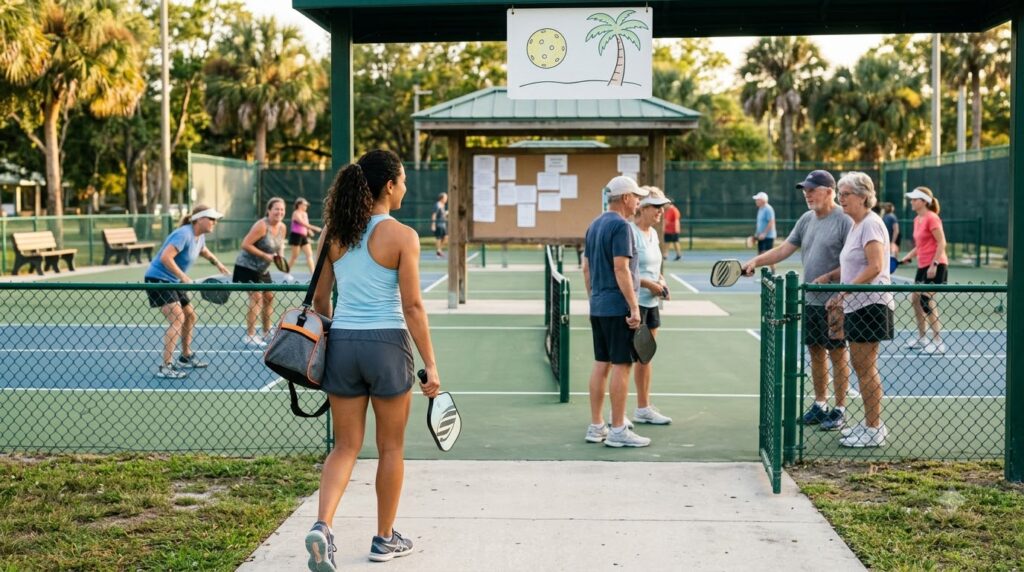
Showing up to pickleball alone can feel strange the first time.
You walk in carrying one paddle, notice players already talking in groups, and immediately wonder whether everyone else arrived with a partner.
That is exactly the kind of problem open play is designed to solve.
If you are heading to pickleball open play in Tampa alone, knowing the rules of the game is only part of it. This guide covers the open play etiquette that makes a first solo visit easier: what to say at check-in, how to follow the rotation, how to ask for closer games without offending anyone, and the habits that make other players want you in their next game.
Quick Answer: Good open play etiquette comes down to a few habits. Tell staff it is your first visit, ask how the rotation works before taking a court, keep track of the score, make fair line calls, communicate with your partner, keep games moving, and avoid coaching strangers unless they ask.
If you still need to choose the right session, check the schedule, or decide what to bring, start with our guide to joining pickleball open play in Tampa without a partner.
Open Play Etiquette at Check-In: What to Say When You Arrive Alone
Your first visit becomes much easier when staff knows immediately why you are there.
At Pickle Social Lounge in Tampa, open play is organized for beginner, intermediate, and advanced players. Arrive with enough time to check in and understand the session before play begins. If this is your first open-play visit, a simple introduction can remove most of the awkwardness:
“Hi, this is my first open-play session here. I registered for the intermediate group and came by myself. Can you show me how today’s rotation works?”
That one sentence tells staff:
- You are new to the venue
- You registered in advance
- You know your chosen level
- You need help entering the current rotation
Open-play systems are not identical at every facility. Do not assume another club’s paddle-stack, queue, timed-round, or court-assignment system automatically applies here.
Ask first. Then follow the system being used for your session.
How to Ask for Competitive Games Without Upsetting Anyone
Getting onto a court is only half the goal.
Most players searching for open play want games that are close enough to be interesting. They do not want to spend an entire session overwhelming beginners or chasing balls against players far beyond their current level.
The easiest starting point is choosing the correct skill session.
After that, let several games develop before deciding the level is wrong.
One bad game tells you very little. You may have had an unfamiliar partner, difficult matchup, slow start, or opponents whose style exposed something unusual in your game.
After a few games, look for patterns.
Signs the Level May Be a Good Fit
You are probably in a productive group when:
- Rallies develop instead of ending immediately
- All four players are involved in points
- You are challenged without being completely overwhelmed
- Positioning and shot selection matter
- Mistakes are punished, but you still have opportunities to recover
- Games are not consistently dominated by the same player
- You need to make adjustments as matches progress
Competitive does not mean every game ends 11-9.
It means your decisions, consistency, positioning, communication, and execution can meaningfully affect the outcome.
What If the Games Feel Mismatched?
Do not tell staff that you “need better players.”
That can easily sound like criticism of the people you just played with.
Instead, make the request about match quality:
“I’m looking for some closer games around my level. Is there another group or session you would recommend?”
That gives staff useful information without turning another player’s ability into the problem.
Make Yourself the Partner People Want in Their Next Game
Skill matters, but open play also has a social memory.
Players remember the person who:
- Keeps track of the score
- Makes fair line calls
- Communicates with a partner
- Is ready when the next game starts
- Shares the court properly
- Handles mistakes without creating tension
- Respects the rotation
- Keeps games moving
- Avoids coaching strangers after every rally
You do not need to become the most entertaining player in the building.
You need to be someone others are comfortable sharing a court with.
That becomes especially valuable when you are trying to build a regular playing network from scratch.
Open Play Etiquette Mistakes Solo Players Should Avoid
Choosing a Level Based on Ego
Entering the highest available group does not automatically create better competition.
If rallies repeatedly end before you can participate meaningfully, the session is not helping you improve simply because the players are stronger.
Choose the level where you can contribute to the game while still being challenged.
Judging the Session After One Match
Do not make a decision based on your first 10 minutes.
Different partners and opponents can completely change the character of a game.
Give the session enough time to reveal whether the mismatch is temporary or consistent.
Assuming You Know the Rotation
Do not move someone’s paddle, jump a queue, take a court, or reorganize players because another facility uses a different system.
Ask staff how that day’s session works.
Treating Open Play Like a Championship Final
Competitive pickleball can be intense without becoming hostile.
Avoid prolonged line-call arguments, blaming partners, visible frustration after every mistake, or turning recreational games into personal confrontations.
You may be trying to win the current game, but you are also playing with people you may see again next week.
Giving Unrequested Lessons
Brief communication with your partner is normal.
Repeatedly analyzing another player’s mechanics after every rally is different.
If someone wants coaching, let them ask.
How Open Play Can Help You Find Regular Partners
You may arrive alone, but you do not have to remain a solo player forever.
Open play creates repeated opportunities to meet people who already play at approximately the same time and level.
After a close game, skip the vague:
“We should play sometime.”
Ask something more useful:
“Do you normally come to this session?”
That question tells you whether your schedules already overlap.
If you repeatedly see the same players at the same session, building a regular group becomes much easier. Eventually, those open-play introductions can lead to private court reservations, tournament partners, practice groups, or simply a reliable list of people to message when you want a game.
Pickleball is social by design, but becoming part of the community usually happens through repeated small interactions rather than one dramatic introduction.
Use Pickle Social Lounge’s Competitive Programs as Your Next Step
Open play is useful for meeting players and getting varied games, but it is not the only competitive option available at Pickle Social Lounge.
The venue also lists:
- Round robins
- Challenge courts
- Ladder play
- Monthly tournaments
Players who enjoy open play but eventually want more structured competition should check which of these formats is currently available.
Round Robins
Round robins can expose you to several opponents during the same event rather than keeping you with one matchup.
Challenge Courts
Challenge-court formats can give players an opportunity to test themselves in a more competitive environment.
Ladder Play
Ladder formats can be useful for players who want recurring competitive matchups and a clearer progression structure.
Tournaments
Tournaments offer another step for players who want to compete in organized singles or doubles formats.
Program schedules can change, so verify current dates, divisions, partner requirements, and registration details before planning around a particular format.
What If You Are Completely New to Pickleball?
Being comfortable attending alone does not necessarily mean you are ready for regular open play.
If you are still learning how scoring works, where to stand, how serving works, or what the non-volley zone is, a beginner-focused instructional option may give you a smoother introduction.
Pickle Social Lounge lists options including:
- Newcomer’s Open House
- Group clinics
- Private lessons
- Beginner open play
A lesson or clinic can help you learn enough structure to enjoy your first open-play session instead of spending every rally trying to understand what is happening.
Once you know the basic rules and can participate safely, beginner open play can become a practical bridge from instruction into regular games.
Frequently Asked Questions
Can I go to pickleball open play in Tampa without knowing anyone?
Yes. Open play is particularly useful for individual players because you do not need to organize your own complete foursome first. Pickle Social Lounge lists open-play sessions for beginner, intermediate, and advanced players.
What should I say when I arrive at open play alone?
Tell staff it is your first open-play session, which level you registered for, that you came by yourself, and ask how that day’s rotation works. That gives staff everything they need to fit you into the session.
How early should I arrive for my first session?
Give yourself enough time to check in, find the correct area, and learn how that session’s rotation works. Arriving shortly before play begins is easier than rushing in after the group has already started.
What happens if I choose the wrong level?
If the pace consistently feels far too fast or too slow, ask staff which current or future session would provide a closer match. Do not switch groups or courts without checking how the session is being managed.
Is it okay to give other players tips during open play?
Brief communication with your partner is normal, but repeatedly analyzing another player’s mechanics after every rally is not. If someone wants coaching, let them ask.
How do I ask for closer games without offending anyone?
Make the request about match quality, not other players’ ability. For example: “I’m looking for some closer games around my level. Is there another group or session you would recommend?”
Can beginners attend open play?
Pickle Social Lounge lists beginner open play as well as newcomer and coaching options. If you do not yet understand basic scoring, serving, court positioning, or safety, starting with instruction may make your first open-play experience easier.
How do I find stronger competition?
Start with the correct level-based session. If the games repeatedly feel mismatched after several rotations, ask staff about a closer group or explore available round robins, challenge courts, ladder play, or tournaments.
Can open play help me find regular pickleball partners?
Yes. Repeated attendance gives you opportunities to meet players who already share your schedule and approximate level. Asking other players which sessions they normally attend can make it easier to build a consistent playing group.
Arrive Solo. Leave With More People to Play.
You do not need a permanent partner, established foursome, or Tampa pickleball group before signing up for open play. What helps most is good etiquette.
Tell staff it is your first visit. Ask how the session is organized. Respect the rotation, keep games moving, and be the kind of partner people are comfortable sharing a court with.
Then play enough games to evaluate the level fairly.
If the matchup feels right, keep returning. If it does not, ask about another level or one of the venue’s more structured competitive formats.
The first visit may begin with one player walking through the door alone.
A few sessions later, you may already know who plays on your nights, who gives you the closest games, and who you want standing beside you in the next doubles match.