
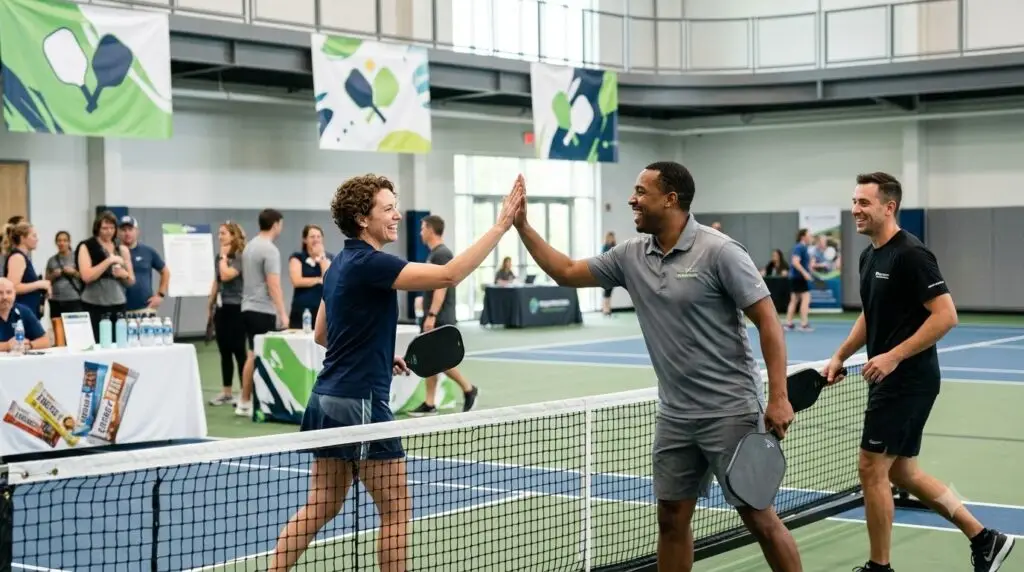
Traditional team-building events often begin with the right goal but use the wrong format.
Employees may attend another catered lunch, conference-room workshop, trivia night, or conversation-based icebreaker while remaining beside the same coworkers they already know. The event technically brings people together, but it does not always create meaningful interaction.
Corporate pickleball events offer a more active alternative.
Pickleball gives employees a shared activity, simple rules, rotating partners, friendly competition, and natural opportunities to talk between games. Beginners can participate with a short introduction, while experienced players can enjoy structured matches or tournament formats.
The sport is also familiar to a growing number of Americans. The Sports & Fitness Industry Association reports that 24.3 million people played pickleball in the United States in 2025, compared with 4.2 million in 2020. That represents more than fivefold growth in five years.
For Tampa companies, Pickle Social Lounge offers customizable packages for team-building days, corporate events, group outings, casual round robins, and mini-tournaments, with equipment, event coordination, food-and-beverage options, catering, music, décor, and lounge time available depending on the selected package.
Quick Answer
Corporate pickleball events work well because they combine:
- An approachable group activity
- Physical movement
- Friendly competition
- Rotating partners
- Cross-department interaction
- Beginner-friendly instruction
- Food, drinks, and social time
- Flexible formats for different company goals
They are a strong option for employee appreciation, department mixers, company celebrations, client events, new-hire activities, and social wellness outings.
Pickleball should not replace formal training, strategic planning, conflict resolution, or professional development. Its role is to create a recreational shared experience, not solve deeper workplace problems.
What Is a Corporate Pickleball Event?
A corporate pickleball event is a company outing organized around pickleball instruction, games, team rotations, and social time.
Depending on the company’s goal, the event may include:
- Beginner instruction
- Casual doubles
- Rotating partners
- Department challenges
- Round-robin play
- Mini-tournaments
- Skill stations
- Food and drinks
- Awards
- Music
- Lounge time
- Client entertainment
A small team may reserve courts and play casual games. A larger company may need multiple courts, an event coordinator, equipment, instructors, structured rotations, food service, and dedicated social space.
Why Pickleball Works for Team Building
1. It Gives Employees Something Natural to Do Together
Conversation can feel easier when people are participating in a shared activity.
During pickleball, employees can:
- Learn the rules together
- Encourage partners
- Rotate between games
- Celebrate good rallies
- Laugh at beginner mistakes
- Talk during breaks
- Interact outside normal workplace roles
The game provides an immediate conversation topic. Employees do not need to manufacture small talk or perform in front of the entire group.
2. Beginners Can Participate Quickly
Corporate groups usually include a mixture of:
- Experienced athletes
- Casual players
- Complete beginners
- Employees returning to physical activity
- People who prefer less competitive recreation
Pickleball’s basic serve, scoring, kitchen rule, and doubles positioning can be introduced during a short beginner session.
That does not mean every employee will immediately play at the same level. Successful events still need balanced teams, simple rules, patient instruction, and appropriate game formats.
3. Partner Rotations Can Mix Departments
Employees often remain with familiar colleagues during company outings.
Pickleball makes it easier to intentionally rotate:
- Departments
- Offices
- Seniority levels
- Remote and in-person employees
- New hires and established staff
- Managers and individual contributors
Partners can change after each short game, allowing employees to interact with several people without turning the event into a formal networking exercise.
4. Friendly Competition Adds Energy
Competition can create excitement when the format remains inclusive.
Possible awards include:
- Tournament champions
- Best team name
- Most improved player
- Best sportsmanship
- Longest rally
- Best comeback
- Most enthusiastic team
The objective should be participation and shared enjoyment, not discovering which department has secretly been training for kitchen-line domination.
5. It Adds Movement to a Screen-Heavy Workweek
Many employees spend a substantial portion of the day sitting or working at screens.
CDC guidance encourages employers to create opportunities that support physical activity. Workplace programs that promote activity can contribute to a healthier workforce when they are designed around employee needs and supported by the broader work environment.
A pickleball outing can provide an active break from the usual work routine. However, one recreational event should not be presented as a complete employee wellness program or a guaranteed way to improve productivity.
6. Social Time Continues After Play
The strongest conversations may happen after employees leave the court.
Food, drinks, seating, music, and lounge time give people space to continue interacting without focusing on scores.
Pickle Social Lounge’s event packages can combine court play with food-and-beverage options, catering, music, themed décor, and lounge time.
Corporate Pickleball vs Traditional Team Building
| Decision Factor | Traditional Workshop | Corporate Pickleball Event |
| Primary format | Discussion or instruction | Shared recreational activity |
| Physical movement | Usually limited | Built into the experience |
| Interaction | Often conversation-led | Happens during play and breaks |
| Beginner participation | Depends on activity | Basic rules can be taught quickly |
| Department mixing | Must be actively facilitated | Can be built into rotations |
| Competition | Limited or artificial | Natural and adjustable |
| Social time | Usually before or after | Integrated throughout |
| Best use | Training, strategy, or education | Recreation, celebration, and connection |
| Main risk | Feels like another meeting | Becomes too competitive or exclusive |
Neither format is universally better.
A workshop is the correct choice when a company needs training, decisions, or structured education. Pickleball is more suitable when the goal is recreation, employee appreciation, social interaction, or celebration.
Best Corporate Pickleball Event Formats
Casual Team Outing
Best for: Small teams and first-time players
Begin with a short rules introduction, followed by relaxed doubles games and social time. Formal scoring is optional.
Beginner Clinic and Social Play
Best for: Groups with little or no pickleball experience
An instructor covers serving, scoring, kitchen rules, positioning, and safety before employees enter organized games.
Department Mixer
Best for: Teams that rarely work together
Employees are paired with people from other departments. Partners rotate after each short game.
Mini-Tournament
Best for: Competitive teams and milestone celebrations
Teams play short round-robin or bracket matches. Beginners and experienced players should be separated or balanced appropriately.
New-Hire Welcome Event
Best for: Onboarding groups
New employees play with people from different departments and leadership levels, creating a less formal introduction to the company community.
Client Appreciation Event
Best for: Sales teams, professional services, real estate, finance, and partnership-based businesses
Clients participate in beginner-friendly games followed by food, drinks, and relaxed conversation.
Wellness Outing
Best for: Companies encouraging active recreation
The focus remains on movement, participation, hydration, and social play rather than rankings or aggressive competition.
Holiday Party Alternative
Best for: Teams looking for something more interactive than dinner alone
Pickleball is combined with food, music, drinks, team awards, or themed décor.
Fundraiser or Charity Tournament
Best for: Community engagement
Employees and guests compete in support of a cause. Ask whether the venue can accommodate sponsorships, fundraising elements, raffles, and the desired tournament structure.
Which Teams Benefit Most?
Corporate pickleball can work particularly well for:
| Team Type | Potential Benefit |
| Remote or hybrid teams | Creates an in-person shared experience |
| Newly formed departments | Helps employees meet through activity |
| Sales teams | Adds friendly competition |
| Technology teams | Breaks up screen-heavy routines |
| Healthcare teams | Provides active social recreation |
| Real estate teams | Works for staff or client events |
| Small businesses | Offers a complete group outing |
| Leadership teams | Creates informal interaction |
| Client-facing teams | Supports hosted relationship building |
| Multi-office companies | Brings different locations together |
The format should be adjusted for the people attending rather than forcing every group into the same tournament structure.
Is Pickleball Suitable for Every Employee?
Not automatically.
A genuinely inclusive event must consider:
- Mobility limitations
- Disabilities
- Previous injuries
- Pregnancy
- Medical restrictions
- Different comfort levels
- Employees who do not drink alcohol
- Employees who prefer not to compete
- Employees who do not wish to participate physically
Participation should be optional and should never affect an employee’s professional evaluation.
Non-playing roles may include:
- Scorekeeper
- Team captain
- Event photographer
- Bracket coordinator
- Announcer
- Music coordinator
- Awards presenter
- Spectator
- Lounge participant
Before booking, ask the venue about accessibility, seating, rest areas, restrooms, playing accommodations, and options for non-playing attendees.
Safety and Comfort Considerations
Pickleball is approachable, but it still involves movement, quick changes of direction, and the possibility of falls or collisions.
A responsible event should include:
- A short warmup
- Proper court shoes
- Beginner instruction
- Clear court boundaries
- Hydration
- Rest periods
- Balanced games
- No pressure to play through discomfort
- Emergency procedures
- Appropriate waivers
- Safe timing for alcoholic beverages
When alcohol is available, organizers should also provide appealing non-alcoholic options. Heavy drinking should not be combined with active court play.
Sample 90-Minute Corporate Event Schedule
This is a planning example, not a fixed Pickle Social Lounge package.
| Time | Activity |
| 0–15 minutes | Arrival, check-in, equipment, and refreshments |
| 15–25 minutes | Rules, safety, and beginner demonstration |
| 25–40 minutes | Guided warmup and practice |
| 40–70 minutes | Rotating doubles or round-robin games |
| 70–80 minutes | Optional final match or team challenge |
| 80–90 minutes | Awards, photograph, and lounge transition |
Sample Two-Hour Event Schedule
| Time | Activity |
| 0–20 minutes | Arrival and welcome refreshments |
| 20–35 minutes | Beginner instruction |
| 35–50 minutes | Practice and skill stations |
| 50–95 minutes | Team rotations or tournament play |
| 95–110 minutes | Final games or novelty challenges |
| 110–120 minutes | Awards and photographs |
| After play | Food, drinks, and lounge time |
Large groups, full tournaments, catering, or extended social time may require a longer booking.
How Much Does a Corporate Pickleball Event Cost?
Pickle Social Lounge promotes custom group and corporate packages but does not publish one fixed corporate-event price on its event page.
The final cost may depend on:
- Day and time
- Number of attendees
- Number of courts
- Event duration
- Private or shared facility use
- Equipment
- Coaching or beginner instruction
- Event coordination
- Food and beverages
- Catering
- Music
- Décor
- Tournament organization
- Prizes
- Taxes, gratuity, or service charges
Request an itemized proposal rather than relying on a general starting price.
Questions to Ask Before Requesting a Quote
Group and Capacity
- How many attendees can the venue accommodate?
- How many courts will our group receive?
- How many employees can play at once?
- Is seating available for non-playing attendees?
- Can the venue accommodate accessibility requirements?
Event Format
- Is beginner instruction included?
- Can the venue organize rotations or a mini-tournament?
- Is a dedicated event coordinator included?
- Can players be grouped by department or skill level?
- Can the format include non-playing roles?
Equipment and Facilities
- Are paddles and balls included?
- Are court shoes required?
- Are changing facilities available?
- Is parking available?
- Are water or hydration stations provided?
Food and Drinks
- Which food-and-beverage packages are available?
- Can dietary restrictions and allergies be accommodated?
- Are non-alcoholic drinks available?
- Is outside food permitted?
- When can food be served?
Pricing and Terms
- What is the complete cost?
- Is a deposit required?
- What is the cancellation or rescheduling policy?
- Are taxes, gratuity, and service fees additional?
- Is overtime charged?
- What happens when the final headcount changes?
Get the complete package and policies in writing before confirming the event.
How to Plan a Corporate Pickleball Event
Step 1: Define One Primary Goal
Choose the main purpose:
- Employee appreciation
- Team interaction
- Client entertainment
- Wellness
- Onboarding
- Department mixing
- Company celebration
- Fundraising
Trying to achieve every objective at once can make the event cluttered.
Step 2: Estimate Attendance
Ask employees whether they plan to:
- Play actively
- Participate casually
- Attend without playing
- Request an accommodation
- Bring an approved guest
Do not assume every invited employee will want to play.
Step 3: Identify Experience Levels
Separate participants broadly into:
- Never played
- Beginner
- Recreational
- Intermediate
- Experienced
This helps the venue recommend the right instruction and rotations.
Step 4: Choose the Event Tone
Decide whether the event should be:
- Casual
- Instructional
- Competitive
- Celebration-focused
- Client-facing
- Wellness-oriented
Step 5: Build an Inclusive Format
Include:
- Beginner instruction
- Short games
- Balanced teams
- Regular rotations
- Breaks
- Non-playing roles
- Food or lounge time
Step 6: Review the Proposal
Confirm:
- Courts
- Staffing
- Equipment
- Food
- Drinks
- Duration
- Accessibility
- Deposit
- Cancellation terms
- Complete pricing
Step 7: Send Clear Instructions
Employees should receive:
- Date and time
- Venue address
- Arrival time
- Clothing and footwear guidance
- Equipment information
- Food and drink details
- Participation expectations
- Parking information
- Accessibility contact
Common Planning Mistakes
Making the Event Too Competitive
Experienced players should not dominate beginners. Use separate divisions, balanced teams, or optional advanced games.
Forgetting Non-Players
Employees with injuries, disabilities, or different preferences should still have meaningful ways to participate.
Skipping Beginner Instruction
A brief rules and safety session can significantly improve the first experience.
Booking Too Little Time
Arrival, equipment, instruction, rotations, breaks, photographs, and food all take time.
Assuming Equipment Is Included
Confirm exactly what paddles, balls, scoring materials, and coaching are part of the package.
Ignoring Dietary Requirements
Collect allergy and dietary information before confirming food service.
Treating the Event as a Guaranteed Culture Fix
An enjoyable outing can create positive interaction. It cannot compensate for poor leadership, excessive workloads, unresolved conflict, or unhealthy workplace practices.
Why Pickle Social Lounge Fits Tampa Corporate Events
Pickle Social Lounge is located at 4417 Northdale Boulevard in Tampa and lists daily hours from 7:00 a.m. to 9:00 p.m.
Its official event offering includes:
- Corporate events
- Team-building days
- Group outings
- Private parties
- Casual round robins
- Mini-tournaments
- Equipment
- Event coordination
- Food-and-beverage options
- Catering
- Music
- Themed décor
- Lounge time
- Flexible formats for different group sizes
Because packages are customized, companies should provide their preferred date, headcount, experience levels, accessibility needs, food requirements, and primary event goal when requesting a proposal.
Frequently Asked Questions
What is a corporate pickleball event?
It is a company outing that combines pickleball instruction or games with team interaction, social time, and optional food, drinks, music, or competition.
Are corporate pickleball events suitable for beginners?
Yes, when the event includes beginner instruction, short games, balanced teams, and a low-pressure format.
Can employees attend without playing?
They should be able to. Possible roles include scorekeeper, captain, photographer, announcer, awards presenter, spectator, or lounge participant.
Can pickleball work for a large corporate group?
Yes, but the appropriate format depends on the number of courts, event duration, rotation structure, facility capacity, and number of playing and non-playing attendees.
How long should a corporate pickleball event last?
A small casual outing may work in 60 to 90 minutes. Larger groups, beginner instruction, tournaments, catering, and lounge time may require two hours or longer.
Does Pickle Social Lounge provide equipment?
Its event page says group packages can include courts, equipment, and a customized format. Confirm the exact equipment included in the written proposal.
Does Pickle Social Lounge offer food and drinks?
Yes. Its event page lists food-and-beverage options, catering, and lounge time. Menu choices and dietary accommodations should be confirmed for the specific event.
Can Pickle Social Lounge organize a tournament?
The venue says events can be customized from casual round-robin play to mini-tournaments.
How much does a corporate event cost?
The website does not publish one fixed corporate-event rate. Pricing depends on the selected courts, duration, group size, food, entertainment, staffing, and add-ons.
Can a pickleball outing improve teamwork?
It can create opportunities for communication, shared experiences, and cross-team interaction. It cannot guarantee lasting teamwork or solve structural workplace problems by itself.
Give Your Team a Shared Experience
A corporate outing becomes more engaging when employees have something to do together rather than another agenda to sit through.
Pickleball provides movement, beginner participation, friendly competition, partner rotations, and natural opportunities for conversation. With thoughtful planning, it can work as an employee celebration, department mixer, wellness outing, client event, holiday gathering, or company off-site.
Pickle Social Lounge offers customizable Tampa corporate packages combining pickleball, event coordination, equipment, food, drinks, music, and lounge time.
Contact the event team with your preferred date, estimated headcount, company goal, experience levels, accessibility needs, and food requirements to request a customized proposal.