
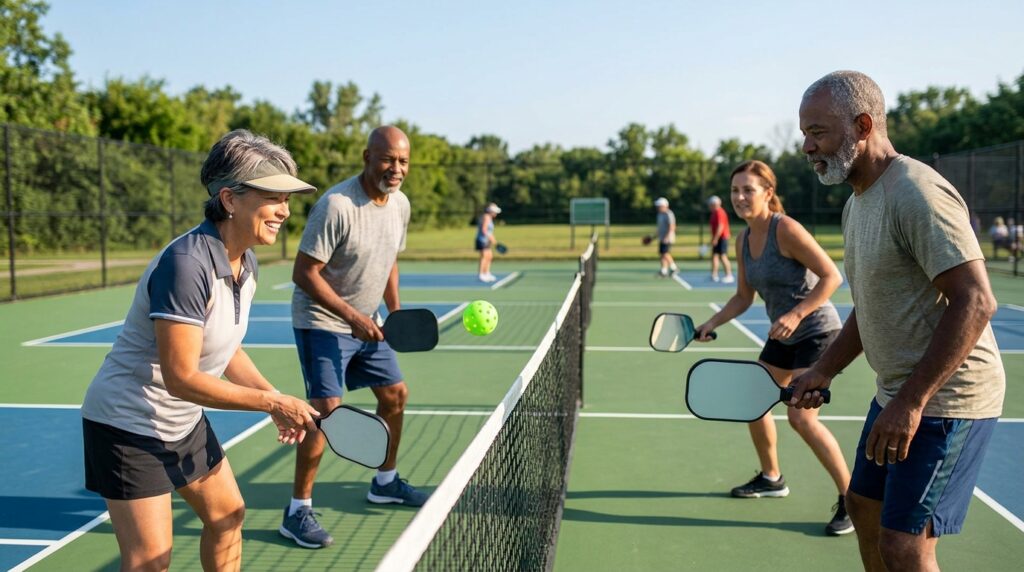
Finding an activity after 40 is not difficult. Finding one that is enjoyable, social, challenging, and realistic enough to continue is the harder part.
Pickleball appeals to many adults because it combines movement, strategy, friendly competition, and community without requiring years of training before a beginner can participate.
The sport is played indoors or outdoors on a badminton-sized court using a paddle, a perforated plastic ball, an underhand serve, and a non-volley zone commonly called the kitchen. It can be played as singles or doubles, although doubles is often the more social and manageable starting format.
For adults over 40, pickleball may support:
- Aerobic activity
- Balance and coordination
- Lower-body movement
- Hand-eye coordination
- Strategic thinking
- Social connection
- Stress management
- Motivation to exercise consistently
It should not be described as risk-free or as a replacement for strength training. Pickleball injuries, particularly falls, fractures, sprains, and upper-extremity injuries, occur disproportionately among older players. Preparation, appropriate footwear, gradual progression, strength work, and recovery remain important.
At Pickle Social Lounge in Northdale, Tampa, adults can start through beginner-friendly open play, clinics, private coaching, court reservations, leagues, and social events in an indoor setting.
Is Pickleball Good Exercise After 40?
Pickleball can be a useful form of physical activity after 40 because it combines continuous movement with short bursts of quicker effort, balance adjustments, paddle control, and social interaction.
Its greatest advantage is often not that it is the hardest workout. It is that many players enjoy it enough to return consistently.
Adults should still aim for a balanced weekly activity plan. Current U.S. physical activity guidance recommends at least 150 to 300 minutes of moderate-intensity aerobic activity each week, along with muscle-strengthening activity involving all major muscle groups on at least two days.
Pickleball may contribute toward aerobic activity, but players should also include strength, mobility, balance, and recovery according to their abilities.
Why Pickleball Has Become So Popular
Pickleball is no longer a small recreational niche.
The Sports & Fitness Industry Association reported that approximately 24.3 million Americans played pickleball in 2025, compared with 4.2 million in 2020. That represents growth of more than fivefold in five years.
Its appeal crosses age groups because the sport offers:
- Rules that beginners can understand relatively quickly
- Shorter court dimensions than tennis
- Casual and competitive formats
- Singles and doubles play
- Indoor and outdoor options
- Social open-play environments
- Opportunities for continued skill development
The basics may be accessible, but the strategy remains deep enough to keep experienced players engaged through shot placement, positioning, partner communication, pace changes, and decision-making.
1. Pickleball Makes Physical Activity More Enjoyable
Many adults understand that they should exercise but struggle to remain interested in repetitive routines.
Pickleball gives movement an immediate purpose. Instead of watching a timer, players focus on:
- Returning the ball
- Moving into position
- Communicating with a partner
- Reading an opponent
- Controlling shot placement
- Winning the next rally
Enjoyment matters because consistency produces more value than an intense routine that disappears after three weeks.
CDC guidance notes that social support systems, activity groups, and shared-interest communities can help people begin, maintain, or increase physical activity.
Pickleball naturally combines these elements. A scheduled game or open-play session creates both an activity commitment and a social reason to attend.
2. It Can Contribute to Cardiovascular Activity
Pickleball involves repeated court movement, including:
- Walking
- Lateral shuffling
- Short forward movements
- Controlled stops
- Reaching
- Brief bursts of faster effort
The actual intensity depends on the player, match format, rally length, skill level, and rest between games.
Some sessions may provide moderate-intensity activity, while slower recreational games may contribute less. Players can use the talk test as a simple guide: during moderate activity, breathing is elevated, but speaking in short sentences remains possible.
Regular physical activity supports heart health and can help reduce the risk of several chronic conditions. It may also support sleep, mood, cognition, and healthy weight management.
Pickleball should therefore be viewed as one possible part of an active lifestyle, not as a guaranteed treatment or complete fitness program.
3. The Smaller Court Can Make the Game More Approachable
A standard pickleball court is smaller than a tennis court, and doubles play divides court coverage between two partners. This can make the sport feel more approachable for adults who do not want the longer running demands of full-court tennis.
However, “smaller court” does not mean “no physical demand.”
Pickleball still requires:
- Sudden direction changes
- Short acceleration
- Lunging
- Rotational movement
- Reaching
- Quick reactions
- Controlled deceleration
Players may underestimate these demands because the court looks compact. That false confidence can lead someone who has been inactive for years to begin at tournament speed during the first session.
A more sustainable approach is to start with short games, take breaks, and gradually increase playing duration.
4. Pickleball Challenges Balance and Coordination
During a rally, a player must track the ball, judge its speed, position the body, control the paddle, and recover for the next shot.
These actions require coordination between vision, movement, timing, and decision-making.
Pickleball may provide opportunities to practice:
- Hand-eye coordination
- Court awareness
- Weight shifting
- Direction changes
- Reaction speed
- Partner positioning
Balance becomes increasingly important with age. CDC guidance recommends that older adults combine aerobic activity with muscle-strengthening and balance-focused activity to support physical function and reduce fall risk.
Pickleball itself should not be the only balance-training strategy. Players can also include exercises such as supported single-leg standing, heel-to-toe walking, step-ups, and controlled lateral stepping.
5. It Encourages Social Connection
One of pickleball’s strongest benefits may occur between rallies.
Open play, doubles games, clinics, and leagues create opportunities to meet people through a shared activity. Players rotate partners, learn names, discuss games, and gradually become part of a recurring community.
Social connection is associated with better health and well-being, stronger stress management, healthier habits, and lower risks of loneliness, depression, and anxiety. Joining a group organized around a shared interest can also support a sense of belonging.
For adults whose social circles have changed because of remote work, relocation, caregiving, retirement transitions, or family responsibilities, pickleball can provide regular contact without requiring awkward forced networking.
The conversation already has a ball to bounce around.
6. It Can Support Mood and Stress Management
Physical activity can provide immediate and long-term mental health benefits.
CDC guidance states that physical activity can help reduce short-term anxiety and support emotional balance, cognition, memory, and a lower risk of depression.
Pickleball adds several elements that may make activity mentally refreshing:
- Attention to the current rally
- Strategic decisions
- Friendly competition
- Social interaction
- Visible skill improvement
- Time away from routine responsibilities
It would be inaccurate to claim that pickleball treats anxiety, depression, or chronic stress by itself. Players experiencing persistent mental health symptoms should seek appropriate professional support.
The game can still provide a structured break in which attention shifts from emails, deadlines, and household responsibilities to one suspiciously bouncy plastic ball.
7. Beginners Can Participate Without Mastering Every Skill
Pickleball has enough simple foundational elements for a beginner to start rallying during an introductory session.
A new player primarily needs to learn:
- Basic paddle grip
- Underhand serving
- Simple scoring
- The two-bounce rule
- The non-volley zone
- Ready position
- Basic court safety
- Partner communication
Mastering the sport takes considerably longer.
Experienced players continue developing:
- Dinks
- Drops
- Drives
- Resets
- Volleys
- Serves and returns
- Court positioning
- Shot selection
- Partner strategy
This balance between early accessibility and long-term challenge can keep adults engaged after the novelty of the first session fades.
Pickle Social Lounge offers beginner-focused open play as well as clinics and skills sessions covering serving, scoring, positioning, and basic strategy.
8. Progress Creates Motivation
Adults do not always need formal competition to experience achievement.
Progress may look like:
- Serving consistently
- Learning the score
- Completing a longer rally
- Reaching the kitchen line safely
- Improving a backhand
- Communicating better with a partner
- Joining open play confidently
- Entering a first league
These milestones create feedback that a conventional workout may not provide as clearly.
Skill development also keeps the activity mentally engaging. Players must identify patterns, choose shots, anticipate opponents, and adjust strategy.
The body moves, but the brain does not receive the afternoon off.
Is Pickleball Really Low Impact?
Pickleball is frequently described as a low-impact sport, but that phrase needs context.
Compared with sports involving sustained running, frequent jumping, or full-field movement, recreational doubles pickleball may feel more manageable for many adults.
However, the sport still includes sudden stopping, reaching, lunging, rotation, and fall risk.
Research on emergency-department visits shows that older adults account for a substantial share of pickleball injuries. Falls are a major injury mechanism, and players aged 60 to 79 have shown higher odds of fractures and wrist or hand injuries in recent analyses.
A more accurate description is:
Pickleball can be an approachable and adaptable activity, but it is not automatically gentle or safe for every person.
Risk can be reduced by:
- Warming up
- Wearing court-specific footwear
- Building playing time gradually
- Learning safe footwork
- Avoiding uncontrolled backward running
- Taking rest days
- Strengthening the legs and core
- Stopping when pain changes normal movement
Pickleball Is Not a Complete Exercise Program
Pickleball can contribute aerobic movement, coordination, and social activity, but it may not provide enough resistance training for every major muscle group.
Adults should also consider:
- Leg and hip strengthening
- Upper-back and shoulder strengthening
- Core stability
- Calf strength
- Balance exercises
- Mobility work
- Rest and recovery
Public health guidance recommends muscle-strengthening activity on at least two days per week in addition to aerobic exercise.
A balanced plan might include two or three pickleball sessions, one or two strength sessions, mobility work, and appropriate recovery rather than playing hard every day.
Who Should Speak With a Healthcare Professional Before Starting?
Medical clearance may be appropriate for someone who has:
- Recent surgery
- Uncontrolled heart or blood-pressure concerns
- Chest pain
- Frequent dizziness
- A recent fall
- Significant balance difficulty
- Severe joint pain
- An unresolved injury
- New shortness of breath
- Movement restrictions
- A condition affected by exercise
Stop playing and seek prompt medical attention for chest pressure, fainting, severe breathing difficulty, sudden weakness, confusion, a suspected fracture, significant head impact, or inability to bear weight.
A Beginner-Friendly Place to Start in Tampa
Pickle Social Lounge provides indoor pickleball in Northdale, Tampa, with:
- Open play
- Court reservations
- Beginner clinics
- Skills sessions
- Private coaching
- Leagues
- Tournaments
- Social events
- Food and lounge space
Its beginner programs give new players a structured way to learn rules, scoring, positioning, and basic technique before entering faster games.
For adults over 40, that gradual entry can be more useful than buying a paddle and immediately joining the fastest game on the court.
The best starting point is not proving how athletic you still are.
It is finding a pace that allows you to return next week.
How Adults Over 40 Can Start Pickleball Safely and Sustainably
Pickleball becomes most beneficial when it is played consistently, not when an enthusiastic beginner plays for three hours on the first day and spends the following week negotiating with every muscle.
Adults over 40 should begin with a balanced approach that combines:
- Gradual court time
- A proper warm-up
- Strength and balance training
- Suitable court footwear
- Recovery between sessions
- Instruction appropriate to their skill level
Pickleball can contribute to weekly aerobic activity, but public-health guidance also recommends muscle-strengthening work on at least two days per week. Balance-focused activity becomes increasingly important with age.
Can Pickleball Help With Weight Management?
Pickleball can support weight management because it adds regular physical activity to the week. The amount of energy used varies according to playing time, intensity, singles or doubles format, rally length, and rest between games.
It should not be marketed as a guaranteed weight-loss method.
Long-term weight management usually depends on a combination of physical activity, eating habits, sleep, stress, medical factors, and consistency. The National Institute of Diabetes and Digestive and Kidney Diseases recommends combining regular activity with a healthy eating plan rather than relying on exercise alone.
Pickleball may be especially helpful for adults who struggle to remain consistent with conventional workouts. A scheduled game, clinic, or open-play session provides both movement and a social commitment.
For sustainable progress:
- Begin with manageable sessions.
- Avoid using exercise as permission to overeat afterward.
- Include regular strength training.
- Drink water before, during, and after play.
- Track energy, mobility, and consistency rather than only body weight.
- Speak with a qualified professional when weight management involves diabetes, heart disease, medication, or another medical condition.
Why Strength Training Still Matters
Pickleball uses the legs, hips, core, shoulders, arms, and forearms, but playing alone may not strengthen every major muscle group adequately.
Strength training can help players develop the physical capacity needed to:
- Lower into an athletic stance
- Push off in different directions
- Stop with better control
- Recover from lunges
- Maintain posture
- Stabilize the shoulders
- Control the paddle
- Tolerate longer playing sessions
Federal guidance recommends strengthening all major muscle groups on at least two days per week. Strength sessions should be separated when possible so the same muscles have time to recover.
A Simple Strength Routine for Pickleball Players Over 40
Complete the following routine one or two times per week on nonconsecutive days.
Beginners can start with one set of each exercise. Add a second set only when the first set can be completed with controlled form and without joint pain.
| Exercise | Suggested Repetitions | Main Purpose |
|---|---|---|
| Chair sit-to-stand | 8-12 | Leg and hip strength |
| Low step-up | 6-10 per side | Single-leg control |
| Calf raise | 10-15 | Push-off and ankle support |
| Supported split squat | 6-8 per side | Lunge strength |
| Glute bridge | 8-12 | Hip and trunk support |
| Resistance-band row | 10-15 | Upper-back strength |
| Band shoulder rotation | 8-12 per side | Shoulder control |
| Bird dog or standing core press | 6-10 per side | Core stability |
Strength-Training Rules
- Use a stable chair, wall, or railing for support.
- Move slowly enough to maintain control.
- Stop when an exercise causes sharp pain.
- Do not hold your breath.
- Begin with body weight or light resistance.
- Avoid exhausting the legs immediately before an important game.
- Increase repetitions or resistance gradually, not simultaneously.
People with osteoporosis, recent surgery, uncontrolled blood pressure, joint replacements, significant balance problems, or other medical concerns may need individualized exercise guidance.
Mobility Areas Pickleball Players Should Maintain
Mobility allows a player to reach, rotate, lower the body, and change direction without forcing movement through one vulnerable joint.
The most relevant areas include:
- Ankles
- Calves
- Hips
- Hamstrings
- Upper back
- Shoulders
- Wrists and forearms
A short mobility routine can be performed two or three times per week.
Five-Minute Mobility Routine
- Ankle rocks: 8 repetitions per side
- Supported leg swings: 8 per direction
- Standing torso rotations: 8 per side
- Shoulder circles: 10 forward and backward
- Gentle wrist movements: 10 per direction
Mobility work should feel controlled. Forcing a larger range is not automatically better.
Persistent joint pain, swelling, locking, instability, or reduced movement should be assessed instead of repeatedly stretched.
Balance Training Should Not Be Ignored
Pickleball requires players to shift weight, react to the ball, move laterally, stop quickly, and recover after reaching.
These demands challenge balance, but playing pickleball is not a complete balance-training program. CDC guidance recommends combining aerobic, strengthening, and balance-focused activity, particularly for older adults.
Useful balance exercises include:
- Standing with one foot slightly ahead of the other
- Heel-to-toe walking
- Supported single-leg standing
- Lateral stepping and pausing
- Controlled sit-to-stand movements
- Slow direction changes
Perform these exercises beside a stable wall or counter when additional support is needed.
How Often Should Adults Over 40 Play Pickleball?
There is no universal playing frequency that is right for every adult over 40.
A suitable schedule depends on:
- Current fitness
- Previous sports experience
- Match intensity
- Session duration
- Injury history
- Sleep quality
- Strength training
- Work and family demands
- Recovery between sessions
Beginner Schedule
A new player can often begin with:
- One or two pickleball sessions per week
- One or two strength sessions
- Light walking or mobility work on other days
- At least one complete rest day
Recreational Player Schedule
After adapting to the game, a recreational player may use:
- Two or three pickleball sessions
- Two strength sessions
- One mobility or balance session
- One or more lighter recovery days
These are planning examples, not medical prescriptions.
The most important rule is to increase workload gradually. Do not increase playing frequency, session duration, game intensity, and tournament participation during the same week.
Signs That More Recovery Is Needed
Reduce activity or take additional rest when:
- Soreness does not improve after warming up
- Joint pain appears earlier in each session
- Normal walking changes
- Grip strength feels weaker
- Sleep becomes disrupted
- Fatigue affects daily activities
- Movement becomes slower or less controlled
- Performance declines across several sessions
- Motivation drops because the body feels constantly tired
Rest is not a pause in progress. It is where the body catches up with the calendar.
Essential Injury-Prevention Habits
Pickleball is approachable, but it still involves lateral movement, reaching, sudden stops, rotation, and fall risk.
USA Pickleball recommends court shoes that support side-to-side movement and notes that ordinary running shoes may not provide the same lateral support. It also recommends hydration, appropriate warm-up and cool-down habits, and eye protection.
Before every session:
- Walk or move lightly for several minutes.
- Mobilize the ankles, hips, shoulders, and wrists.
- Practice controlled lateral steps.
- Begin with gentle dinks and volleys.
- Increase speed gradually.
During play:
- Communicate with your partner.
- Stop when a loose ball enters the court.
- Avoid uncontrolled backward running.
- Move the feet instead of repeatedly overreaching.
- Take hydration and rest breaks.
- Do not continue through sharp or worsening pain.
After play:
- Walk slowly for several minutes.
- Stretch tight areas gently.
- Replace fluids.
- Allow adequate recovery before another demanding session.
When Should a Player Stop?
Stop playing and seek appropriate assistance when symptoms include:
- Chest pain or pressure
- Faintness
- Severe shortness of breath
- Sudden weakness
- Confusion
- A serious head impact
- Inability to bear weight
- Visible joint deformity
- Sharp pain accompanied by a pop
- New numbness or tingling
- Significant swelling
Recurring pain that changes normal movement should be evaluated rather than hidden with pain medication, aggressive stretching, or a heroic commitment to finishing one more game.
Beginner Pickleball Equipment: What Do You Actually Need?
Starting pickleball does not require a warehouse of equipment.
Pickleball Paddle
A beginner paddle should feel comfortable and controllable.
Consider:
- Comfortable grip size
- Manageable weight
- Secure grip surface
- Balanced feel
- Compliance with venue or competition requirements
Beginners do not need the most expensive paddle. Technique and consistency will influence early progress more than premium paddle mythology.
Court Shoes
Choose footwear designed for multidirectional court movement.
Look for:
- Lateral stability
- Secure heel fit
- Suitable traction
- Comfortable cushioning
- Adequate toe space
- Secure laces
USA Pickleball specifically recommends court shoes over general running shoes for pickleball’s side-to-side movement.
Comfortable Clothing
Wear clothing that allows:
- Easy movement
- Comfortable bending
- Temperature control
- Safe footwork
Avoid loose items that could catch on equipment or interfere with movement.
Eye Protection
Protective sports eyewear is worth considering because pickleballs and paddles can move quickly at close range. USA Pickleball recommends eye protection for players.
Water and Personal Supplies
Bring:
- Water
- A small towel
- Required medication
- Any medically recommended support equipment
- A light snack for longer sessions when appropriate
Confirm whether the facility provides paddles and balls before buying equipment solely for a first session.
What Should Your First Pickleball Session Look Like?
A first session should build familiarity, not test maximum endurance.
Before Arriving
- Wear secure court shoes.
- Eat a normal meal or snack appropriate for you.
- Bring water.
- Arrive early enough to check in and warm up.
- Tell the instructor that you are new.
- Mention relevant movement limitations privately.
During the Introduction
Learn:
- Paddle grip
- Underhand serve
- Basic scoring
- The two-bounce rule
- The non-volley zone
- Ready position
- Partner communication
- Loose-ball safety
USA Pickleball’s official beginner guidance covers singles and doubles formats, serving order, scoring, and foundational gameplay.
During Play
- Use controlled strokes.
- Focus on keeping the ball in play.
- Avoid chasing every difficult shot.
- Take breaks before becoming exhausted.
- Ask questions.
- Treat mistakes as information.
After the Session
Review:
- Which movements felt comfortable
- Whether any joint became painful
- How long the session lasted
- How the body feels later that day
- Whether the next session should be similar, shorter, or slightly longer
Do not judge the sport entirely by the scoreboard from the first session.
Beginner Clinic, Private Lesson, or Open Play?
Choose a Beginner Clinic When:
- You want structured group instruction.
- You are learning with friends.
- You prefer a lower-cost shared format.
- You want to meet other beginners.
Choose Private Coaching When:
- You want individualized feedback.
- You have a specific movement concern.
- You feel uncomfortable learning in a larger group.
- You want to correct technique early.
Choose Open Play When:
- You understand basic rules and scoring.
- You can serve and maintain a short rally.
- You are comfortable rotating partners.
- The session matches your skill level.
Pickle Social Lounge currently offers indoor court reservations, open play, group clinics, private coaching, leagues, tournaments, and social programming in Northdale, Tampa.
A beginner clinic or introductory lesson is usually a smoother starting point than entering fast open play without understanding scoring, positioning, or court etiquette.
A Practical First-Month Plan
| Week | Suggested Focus |
| Week 1 | Beginner lesson and short practice |
| Week 2 | Second lesson or beginner-friendly play |
| Week 3 | Add one short strength session |
| Week 4 | Try suitable open play or reserve a court with friends |
Progress should be based on how well the body recovers, not on pressure to keep pace with more experienced players.
Starting Pickleball at Pickle Social Lounge
Pickle Social Lounge provides an indoor setting where Tampa-area adults can learn, practice, and progress through:
- Beginner clinics
- Skills sessions
- Private coaching
- Open play
- Court reservations
- Leagues
- Tournaments
- Social events
The venue is located at 4417 Northdale Boulevard, Tampa, Florida 33624, and currently operates from 7:00 a.m. to 9:00 p.m. daily. Program schedules and availability should be confirmed before visiting.
Adults over 40 do not need to arrive in peak athletic condition.
They need an appropriate starting level, a willingness to learn, and a plan that leaves enough energy to return.
Pickleball vs. Tennis, Walking, and Gym Workouts After 40
Pickleball is not automatically the best exercise for every adult over 40. The right activity depends on fitness, joint health, goals, experience, recovery capacity, and personal enjoyment.
Its biggest strength is that it combines movement, skill development, competition, and social interaction in one activity.
Pickleball vs. Tennis
Pickleball generally uses a smaller court, a lighter ball, an underhand serve, and shorter movement distances than tennis. Doubles play also divides court coverage between two partners.
These characteristics may make pickleball more approachable for adults who:
- Have not played a sport recently
- Prefer shorter movement distances
- Want a simpler introduction
- Enjoy doubles and social play
- Find full-court tennis physically demanding
However, pickleball still involves rapid stops, lunges, rotation, lateral movement, and fall risk. It should not be treated as an effortless or injury-proof version of tennis.
Tennis may be a stronger fit for someone who already enjoys it, tolerates the larger court, and wants longer rallies or greater running demands. Pickleball may be a better starting point for someone who values accessibility and quicker entry into recreational games.
The better sport is the one a person can play safely, recover from, and enjoy consistently.
Pickleball vs. Walking
Walking is generally easier to control, requires little equipment, and can be performed at an individual pace. It is useful for building baseline activity and can complement pickleball well.
Pickleball adds:
- Direction changes
- Hand-eye coordination
- Strategic decisions
- Partner communication
- Faster bursts of movement
- Greater social interaction
Walking may be more appropriate during recovery days, for people beginning from a low activity level, or when court movement is not yet comfortable.
These activities do not need to compete. A sustainable weekly plan may include pickleball on selected days and walking between sessions.
Pickleball vs. Gym Workouts
Pickleball can contribute aerobic activity and muscular endurance, but it usually does not provide a complete strength-training stimulus for every major muscle group.
Federal physical activity guidance recommends that adults combine at least 150 minutes of moderate-intensity aerobic activity each week with muscle-strengthening activity on at least two days.
Gym or home strength workouts can help address areas that pickleball may not strengthen adequately, including:
- Glutes
- Hamstrings
- Calves
- Upper back
- Shoulder stabilizers
- Core
- Grip and forearms
For many adults over 40, the strongest approach is not choosing pickleball instead of strength training. It is using pickleball for enjoyable movement and adding short strength sessions to support court performance and long-term function.
Which Activity Is Best for Your Goal?
| Primary Goal | Activity That May Fit |
|---|---|
| Easy entry into regular movement | Walking or beginner pickleball |
| Social exercise | Pickleball |
| Full-body strength development | Resistance training |
| Higher running demand | Tennis or singles pickleball |
| Balance and coordination practice | Pickleball plus dedicated balance exercises |
| Low-intensity recovery | Walking or gentle mobility |
| Skill-based competition | Pickleball or tennis |
| Sustainable overall fitness | A combination of aerobic, strength, balance, and mobility work |
No single activity needs to carry the entire fitness suitcase.
Common Pickleball Injuries After 40
Adults over 40 may bring previous injuries, reduced conditioning, joint stiffness, or years of inconsistent activity into their first session.
Problems often arise when enthusiasm increases faster than physical capacity.
Falls and Fractures
Falls are among the most important pickleball injury concerns, particularly for older players.
They may occur when a player:
- Runs backward for a lob
- Reaches beyond a stable base
- Crosses the feet while moving sideways
- Steps on a loose ball
- Collides with a partner
- Changes direction without control
- Plays in unsuitable footwear
Reduce risk by keeping the court clear, communicating with partners, building balance and leg strength, and allowing an unsafe ball to go.
Knee Pain
Repeated lunging, stopping, and low court positions can irritate the knees.
Common contributing factors include:
- Rapid increases in playing time
- Weak hips or thighs
- Poorly controlled lunges
- Worn footwear
- Limited ankle mobility
- Playing through swelling
Stop playing when the knee locks, gives way, swells, or changes normal walking.
Achilles Tendon and Calf Problems
The calves and Achilles tendons help with pushing off, split steps, and sudden acceleration.
Risk may increase when an inactive player begins with fast games, repeated jumping, or several long sessions without gradual preparation.
Warm up progressively, strengthen the calves, and increase weekly playing time slowly.
A sudden pop, severe pain, or inability to push off requires prompt medical assessment.
Shoulder and Elbow Pain
Repeated serves, drives, volleys, and overheads can affect the shoulder, elbow, wrist, and forearm.
Possible contributing factors include:
- Gripping the paddle tightly
- Oversized swings
- Late ball contact
- Repeated overhead shots
- Weak upper-back and shoulder muscles
- Excessive playing volume
- Poor paddle fit or grip size
Coaching may help identify inefficient technique. Persistent weakness, night pain, numbness, swelling, or loss of movement should not be treated as ordinary soreness.
Lower-Back Discomfort
Remaining bent for long periods, reaching repeatedly, or rotating mainly through the lower back can cause discomfort.
Players should:
- Bend through the hips and knees
- Return to a neutral posture between rallies
- Build hip and core strength
- Avoid off-balance reaching
- Prepare the hips and upper back before playing
Pain accompanied by leg weakness, numbness, or bladder or bowel changes requires urgent medical attention.
Normal Soreness or Possible Injury?
| Ordinary Post-Activity Soreness | Possible Injury Warning |
| General muscle aching | Sharp or sudden pain |
| Improves with gentle movement | Worsens during normal activity |
| Appears after unfamiliar activity | Begins during a specific movement |
| No major swelling | Swelling or bruising |
| Normal walking remains possible | Limping or inability to bear weight |
| Gradually improves | Persists or becomes worse |
Warm-ups and recovery habits can reduce avoidable problems, but they cannot guarantee injury prevention.
Choosing the Right Pickleball Program After 40
The wrong playing environment can make a beginner feel rushed, confused, or physically overwhelmed.
Choose the program according to current ability, not the level you hope to reach eventually.
Beginner Clinic
A beginner clinic is usually the best starting point when you:
- Have never played
- Do not understand scoring
- Need help with the kitchen rule
- Want structured instruction
- Prefer learning with other beginners
- Feel nervous about entering open play
A good beginner clinic should teach basic rules, serving, positioning, safety, and simple rally skills.
Pickle Social Lounge offers clinics and skills sessions covering beginner fundamentals such as serving, scoring, positioning, and basic strategy.
Private Coaching
Private instruction may be useful when you:
- Want individualized feedback
- Have difficulty with one movement or stroke
- Prefer learning without a group
- Want to correct technique early
- Are returning after an injury
- Have progressed beyond general beginner instruction
A coach can adjust drills, pace, and feedback to the player rather than dividing attention across a full class.
Beginner-Friendly Open Play
Open play may be appropriate when you can:
- Serve the ball in consistently
- Understand basic scoring
- Maintain a short rally
- Recognize the non-volley zone
- Rotate partners comfortably
- Move safely around other players
Pickle Social Lounge currently offers designated open-play sessions, including beginner-friendly opportunities, group clinics, and private coaching.
Check the session’s stated skill level before attending. Fast or advanced open play is rarely the best laboratory for learning where to stand.
Court Reservation With Friends
Reserving a court can work well when:
- You want to learn privately
- Several friends are beginning together
- You prefer a flexible pace
- You want extra practice after a clinic
- Competitive open play feels intimidating
At least one participant should understand the basic rules and safety expectations, or the group should schedule instruction first.
League Play
A recreational league may be appropriate when you:
- Understand scoring and positioning
- Can sustain regular games
- Want scheduled weekly play
- Enjoy consistent competition
- Recover comfortably between sessions
Choose a league aligned with your actual level. A league should provide a challenge, not weekly evidence that optimism is not a rating system.
Tournament Play
Consider tournaments only after you can:
- Complete several games safely
- Manage scoring independently
- Recover between matches
- Maintain movement quality when tired
- Understand common rules
- Handle competitive pressure constructively
Pickle Social Lounge offers open play, clinics, coaching, leagues, tournaments, and court reservations for different levels of participation.
What If You Feel Nervous Joining Pickleball After 40?
Many adults hesitate because they believe everyone else will be younger, fitter, or more experienced.
That concern is common, but beginners do not need to arrive with athletic credentials.
Start in a Beginner-Specific Setting
A beginner clinic reduces uncertainty because other participants are also learning.
You will not be the only person asking:
- Which side serves?
- What is the kitchen?
- Who calls the score?
- Why did the serve change sides?
- Was that ball actually out?
Attend With a Friend
Joining with a friend can make check-in and early practice feel more comfortable.
Avoid playing only with that person forever. Rotating partners is one of the easiest ways to build confidence and become part of the community.
Tell the Instructor You Are New
A coach or facilitator cannot adjust instruction if you quietly pretend to understand everything.
Mention relevant concerns privately, such as:
- Balance difficulty
- Previous injury
- Limited mobility
- Anxiety about group play
- Uncertainty about scoring
Focus on One Goal Per Session
Useful early goals include:
- Serving consistently
- Learning the score
- Reaching the kitchen safely
- Keeping five balls in play
- Communicating with a partner
- Finishing without pain
Winning is not the only evidence that learning occurred.
Use the Social Side of the Sport
Social connection can support well-being, stress management, sleep, and continued physical activity.
Arrive early, introduce yourself, ask how rotations work, and stay briefly after play. Familiarity builds through repeated small interactions rather than one grand entrance.
What Does It Cost to Start Playing Pickleball?
Pickleball can be relatively affordable, but the total cost depends on equipment, court access, instruction, and frequency.
Basic Equipment Costs
A beginner may need:
- A paddle
- Court shoes
- Comfortable athletic clothing
- Protective eyewear
- Water bottle
- Optional bag or grip replacements
Many facilities provide or rent paddles for introductory sessions. Confirm equipment availability before buying.
Do not purchase an expensive paddle before learning which weight, grip, and shape feel comfortable.
Court and Open-Play Costs
Costs may include:
- Per-person open-play fees
- Hourly court reservations
- Clinic fees
- Private coaching
- League registration
- Tournament entry
- Membership or visit packages
Pickle Social Lounge currently lists evening open play at $8 per player for a three-hour session and a five-session pack for $32. Prices and schedules may change, so confirm them before visiting.
Is Coaching Worth the Cost?
Beginner instruction may save time by helping players understand:
- Scoring
- Court position
- Safe movement
- Paddle technique
- Partner communication
- Basic strategy
Private coaching costs more than a group clinic but provides individualized attention.
A practical progression is:
- Beginner clinic
- Practice with friends
- Appropriate open play
- Private lesson for specific problems
- League or tournament participation when ready
Beginner Mistakes Adults Over 40 Should Avoid
Playing Too Long on the First Day
A shorter positive session is more useful than playing until movement becomes sloppy.
Begin with limited court time and assess recovery the following day.
Skipping the Warm-Up
The opening game should not be responsible for waking the ankles, hips, and shoulders.
Use several minutes of light movement, mobility, and gentle strokes first.
Wearing Running Shoes
Running shoes are mainly designed for forward movement. Court shoes generally provide more lateral stability for side-to-side play.
USA Pickleball recommends court-specific footwear, hydration, warm-up and cool-down habits, and eye protection as part of safer participation.
Running Backward for Every Lob
Uncontrolled backward movement increases fall risk.
Turn safely, use appropriate footwork, or allow the ball to bounce when the alternative is losing balance.
Reaching Instead of Moving
Repeatedly stretching beyond a stable base can stress the knees, hips, back, and shoulders.
Use small adjustment steps and return to a balanced ready position.
Gripping the Paddle Too Tightly
Constantly squeezing the paddle can increase forearm fatigue and reduce touch.
Use enough pressure to control the paddle without treating it like an object attempting escape.
Playing Only With Much Stronger Players
Occasional play with better players can support learning, but constant mismatch may reduce confidence and prevent meaningful rallies.
Choose a session appropriate to your current ability.
Ignoring Recovery
Several consecutive hard sessions can produce overuse problems even when each individual game feels manageable.
Use lighter days, walking, mobility, strength work, and rest between demanding sessions.
Expecting Pickleball to Replace Every Exercise
Pickleball does not remove the need for strength, balance, and mobility work.
Adults need a mix of aerobic and muscle-strengthening activity for broader health benefits.
Continuing Through Worsening Pain
Stop when pain changes normal movement, causes limping, reduces grip strength, or becomes sharper during play.
Pain is useful information. Muting the messenger does not repair the message.
Finding the Right Next Step at Pickle Social Lounge
Pickle Social Lounge in Northdale, Tampa, offers:
- Court reservations
- Open play
- Beginner-friendly sessions
- Group clinics
- Private coaching
- Leagues
- Tournaments
- Corporate and social events
Its programming allows adults to begin with instruction and gradually progress into recreational or competitive play.
Choose your starting point according to current confidence:
| Your Situation | Recommended Starting Point |
| Never played before | Beginner clinic |
| Want personal guidance | Private coaching |
| Learning with friends | Clinic plus court reservation |
| Know rules and basic scoring | Suitable open play |
| Want scheduled competition | Recreational league |
| Comfortable with repeated matches | Tournament |
Starting at the right level protects confidence as much as it protects the body.
The best program is not the most advanced one you can survive. It is the one that helps you learn, enjoy the experience, and return consistently.
Frequently Asked Questions
Is Pickleball Safe for Adults Over 40?
Pickleball can be an approachable activity for adults over 40, but no sport is completely risk-free.
Players should reduce avoidable risk by:
- Starting gradually
- Warming up before play
- Wearing court-specific shoes
- Learning safe footwork
- Including strength and balance training
- Taking recovery days
- Stopping when pain changes normal movement
Anyone with a recent injury, surgery, significant balance problem, uncontrolled medical condition, chest discomfort, or unexplained shortness of breath should seek appropriate medical guidance before beginning.
Can Someone Start Pickleball After 40 With No Sports Experience?
Yes. Beginners can learn the basic serve, scoring system, non-volley zone, and court positioning during an introductory lesson.
A beginner clinic is usually more suitable than entering fast open play immediately because it provides:
- Structured instruction
- Skill-level-appropriate practice
- Basic safety guidance
- Time to ask questions
- Other beginners to learn alongside
Pickle Social Lounge offers welcoming open play, clinics, skills sessions, court reservations, leagues, and other ways for Tampa players to progress gradually.
How Often Should Adults Over 40 Play Pickleball?
New players can generally begin with one or two sessions per week and increase gradually according to fitness, recovery, session intensity, and medical needs.
A balanced schedule may include:
- Two or three pickleball sessions
- Two strength sessions
- One mobility or balance session
- At least one lighter recovery or rest day
Pain, persistent fatigue, reduced grip strength, disrupted sleep, swelling, or changes in normal walking may indicate that additional recovery is needed.
Can Pickleball Help With Weight Loss?
Pickleball adds physical activity and may support weight management when combined with appropriate nutrition, sleep, recovery, and consistent habits.
Results depend on:
- Playing intensity
- Session length
- Weekly frequency
- Eating habits
- Current fitness
- Medical factors
Pickleball should not be marketed as a guaranteed weight-loss solution. Its practical advantage is that many adults enjoy the activity enough to remain consistent.
Is Pickleball Easier on the Body Than Tennis?
Pickleball uses a smaller court, shorter movement distances, an underhand serve, and commonly involves doubles play. These characteristics may make it more approachable than tennis for some adults.
However, pickleball still includes:
- Sudden stops
- Lateral movement
- Lunging
- Rotation
- Quick reactions
- Fall risk
The better option depends on the player’s joint health, conditioning, experience, movement ability, and enjoyment.
Does Pickleball Replace Strength Training?
No. Pickleball can contribute aerobic movement, coordination, and muscular endurance, but it does not consistently strengthen every major muscle group.
Adults should also train areas such as:
- Legs and hips
- Calves
- Core
- Upper back
- Shoulders
- Forearms
- Balance
Strength training can support safer stopping, lunging, court movement, posture, and recovery.
What Equipment Does a Beginner Need?
A beginner generally needs:
- A comfortable paddle
- Court-specific shoes
- Athletic clothing
- Water
- Optional protective eyewear
Confirm whether paddles and balls are available before buying expensive equipment for a first session.
The paddle should feel controllable, while footwear should provide secure fit and lateral support. Premium equipment cannot replace basic technique, movement, or practice.
Should Beginners Take a Lesson First?
A lesson is strongly worth considering when the player:
- Does not understand scoring
- Has never used a paddle
- Feels uncertain about movement
- Wants to prevent basic technique mistakes
- Prefers guided practice
- Is returning after a long period of inactivity
Pickle Social Lounge offers structured clinics and skills sessions that introduce serving, scoring, positioning, and basic strategy.
When Can a Beginner Join Open Play?
Beginner-friendly open play may be appropriate after the player can:
- Serve the ball into the correct area
- Understand basic scoring
- Recognize the non-volley zone
- Maintain a short rally
- Rotate partners
- Move safely around the court
Choose a session that matches the player’s current ability. Advanced open play is not the ideal place to discover which side is serving.
What Should a Player Do Before the First Game?
Before playing:
- Walk or move lightly for several minutes.
- Mobilize the ankles, hips, shoulders, and wrists.
- Practice controlled side steps.
- Begin with gentle dinks and volleys.
- Increase speed gradually.
The first competitive rally should not double as the body’s alarm clock.
Final Verdict: Is Pickleball One of the Best Sports After 40?
Pickleball can be one of the best recreational sports for adults over 40 because it combines:
- Accessible beginner entry
- Aerobic movement
- Balance and coordination
- Skill development
- Social interaction
- Friendly competition
- Visible progress
- Multiple recreational and competitive formats
Its strongest benefit is not that it is effortless.
Its strongest benefit is that physical activity, strategy, and social connection are packaged into an experience many adults genuinely want to repeat.
Pickleball is most effective when players:
- Begin at the correct level
- Increase court time gradually
- Warm up consistently
- Use appropriate footwear
- Strengthen the body outside games
- Take recovery seriously
- Learn efficient technique
- Avoid playing through worsening pain
The sport should support an active lifestyle rather than become the only form of movement in the week.
Start Playing Pickleball in Tampa
Pickle Social Lounge provides Tampa-area adults with several ways to begin and progress, including:
- Beginner-friendly open play
- Clinics and skills sessions
- Private coaching
- Court reservations
- Leagues
- Tournaments
- Group outings
- Food and lounge time between games
The venue currently promotes community-focused open play, reliable court booking, leagues, social activities, tournaments, and customized group experiences. It operates daily from 7:00 a.m. to 9:00 p.m.; schedules and availability should be checked before visiting.
Reserve a court or explore a beginner-friendly session at Pickle Social Lounge to start learning at a pace that matches your current experience and goals.
The right first step is not the fastest game available.
It is the session that helps you move confidently, enjoy the experience, recover well, and return for the next one.
Medical Disclaimer
This article provides general educational information and does not replace medical diagnosis, treatment, rehabilitation, or individualized exercise advice.
Stop playing and seek appropriate medical assistance for chest pain, fainting, severe breathing difficulty, sudden weakness, confusion, significant head impact, a suspected fracture, or inability to bear weight.
The right first step is not the fastest game available. It is the session that helps you move confidently, enjoy the experience, recover well, and return for the next one.
Contact Pickle Social Lounge to ask about beginner sessions, coaching options, court reservations, and suitable ways to start playing.