
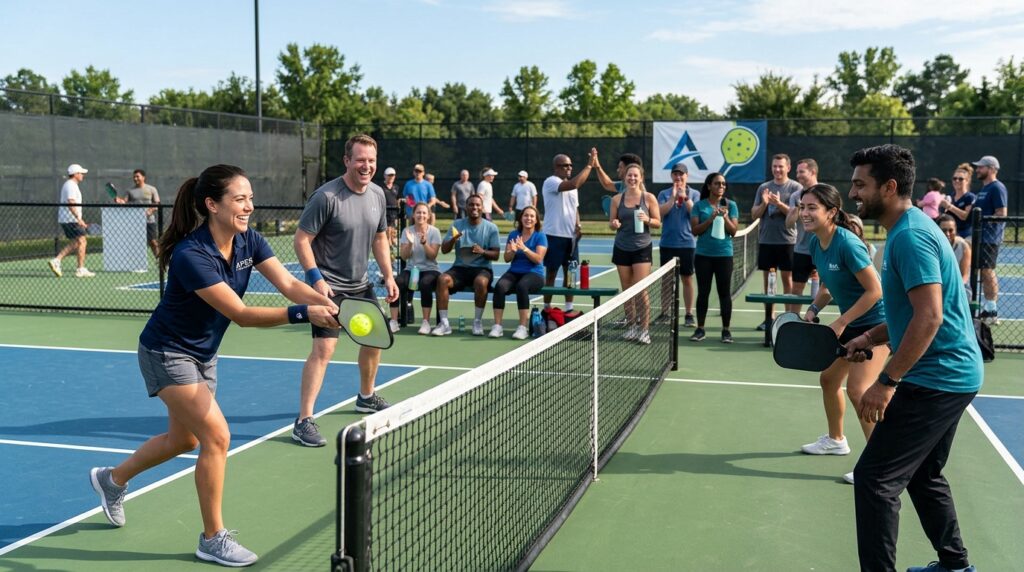
Corporate team building has moved beyond conference-room exercises, generic workshops, and dinners where employees spend most of the evening speaking with the same colleagues they already know.
Today’s organizations need experiences that bring people together naturally, accommodate different personalities and abilities, and create meaningful interaction without making participation feel like another workplace assignment.
Pickleball fits that need unusually well.
The basic game can be introduced quickly, doubles play encourages communication, and event formats can be adapted for beginners, experienced players, spectators, small departments, or larger company groups. Employees can participate through coaching, casual games, organized challenges, social time, or a combination of activities.
At Pickle Social Lounge in Northdale, Tampa, companies can plan customized group outings and corporate events with court play, private rentals, group packages, instruction, social experiences, and lounge time for food, drinks, and conversation.
The result is not merely an afternoon away from work. A thoughtfully planned pickleball event can create space for:
- Informal communication
- Cross-department interaction
- Shared problem-solving
- Friendly competition
- Physical activity
- Employee recognition
- Relaxed networking
- Memorable team experiences
Pickleball has also developed a broad participation base. According to the Sports & Fitness Industry Association, approximately 24.3 million Americans played pickleball in 2025, up from 4.2 million in 2020. SFIA reported that participation grew 171.8% between 2022 and 2025.
That familiarity makes pickleball easier to introduce at a company event than an obscure activity requiring extensive explanation, expensive personal equipment, or advanced athletic ability.
Quick Answer: Why Is Pickleball Effective for Corporate Team Building?
Pickleball works well for team-building events because it combines a simple learning curve, doubles-based cooperation, movement, conversation, and flexible competition in one activity.
A corporate pickleball event can help employees:
- Communicate in a less formal environment
- Interact with colleagues outside their normal teams
- Work with different partners
- Share light physical activity
- Practice quick decision-making
- Celebrate effort rather than only athletic ability
- Connect through games, food, and social time
It is particularly useful when the event is designed around participation rather than elimination.
Employees should not have to be experienced athletes to enjoy the event. Beginner instruction, balanced teams, rotating partners, shorter games, and optional social activities can keep the experience welcoming.
Why Traditional Team-Building Events Often Miss the Mark
Traditional team building is not automatically ineffective. Workshops, retreats, presentations, and company dinners can still serve a purpose.
The problem begins when employees experience the activity as:
- Mandatory
- Predictable
- Overly scripted
- Physically or socially uncomfortable
- Disconnected from the team’s real dynamics
- Dominated by a few outspoken participants
Some employees enjoy formal exercises. Others become self-conscious when asked to share personal information, perform in front of colleagues, or participate in a game with unclear workplace relevance.
Pickleball changes the setting.
Instead of discussing collaboration in theory, employees communicate while trying to cover the court together. Instead of completing a worksheet about adaptability, partners adjust naturally when a rally changes direction. Instead of being instructed to network, colleagues talk between games, during rotations, and while relaxing afterward.
The event still requires thoughtful planning. Simply handing everyone a paddle will not repair a dysfunctional workplace culture. However, pickleball can create a low-pressure environment in which positive interactions become easier.
1. Pickleball Is Accessible to Beginners
One of pickleball’s biggest advantages for corporate events is that employees can learn the basic structure without months of preparation.
USA Pickleball describes the sport as a paddle game combining elements of tennis, badminton, and table tennis. It can be played indoors or outdoors in singles or doubles, with an underhand serve and a smaller court than tennis.
New players still need instruction on:
- Serving
- Scoring
- The non-volley zone
- Court positioning
- Basic safety
- How to hold and use the paddle
However, they can begin participating without mastering advanced technique.
This matters for mixed corporate groups. A single company may include:
- Regular athletes
- First-time players
- Employees returning to activity
- Different age groups
- People with varying comfort levels around competition
- Employees who prefer social participation over intense play
A well-structured event can use short beginner clinics before games begin. Employees learn together, which removes the expectation that everyone should already know what they are doing.
At Pickle Social Lounge, group clinics and private coaching are available across beginner, intermediate, and advanced levels. Beginner sessions focus on rules, foundations, and basic skills, while higher-level instruction can address technique, consistency, drills, and match strategy.
Why Learning Together Supports Team Building
When employees begin at roughly the same level, mistakes become part of the shared experience.
A missed serve or unusual bounce can create laughter without requiring anyone to reveal personal information or perform a forced trust exercise. More experienced players can encourage beginners, provided the event is designed to prevent them from controlling every rally.
The goal is not to discover the company’s next tournament champion.
The goal is to create an activity where people can improve, contribute, and enjoy visible progress during the event.
2. Doubles Play Encourages Natural Communication
Pickleball is commonly played in doubles, placing two colleagues on the same side of the court.
Partners must communicate about:
- Who will take the ball
- When to move forward
- How to cover open space
- Whether to switch sides
- Which strategy to use
- How to respond after losing a point
- How aggressively or cautiously to play
These conversations happen in real time.
There is no facilitator asking employees to role-play teamwork while everyone quietly studies the clock. The game itself creates a practical reason to communicate.
Workplace Skills That Can Appear During Play
A doubles team may need to:
- Share responsibility
- Make fast decisions
- Recover from mistakes
- Adapt to a partner’s strengths
- Give concise information
- Listen under pressure
- Maintain a constructive attitude
These behaviors resemble workplace collaboration, but companies should avoid claiming that one pickleball session will permanently transform communication or productivity.
The more realistic value is that employees experience colleagues in a new context. They may discover who remains calm, who encourages others, who explains clearly, or who quietly helps a beginner regain confidence.
Those observations can create new familiarity that makes future workplace conversations less stiff.
3. It Creates Cross-Department Interaction
Employees often spend most of their working time with people in the same department, location, or project group.
A marketing employee may rarely interact with finance. A new hire may know senior leaders only through company-wide meetings. Remote workers may recognize colleagues from video calls without ever having held a relaxed conversation with them.
A corporate pickleball event can deliberately mix:
- Departments
- Seniority levels
- Office locations
- New and long-term employees
- Remote and on-site staff
- Client-facing and internal teams
Rotating partners can prevent people from remaining inside familiar workplace clusters.
Better Team Mixing
Instead of allowing employees to choose the same friends repeatedly, organizers can create planned rotations such as:
- Marketing paired with operations
- Managers paired with newer employees
- Remote staff paired with office-based colleagues
- Different locations placed on mixed teams
- Leadership members rotating across several courts
The activity gives each pairing something immediate to discuss. Employees do not need to invent small talk while standing beside a buffet table. They can talk about the game, the score, a surprising rally, or what they have just learned.
The pickleball becomes the conversational scaffolding. Nobody has to build the bridge from thin air.
4. It Can Reduce the Weight of Workplace Hierarchy
Job titles influence workplace interaction.
A junior employee may hesitate to speak casually with an executive. A manager may unconsciously spend an event with other managers. Employees who rarely interact with leadership may feel uncomfortable approaching them during a formal company dinner.
On the court, everyone follows the same basic rules.
The CEO can miss a serve. The newest employee can make the winning return. A manager may depend on a colleague from another department to cover the middle.
This does not erase the organizational hierarchy. Employees still return to their real roles afterward.
It can, however, create a more human interaction than employees usually experience inside formal workplace settings.
How Organizers Can Support This Benefit
To prevent the hierarchy from simply rebuilding itself at the event:
- Rotate leadership across different groups.
- Avoid creating an executives-only team.
- Keep competition friendly.
- Recognize sportsmanship and encouragement.
- Do not allow experienced senior leaders to dominate beginners.
- Use coaches or facilitators to organize teams objectively.
When leadership participates with humility, employees may feel more comfortable engaging naturally.
When leadership treats the outing as a televised championship final, the hierarchy may return wearing court shoes.
5. Pickleball Combines Social Connection With Physical Activity
A corporate pickleball event combines two elements that are often separated: movement and social interaction.
The CDC reports that even a single session of moderate-to-vigorous physical activity can provide immediate benefits, including reduced short-term anxiety. Regular activity can also support sleep, cognition, and mental health.
The CDC and National Institute for Occupational Safety and Health also identify social connection as an important part of worker well-being. Meaningful social connection can support stress management, health, and overall well-being.
A pickleball event can bring those elements together through:
- Light-to-moderate activity
- Shared learning
- Partner interaction
- Spectator conversation
- Breaks between games
- Food and lounge time
- Group celebration
Companies should not present one outing as a substitute for a comprehensive wellness program. An occasional event cannot repair chronic overwork, poor management, unsafe conditions, or inadequate benefits.
It can still be a useful component of a broader employee-wellness and engagement strategy.
6. The Activity Can Be Adapted to Different Comfort Levels
A common weakness in sports-based corporate events is the assumption that everyone wants to compete in the same way.
Some employees enjoy tournaments. Others prefer casual play, coaching, conversation, or watching colleagues.
A more inclusive pickleball event can offer several participation paths:
Active Players
Employees can join matches, round robins, or team challenges.
First-Time Players
Beginners can attend a short introduction and play simplified games.
Social Participants
Employees can watch, talk, enjoy refreshments, and support teams.
Limited-Participation Guests
Employees who cannot or do not wish to play may help with:
- Scorekeeping
- Team naming
- Event photography
- Awards
- Music
- Check-in
- Spectator challenges
- Social activities
Inclusivity does not mean pretending that every person has the same physical ability. It means designing the event so that playing a full match is not the only way to belong.
Employees with injuries, disabilities, medical limitations, pregnancy-related considerations, or other concerns should be able to communicate their needs privately and participate appropriately.
7. It Offers Friendly Competition Without Requiring Elimination
Competition can create excitement, but a poorly designed tournament can sideline beginners after one short match.
Corporate events usually work better when participants continue playing and meeting different colleagues.
Useful formats include:
- Rotating-partner games
- Round-robin play
- Short timed matches
- Department challenges
- Beginner and experienced divisions
- Cooperative rally goals
- Skills stations
- Team points earned across several activities
Recognition Beyond Winning
Awards can include:
- Best teamwork
- Most encouraging teammate
- Strongest comeback
- Best team name
- Most improved player
- Best sportsmanship
- Longest rally
- Most enthusiastic beginner
This keeps athletic performance from becoming the only form of success.
A highly competitive player may win the tournament. A first-time player who supports every partner may contribute more to the actual team-building goal.
8. Pickleball Can Help Reconnect Hybrid and Remote Teams
Remote and hybrid work can reduce spontaneous interaction.
Colleagues may collaborate effectively through email, chat, and video calls while knowing very little about one another outside assigned tasks.
An in-person event gives those employees an opportunity to:
- Match names with faces
- Build shared memories
- Have unstructured conversations
- Meet colleagues outside scheduled calls
- Develop stronger familiarity
- Interact without an agenda or presentation deck
Social connection matters in worker well-being, particularly when employees have limited opportunities for informal contact.
A corporate pickleball outing can provide a reason for distributed teams to gather without spending the entire event discussing quarterly targets.
The activity should still be scheduled carefully. Companies may need to consider:
- Travel requirements
- Time zones
- Accessibility
- Work schedules
- Caregiving responsibilities
- Whether attendance is optional
- Transportation
- Appropriate notice
A social event becomes less welcoming when employees must quietly absorb avoidable personal costs to attend.
9. Shared Experiences Can Strengthen Team Familiarity
Employees often remember specific moments more clearly than they remember formal team-building lessons.
At a pickleball event, those moments may include:
- A beginner making an unexpected return
- Two departments completing a long rally
- A manager learning the rules from a new employee
- A team recovering after losing several points
- Colleagues creating an inventive team name
- A close final game
- A shared meal after play
The value is not that every memory directly improves business performance.
The value is that shared experiences give colleagues social reference points. A future workplace conversation may begin more easily because the employees have already laughed, learned, or solved a small challenge together.
Teams are partly built through systems and leadership. They are also built through accumulated moments of familiarity.
10. Corporate Pickleball Events Are Flexible
A pickleball outing can be adapted around the company’s group size, goals, experience level, available time, and desired atmosphere.
Pickle Social Lounge lists customized group packages, private rentals, corporate outings, social events, courts, coaching, food, drinks, and lounge experiences among its offerings.
Possible corporate formats include:
- A two-hour beginner social
- A half-day team-building outing
- A department tournament
- An employee-appreciation event
- A leadership retreat activity
- A new-hire networking session
- A wellness-focused company event
- A client or partner gathering
- A holiday celebration
- A team milestone event
The event can be designed around relaxed play or organized competition.
That flexibility is one reason pickleball can work for companies that would not choose a conventional sports tournament.
Which Companies Can Benefit From a Pickleball Team-Building Event?
Corporate pickleball is not limited to large national organizations.
It can work for:
- Small businesses
- Startups
- Healthcare teams
- Real estate companies
- Technology firms
- Financial organizations
- Sales teams
- Professional-service companies
- Educational organizations
- Nonprofits
- Distributed teams
- Client-facing departments
The strongest fit is usually an organization seeking an activity that combines participation, social time, movement, and flexible event design.
Small Teams
A small team can use one or more courts for coaching, rotating games, and relaxed conversation.
The smaller group size may allow:
- More playing time
- Personalized instruction
- Deeper conversation
- A simpler event schedule
- Flexible pairings
Medium and Large Teams
Larger organizations may benefit from:
- Multiple courts
- Assigned rotations
- Skill-based groups
- Team captains
- Structured tournament brackets
- Lounge and spectator areas
- Staggered coaching sessions
- Dedicated networking time
Large events require more planning to prevent long waits and participant confusion.
Client and Partner Events
Pickleball can also create an alternative to the conventional client dinner or networking reception.
A client event may combine:
- Beginner instruction
- Light games
- Food and beverages
- Informal conversation
- Team challenges
- Branded recognition or prizes
The atmosphere should remain professional and accessible. Clients should not feel pressured to demonstrate athletic ability in order to participate.
Pickleball Is a Tool, Not a Workplace-Culture Shortcut
A successful outing can support connection, morale, wellness, and employee recognition.
It cannot compensate for:
- Poor leadership
- Unsustainable workload
- Unclear communication
- Workplace exclusion
- Inadequate recognition
- Unresolved team conflict
- A lack of psychological safety
Companies gain the most value when the event reflects the culture they are trying to build.
That means:
- Participation is welcoming rather than coercive.
- Beginner employees are not embarrassed.
- Physical limitations are respected.
- Leaders join without dominating.
- Teams are mixed thoughtfully.
- Employees have time to socialize.
- Recognition includes teamwork and encouragement.
- Feedback is gathered afterward.
Pickleball creates the court. The organization still decides how people are invited to play on it.
Corporate Pickleball Events at Pickle Social Lounge
Pickle Social Lounge provides indoor pickleball and group-event options in Northdale, Tampa.
Its offerings include:
- Corporate outings
- Customized group packages
- Private court rentals
- Beginner, intermediate, and advanced clinics
- Private coaching
- Open play
- Leagues
- Tournaments
- Social nights
- Food and drinks
- Lounge space between games
The venue positions its events around both play and social interaction, allowing companies to combine organized activity with time for employees to relax and connect.
A corporate event can therefore be planned around the company’s actual objective rather than forcing every group into the same tournament format.
The first planning question should be:
What should employees experience by the end of this event?
The answer may be meeting new colleagues, celebrating a milestone, reconnecting a hybrid team, introducing a wellness activity, thanking employees, or simply having an enjoyable afternoon together.
Once that objective is clear, the courts, coaching, game format, team rotations, food, social time, and recognition can be organized around it.
How to Plan a Successful Corporate Pickleball Team-Building Event
A successful corporate pickleball event requires more than reserving courts and dividing employees into teams.
The organizer must create an experience where:
- Beginners understand how to participate
- Experienced players remain engaged
- Employees interact beyond their usual workplace circles
- Non-players still feel included
- Competition remains friendly
- The schedule provides time for both activity and conversation
- Physical safety and accessibility are considered
- The event supports a clear business or cultural objective
Pickle Social Lounge offers indoor pickleball in Northdale, Tampa, along with customized group packages, corporate outings, private rentals, coaching, social experiences, food, drinks, and lounge space. Its flexible format allows companies to build an event around their team rather than forcing every group into the same tournament structure.
Step 1: Define the Purpose of the Event
Before selecting teams or deciding how many games to play, determine what the organization wants employees to experience.
Possible objectives include:
- Welcoming new employees
- Reconnecting a hybrid or remote team
- Improving cross-department familiarity
- Celebrating a company milestone
- Recognizing employee performance
- Supporting a workplace wellness initiative
- Strengthening leadership relationships
- Entertaining clients or business partners
- Providing a relaxed holiday or seasonal outing
- Creating a social experience after a meeting or conference
The objective should shape the event format.
For example, a company focused on networking may use frequent partner rotations and generous lounge time. A sales team celebrating a successful quarter may prefer a lively department challenge. A wellness-focused event may emphasize beginner instruction, movement, breaks, hydration, and participation rather than tournament results.
Without a clear purpose, an event can become a collection of games that employees enjoy but that does little to encourage new interaction.
Step 2: Understand the Group Before Building the Schedule
Send a short pre-event form or registration survey.
Ask employees about:
- Pickleball experience
- General comfort with physical activity
- Interest in casual or competitive play
- Equipment needs
- Dietary requirements
- Accessibility needs
- Injuries or movement limitations they wish to disclose
- Whether they prefer playing, social participation, or both
Employees should not be required to publicly explain a medical condition or disability.
A private registration process gives organizers enough information to plan appropriate participation without placing anyone in an uncomfortable spotlight.
Useful Skill-Level Categories
Keep the categories simple:
New Player
Has never played or has played only once or twice.
Recreational Player
Understands basic rules and can maintain a short rally.
Experienced Player
Plays regularly and is comfortable with scoring, positioning, and strategy.
Avoid asking employees to assign themselves complicated tournament ratings unless the event genuinely requires them.
The goal is not to conduct a secret athletic census. It is to prevent a first-time player from being placed against someone who travels with three paddles and a personal ball machine.
Step 3: Choose the Right Event Length
Most corporate pickleball events work best when they are long enough to include instruction, play, breaks, and social interaction without exhausting participants.
Two-Hour Event
Best for:
- Small teams
- After-work outings
- Beginner introductions
- Employee-appreciation activities
- A pickleball session attached to another corporate event
A two-hour event should use a simple format with limited downtime.
Three-Hour Event
Best for:
- Mixed-experience groups
- Team-building outings
- Department networking
- Beginner instruction followed by games
- Food and social time after play
Three hours usually provides enough room for orientation, coaching, rotations, breaks, and conversation.
Four-Hour Event
Best for:
- Larger organizations
- Multi-department gatherings
- Structured tournaments
- Client events
- Leadership retreats
- Company celebrations with food and awards
A longer event should not require every employee to play continuously. Rotate participants and include lounge, refreshment, networking, and spectator periods.
Sample Two-Hour Corporate Pickleball Schedule
| Time | Activity |
|---|---|
| 0:00–0:15 | Arrival, check-in, team assignments, equipment distribution |
| 0:15–0:30 | Safety briefing, rules, and beginner instruction |
| 0:30–0:45 | Guided warm-up and practice rallies |
| 0:45–1:30 | Rotating-partner games or team challenges |
| 1:30–1:45 | Final group challenge |
| 1:45–2:00 | Recognition, refreshments, and team photo |
This format keeps the event moving while giving beginners enough preparation to participate.
Sample Three-Hour Corporate Pickleball Schedule
| Time | Activity |
| 0:00–0:20 | Check-in, refreshments, and informal networking |
| 0:20–0:40 | Welcome, safety guidance, and beginner clinic |
| 0:40–1:00 | Warm-up and skill stations |
| 1:00–1:50 | Rotating doubles games |
| 1:50–2:05 | Break and team mixing |
| 2:05–2:35 | Department or company challenge |
| 2:35–3:00 | Food, drinks, recognition, and social time |
This format balances playing time with the conversations that make the event useful for team building.
Sample Four-Hour Corporate Tournament Schedule
| Time | Activity |
| 0:00–0:30 | Arrival, check-in, food, and networking |
| 0:30–0:50 | Group welcome, rules, and safety briefing |
| 0:50–1:15 | Beginner clinic and experienced-player warm-up |
| 1:15–2:15 | Round-robin matches |
| 2:15–2:35 | Break, refreshments, and standings update |
| 2:35–3:15 | Placement matches or cooperative team challenges |
| 3:15–3:35 | Final matches |
| 3:35–4:00 | Awards, food, photos, and closing remarks |
Companies should avoid building a four-hour schedule in which eliminated teams spend half the event watching others play.
Round-robin, skills-based, or consolation formats keep more employees involved.
Corporate Pickleball Event Formats
The best format depends on the group’s size, skill mix, purpose, and desired atmosphere.
1. Beginner Pickleball Social
Best for:
- First-time players
- New teams
- Employee-appreciation outings
- Groups prioritizing social connection
- Companies with varied fitness levels
The event begins with a short clinic covering:
- Basic court areas
- Paddle grip
- Underhand serving
- Scoring
- The non-volley zone
- Safe movement
- Simple doubles positioning
After instruction, employees play short guided games.
Scores may be kept, but winning is not the central purpose.
Pickle Social Lounge advertises group clinics and private coaching, alongside welcoming open-play opportunities for new players.
2. Rotating-Partner Round Robin
Best for:
- Cross-department interaction
- Hybrid-team reunions
- Medium-sized groups
- Employees with mixed experience
- Networking-focused events
Employees change partners after each short game.
Instead of one fixed team playing together all afternoon, participants interact with several colleagues.
Rotations can be arranged so employees partner with people from:
- Different departments
- Different seniority levels
- Different office locations
- Different project teams
- Different experience levels
Matches can be timed rather than played to a full score. This keeps the event schedule predictable.
3. Department Challenge
Best for:
- Sales meetings
- Company celebrations
- Larger teams
- Organizations with strong department identities
- Groups that enjoy friendly competition
Departments earn points through multiple activities rather than one elimination bracket.
Points may be awarded for:
- Match wins
- Long rallies
- Skills challenges
- Team spirit
- Sportsmanship
- Creative team names
- Beginner improvement
- Partner communication
Using several scoring categories prevents the most experienced athletes from determining the entire outcome.
4. Cooperative Rally Challenge
Best for:
- Beginner-heavy groups
- Wellness events
- Teams uncomfortable with direct competition
- Leadership-development activities
- Smaller gatherings
Partners work together to achieve a shared result.
Examples include:
- Completing ten consecutive dinks
- Maintaining the longest rally
- Moving through a skills course together
- Landing serves in designated areas
- Reaching a group-wide rally target
This format emphasizes patience, communication, and shared progress.
The opposing team is not always the enemy. Sometimes the real villain is the ball that refuses to remain inside the court.
5. Leadership Rotation Event
Best for:
- Leadership retreats
- New-management introductions
- Employee-engagement events
- Organizations trying to increase informal access to leaders
Managers and executives rotate through different teams rather than playing together.
The format should be casual and should avoid creating a leadership-versus-employees spectacle.
Useful rules include:
- Leaders change partners every round.
- No executive-only team is created.
- Experienced leaders support rather than dominate beginners.
- Awards recognize encouragement and sportsmanship.
- Lounge time includes mixed seating.
6. Client and Partner Pickleball Social
Best for:
- Client appreciation
- Professional networking
- Vendor relationships
- Referral-partner events
- Business-development gatherings
Use a polished but relaxed structure:
- Welcome refreshments
- Brief beginner instruction
- Light rotating games
- Optional skills challenge
- Food and networking
- Informal recognition
Avoid overly aggressive competition. Clients should leave remembering the conversation and hospitality, not the regional sales director’s disputed kitchen violation.
7. Employee Wellness Event
Best for:
- Wellness weeks
- Health-focused initiatives
- Stress-management programming
- Employee-appreciation days
- Organizations introducing recreational movement
A wellness event can include:
- Guided warm-up
- Beginner instruction
- Low-pressure play
- Hydration breaks
- Mobility guidance
- Short games
- Social time
- Recovery tips
One recreational event should not be presented as a complete workplace wellness strategy. It can function as an approachable entry point that encourages movement and social participation.
How to Introduce Beginners Without Slowing the Event
Beginners should not be handed a paddle, shown the court, and expected to learn through confusion.
A short orientation can prevent frustration and improve safety.
What the Beginner Clinic Should Cover
Keep instruction focused on what employees need for the event:
- How to hold the paddle
- How to serve underhand
- Where the serve must land
- How basic scoring works
- What the kitchen or non-volley zone means
- Where partners should stand
- How to call the ball
- How to move safely
- When to stop play
- How rotations will work
Avoid overwhelming participants with advanced strategy.
They do not need a lecture on third-shot drop mechanics before they know which side is serving.
Create a Practice Period
Allow beginners to:
- Hit several serves
- Practice returning the ball
- Rally from a comfortable distance
- Try a few dinks
- Learn where to stand
- Ask questions
The practice period can happen while experienced players complete their own warm-up or advanced challenge.
Use Short Games
Beginner-friendly games may be:
- Timed for six to eight minutes
- Played to seven points
- Focused on maintaining rallies
- Guided by a coach or facilitator
- Organized with experienced, supportive partners
Short games reduce waiting and allow teams to rotate more frequently.
How to Mix Teams Strategically
Team assignments determine whether employees meet new colleagues or simply recreate the office lunch table on court.
Avoid Pure Self-Selection
Allowing everyone to choose partners may feel comfortable, but it often causes:
- Friends to remain together
- Departments to stay separated
- New employees to feel excluded
- Leadership to cluster
- Remote staff to remain unfamiliar
- Athletic employees to form dominant teams
Organizers can accept limited preferences while still creating purposeful rotations.
Useful Team-Mixing Methods
Cross-Department Pairing
Pair employees from different areas of the organization.
Experience Balancing
Place one recreational player with one beginner rather than grouping all experienced players together.
Randomized Rotation
Use numbered cards, colored wristbands, or a prepared schedule.
Project-Based Mixing
Pair employees who rarely work together but whose departments depend on one another.
New-Hire Integration
Rotate newer employees across several teams so they meet more colleagues.
Leadership Mixing
Assign managers and executives to different courts and rotate them regularly.
Do Not Turn Experienced Players Into Unpaid Coaches
An experienced employee may enjoy helping a beginner, but the organizer should not assume that person wants to spend the entire event teaching.
Use professional instruction or event facilitators for the core clinic when available.
Experienced employees can then participate rather than carrying the event on their back alongside their paddle bag.
Making the Event Inclusive
Inclusivity requires more than saying that pickleball is “for everyone.”
Not every employee can or wants to participate in the same way.
Offer Multiple Participation Options
Employees may participate as:
- Players
- Casual learners
- Spectators
- Scorekeepers
- Team captains
- Event photographers
- Award presenters
- Social participants
- Check-in volunteers
- Music or activity coordinators
Playing should be encouraged without being treated as a test of loyalty to the company.
Provide a Private Way to Request Accommodations
The registration process should allow employees to privately share:
- Mobility needs
- Hearing or visual needs
- Injury restrictions
- Dietary requirements
- Seating needs
- Communication preferences
- Other relevant accommodations
The organizer should then coordinate with the venue before finalizing the schedule.
Do not ask employees to explain personal health information in front of colleagues.
Create Rest and Social Areas
Employees should have places to:
- Sit between games
- Drink water
- Talk with colleagues
- Eat
- Observe matches
- Recover from activity
- Participate without remaining on court
Pickle Social Lounge promotes a lounge-centered experience with food and drinks available between play, which can support the social portion of a corporate outing.
Avoid Overly Long Playing Blocks
Continuous play may exclude employees who can participate comfortably for shorter periods.
Use:
- Short matches
- Scheduled breaks
- Rotating substitutions
- Optional rounds
- Lounge periods
- Skills stations
The event should not quietly become an endurance contest disguised as inclusion.
Plan the Food and Networking Experience
The social portion should be treated as part of the event, not leftover time after the tournament.
Some employees build stronger connections during a rally. Others connect while discussing the rally afterward.
When to Schedule Food
Before Play
Light refreshments can support arrival and early networking.
Avoid serving a heavy meal immediately before physical activity.
During Play
Provide water and easy-to-manage refreshments during scheduled breaks.
After Play
A post-game food and lounge period creates space for:
- Informal conversation
- Recognition
- Team photos
- Client networking
- Leadership interaction
- Event feedback
- Continued celebration
Arrange Seating to Encourage Interaction
Avoid assigning tables strictly by department.
Use:
- Mixed seating
- Shared high-top areas
- Team-based tables that change after play
- Leadership rotation
- Informal standing areas
- Conversation prompts related to the event
The pickleball provides the opening story. The lounge gives employees time to finish it.
Confirm Food and Beverage Details Early
Ask the venue about:
- Available menus
- Dietary accommodations
- Minimum food or beverage commitments
- Outside catering policies
- Alcohol service
- Non-alcoholic options
- Service timing
- Seating
- Cleanup
- Billing arrangements
Pickle Social Lounge currently promotes food, drinks, lounge time, and social experiences alongside its court activities. Corporate packages are customized, so companies should request event-specific details directly rather than assuming ordinary court or open-play pricing applies.
Corporate Event Safety Planning
Safety does not require turning the event into a seminar. It requires clear expectations and sensible preparation.
Before the Event
Tell employees to bring or wear:
- Comfortable athletic clothing
- Secure court-appropriate shoes
- Socks suitable for activity
- Any personally required support equipment
- A refillable water bottle when permitted
Clarify whether the venue supplies paddles and balls for the group. Do not rely on assumptions made from unrelated classes or open-play sessions.
At Check-In
Explain:
- Court boundaries
- The non-volley zone
- How team rotations work
- Where bags and drinks belong
- What to do when a loose ball enters the court
- How to contact an event facilitator
- That employees should stop if they feel unwell or experience sharp pain
During Play
Encourage participants to:
- Warm up before faster games
- Communicate with partners
- Avoid uncontrolled backward running
- Stop when another ball enters the court
- Take breaks
- Drink fluids
- Allow unsafe or unreachable balls to go
- Report wet or damaged areas
- Avoid playing through pain
Avoid Public Pressure
Employees should not be pressured to:
- Continue after feeling unwell
- Play through an injury
- consume alcohol
- compete at a higher level than is comfortable
- disclose medical information
- participate in every round
A voluntary social event quickly loses its social sparkle when opting out requires a courtroom defense.
How to Budget for a Corporate Pickleball Event
Corporate event pricing may depend on:
- Number of courts
- Event duration
- Day and time
- Group size
- Private rental requirements
- Coaching
- Equipment
- Food and beverage selections
- Staffing or facilitation
- Tournament organization
- Decorations
- Awards or prizes
- Additional lounge space
Pickle Social Lounge lists customized packages for group events and corporate outings, which means companies should request a quote built around their specific attendance, schedule, and service needs.
Questions to Ask Before Approving the Budget
- How many courts are included?
- Is the event private or shared with other guests?
- What is the recommended group size for the reserved courts?
- Is beginner instruction included?
- Are paddles and balls included?
- Will staff organize rotations or tournament play?
- Is setup and cleanup included?
- What food and beverage options are available?
- Are there minimum spending requirements?
- Are taxes, gratuities, and service charges included?
- What deposit is required?
- What is the cancellation or rescheduling policy?
- Can attendance numbers change after booking?
- Are additional hours available?
- What accessibility arrangements can be supported?
The lowest quote is not automatically the best value.
A less expensive package may require the company to organize instruction, equipment, teams, scoring, check-in, food, and cleanup independently.
Why Indoor Pickleball Helps Corporate Event Planning
Indoor courts reduce several uncertainties associated with outdoor company activities.
Companies do not have to build the entire event around:
- Rain
- Direct sun
- Outdoor court availability
- Extreme heat
- Wind
- Wet playing surfaces
This does not remove the need for hydration, breaks, or contingency planning. It does make scheduling more predictable, especially for companies coordinating employees, clients, transportation, catering, or leadership calendars.
Pickle Social Lounge currently operates indoor pickleball courts in Northdale, Tampa, and lists daily operating hours of 7 a.m. to 9 p.m. Event availability should be confirmed directly for the desired date and group size.
How Far in Advance Should a Company Book?
Booking needs vary according to:
- Group size
- Number of courts
- Preferred date
- Weekday or weekend timing
- Coaching requirements
- Food and beverage needs
- Private rental requests
- Custom tournament planning
A small weekday outing may require less coordination than a large private event involving several courts, catering, coaches, and company branding.
Companies should begin planning early when:
- Attendance is high
- Leadership calendars are difficult to coordinate
- Employees are traveling
- The event is connected to a holiday
- Private venue use is required
- Custom food service is needed
- The company wants a structured tournament
Do not announce a date to employees before confirming that the venue, courts, and required services are available.
Communicating the Event to Employees
The invitation should make the experience feel welcoming, not mysterious.
Include:
- Date and time
- Venue location
- Event purpose
- Whether attendance is optional
- Expected activity level
- Recommended clothing and footwear
- Whether equipment is provided
- Food and beverage details
- Registration deadline
- Transportation or parking information
- Accommodation request process
- Whether guests are permitted
- Who to contact with questions
Avoid marketing the event only around intense competition.
A subject line such as “Company Pickleball Championship” may excite regular players while making beginners quietly investigate whether sudden dental appointments are available.
Use inclusive language such as:
Join us for a beginner-friendly afternoon of pickleball, team challenges, food, and social time. No previous pickleball experience is required.
Measuring Whether the Event Worked
Do not evaluate success only by counting attendance or identifying the winning team.
A short post-event survey can ask:
- Did you feel welcome participating?
- Did you interact with colleagues outside your usual team?
- Was the beginner instruction useful?
- Was the event appropriately competitive?
- Was there enough time for social interaction?
- Did you understand the schedule?
- Were the activity options inclusive?
- Would you attend a similar event again?
- What should be improved?
- Which part of the event was most valuable?
Keep the survey short enough that employees will actually complete it.
Useful Event Indicators
The company may also review:
- Registration versus attendance
- Number of departments represented
- Participation in beginner instruction
- Use of non-playing options
- Employee feedback
- Requests for future activities
- Safety incidents
- Scheduling problems
- Food and service feedback
- Whether people remained for social time
A successful event should not need a spreadsheet with seventeen tabs to prove that employees enjoyed meeting one another.
The evidence may be visible in partner rotations, conversations between departments, beginner participation, shared laughter, and employees who remain after play rather than racing toward the exit.
Planning a Corporate Outing at Pickle Social Lounge
Pickle Social Lounge can support corporate outings through customized group packages, private rentals, indoor court play, coaching, social events, and a lounge experience with food and drinks.
When requesting event information, companies should provide:
- Preferred date
- Estimated number of guests
- Desired event duration
- Employee skill mix
- Need for beginner instruction
- Preferred casual or competitive format
- Food and beverage requirements
- Accessibility considerations
- Private-rental needs
- Company objective
- Approximate budget
The more clearly the organizer explains the group and goal, the easier it becomes to create an event that feels intentional rather than improvised.
A productive corporate pickleball outing should leave employees with more than a final score.
It should give them new conversations, new connections, a few memorable rallies, and at least one colleague whose unexpected backhand becomes company folklore.
Common Corporate Pickleball Event Mistakes to Avoid
Pickleball is easy to introduce, but a successful corporate event does not organize itself.
Poor scheduling, unbalanced teams, excessive competition, or weak communication can turn a promising outing into an afternoon of waiting, confusion, and awkward participation.
Avoiding the following mistakes can help companies create an event that feels organized, inclusive, and genuinely useful.
Mistake 1: Treating Every Employee as an Experienced Player
A company may have several regular pickleball players, but many employees may be holding a paddle for the first time.
Beginning immediately with competitive matches can leave new players:
- Confused about scoring
- Uncertain about court positioning
- Embarrassed by basic mistakes
- Worried about slowing down teammates
- Less likely to participate again
Include a short beginner clinic before formal games begin.
The introduction should explain:
- Serving
- Basic scoring
- The non-volley zone
- Court positioning
- Partner communication
- Safe movement
- Event rotations
Pickle Social Lounge offers group events and customizable experiences intended for both first-time and experienced players, making structured beginner onboarding a natural part of event planning.
Mistake 2: Allowing Employees to Form Their Own Teams
Self-selected teams usually recreate existing workplace groups.
Friends partner with friends. Departments remain separated. Senior leaders cluster together. New employees wait for someone to choose them.
This may produce enjoyable matches, but it limits the cross-team interaction that the company intended to create.
Use planned rotations based on:
- Department
- Seniority
- Location
- Experience level
- Project involvement
- New-hire status
Employees can still spend some time with familiar colleagues, but the event should deliberately create new pairings.
Mistake 3: Making the Event Too Competitive
Friendly competition can create energy. Excessive competition can make beginners withdraw and turn coworkers into unpaid line judges arguing over kitchen violations.
Warning signs include:
- Experienced players dominating every game
- Employees disputing points aggressively
- Beginners receiving criticism
- The tournament winner becoming the event’s only focus
- Eliminated teams spending most of the event watching
- Leaders treating the event as a performance test
Use shorter games, rotating partners, multiple recognition categories, and skill-balanced divisions.
Awards should celebrate more than winning.
Useful categories include:
- Best teammate
- Best sportsmanship
- Most improved player
- Longest rally
- Strongest comeback
- Best team name
- Most encouraging beginner
- Best cross-department partnership
Mistake 4: Creating Too Much Downtime
Employees become disengaged when they spend most of the event waiting for a court.
Downtime may result from:
- Too few courts
- Long games
- Elimination brackets
- Complicated scoring
- Unclear rotations
- Late arrivals
- No activities for waiting teams
Reduce waiting through:
- Timed matches
- Short scoring formats
- Multiple courts
- Skills stations
- Lounge activities
- Planned breaks
- Clear rotation boards
- Dedicated event facilitators
Pickle Social Lounge promotes organized leagues, tournaments, events, and inclusive play formats, which can support smoother match flow when event requirements are discussed in advance.
Mistake 5: Forgetting the Social Portion
An event can include excellent matches and still miss the team-building objective when employees leave immediately after their final game.
Schedule time for:
- Food and drinks
- Mixed seating
- Team photos
- Informal conversation
- Recognition
- Leadership interaction
- Client networking
- Event feedback
Pickle Social Lounge combines indoor pickleball with food, drinks, and lounge space, allowing companies to treat conversation as part of the experience rather than an accidental pause between matches.
Mistake 6: Ignoring Employees Who Do Not Want to Play
Not every employee will be comfortable participating in a physical activity.
Some may have:
- An injury
- A disability
- A medical restriction
- Limited mobility
- Pregnancy-related considerations
- Anxiety about competitive sports
- A personal preference not to play
The company should offer meaningful alternatives rather than positioning non-participation as a lack of team spirit.
Alternative roles may include:
- Scorekeeping
- Event photography
- Team coordination
- Award presentation
- Check-in
- Spectator challenges
- Music
- Social activities
- Client hosting
Employees should have a private way to request accommodations and should not be expected to discuss personal health information publicly.
Mistake 7: Making Attendance Feel Compulsory
An event may be technically described as optional while employees still believe absence will be noticed negatively.
This pressure becomes stronger when the event takes place:
- Outside normal work hours
- Far from the workplace
- Without transportation
- During caregiving hours
- With personal travel costs
- Without alternatives for employees who cannot participate
Companies should communicate clearly whether attendance is optional, whether travel time is compensated, and what arrangements are available.
A team-building event should strengthen belonging. It should not create a new category of employees who feel penalized for having responsibilities outside work.
Mistake 8: Failing to Plan for Different Skill Levels
A first-time player and a tournament participant may both enjoy pickleball, but they should not be placed into identical event formats without adjustment.
Options include:
- Beginner and recreational courts
- Separate competitive divisions
- Guided games
- Mixed-experience partnerships
- Skills challenges
- Optional tournament rounds
- Casual open-play periods
Experienced players should remain engaged without being permitted to turn every beginner game into a demonstration of paddle velocity.
Mistake 9: Skipping Safety Guidance
Corporate participants may be less familiar with court movement than regular players.
A brief safety orientation should explain:
- Court boundaries
- Where bags and drinks belong
- What to do when a loose ball enters the court
- Why uncontrolled backward running should be avoided
- When to stop playing
- How to communicate with a partner
- Where rest and hydration areas are located
The organizer should also confirm:
- Whether equipment is provided
- Recommended footwear
- Emergency procedures
- Venue staffing
- Accessibility arrangements
- First-aid availability
- Incident-reporting procedures
Mistake 10: Promising Business Results the Event Cannot Guarantee
A corporate pickleball outing may support communication, social connection, morale, and employee recognition.
It cannot guarantee:
- Increased revenue
- Permanent productivity improvements
- Reduced turnover
- Resolution of workplace conflict
- Improved leadership
- Elimination of employee stress
- A transformed company culture
CDC workplace guidance recommends treating worker well-being and social connection as strategic, ongoing priorities supported by organizational policies and leadership practices. A single social event may contribute to that environment, but it is not a substitute for healthy working conditions.
How Leadership Should Participate
Leadership behavior can shape the entire event.
When executives and managers participate with humility, employees may feel more comfortable interacting informally. When leaders dominate games, criticize beginners, or speak only with one another, the outing can reinforce the same hierarchy it was intended to soften.
Leadership Best Practices
Leaders should:
- Join mixed teams
- Rotate between departments
- Encourage new players
- Accept mistakes with humor
- Avoid coaching every colleague
- Participate in social time
- Recognize effort and sportsmanship
- Speak with employees outside their reporting lines
- Respect employees who choose limited participation
- Avoid making business decisions during games
Behaviors Leaders Should Avoid
Leaders should not:
- Create an executives-only team
- Select only athletic employees as partners
- criticize performance
- Pressure injured employees to play
- turn scores into workplace jokes that continue afterward
- discuss confidential work issues on court
- treat the event as an evaluation
- remain isolated in a leadership group
The event becomes more valuable when leadership participates as part of the community rather than arriving as a visiting royal court with paddles.
Can a Pickleball Event Improve Employee Engagement?
A pickleball event may support engagement by creating opportunities for social connection, recognition, shared activity, and interaction outside routine work.
Gallup’s employee-engagement guidance emphasizes trust, meaningful conversations, recognition, clarity, and shared effort. Its research also associates close workplace relationships with stronger engagement and communication.
However, companies should distinguish between supporting engagement and proving engagement improved because of one event.
A corporate outing is most likely to contribute positively when:
- Employees feel welcome
- Participation is not coercive
- Leaders interact authentically
- Departments are mixed thoughtfully
- Beginners receive support
- Employees have time to socialize
- Recognition is inclusive
- Feedback leads to visible follow-up
An event may create a useful spark. Daily management practices determine whether that spark survives Monday morning.
Measuring the Return on a Corporate Pickleball Event
The return on a team-building event should not be measured only through immediate financial revenue.
A more realistic assessment considers whether the event achieved its stated purpose.
Participation Metrics
Track:
- Number of invited employees
- Number registered
- Number attending
- Departments represented
- Leadership participation
- Beginner-clinic participation
- Players and non-playing participants
- Attendance during social time
Attendance alone does not prove success, but low attendance may reveal scheduling, communication, accessibility, or trust problems.
Interaction Metrics
Ask whether employees:
- Met colleagues outside their department
- Interacted with senior leaders
- Worked with a new partner
- Spoke with remote or hybrid colleagues
- Felt included
- Had enough time to socialize
These measures are particularly relevant when the event’s objective is cross-team connection.
Experience Metrics
Use a short post-event survey to measure:
- Overall satisfaction
- Quality of instruction
- Clarity of the schedule
- Appropriate level of competition
- Food and venue experience
- Perceived inclusivity
- Willingness to attend again
- Suggestions for improvement
Operational Metrics
Review:
- Event cost per attendee
- Registration-to-attendance rate
- Court utilization
- Schedule delays
- Safety incidents
- Equipment problems
- Food and beverage usage
- Overtime or unexpected charges
- Organizer workload
Follow-Up Indicators
In the following weeks, organizers may observe:
- Employee interest in future activities
- Informal pickleball groups forming
- Increased cross-department conversation
- Requests for leagues or wellness programming
- Employees sharing photos and event stories
- Stronger participation in later company events
These are useful signals, but they should not be presented as proof that pickleball alone changed productivity or retention.
Sample Post-Event Survey
Keep the survey brief and anonymous when practical.
Use a five-point scale for the following statements:
- I felt welcome at the event.
- The activity was appropriate for my experience level.
- I interacted with colleagues outside my usual team.
- The beginner instruction was clear and useful.
- The level of competition felt appropriate.
- There was enough time for social interaction.
- The schedule was easy to understand.
- The venue supported both playing and social participation.
- I would attend a similar event again.
Add two open questions:
- What was the most valuable part of the event?
- What should we change next time?
Avoid a survey so long that completing it feels like the company has scheduled a second team-building activity.
Turning One Event Into Longer-Term Engagement
The corporate outing should not disappear the moment the photos are uploaded.
Companies can extend its value without forcing employees into another program.
Share Event Highlights
Send employees:
- Group photos
- Award winners
- Memorable moments
- Thank-you messages
- Future activity information
- A short feedback survey
Obtain appropriate permission before publishing employee images externally.
Create an Optional Pickleball Group
Interested employees may organize:
- Monthly open play
- Beginner practice
- Department challenges
- A company league team
- Client pickleball socials
- Charity tournaments
Participation should remain voluntary.
Connect the Event to Wellness Initiatives
The company may offer:
- Optional movement breaks
- Recreational activity allowances
- Wellness challenges
- Beginner sports sessions
- Education on physical activity and recovery
- Access to local recreational programs
CDC’s workplace health model recommends coordinated and comprehensive approaches rather than isolated wellness activities.
Continue Cross-Team Interaction at Work
The event may reveal that employees value more informal contact.
Organizations can support that need through:
- Cross-department lunches
- Mentoring
- New-hire introductions
- Employee resource groups
- Project showcases
- Leadership office hours
- Hybrid-team gatherings
- Peer-recognition programs
The pickleball event may open the door. Everyday workplace practices decide whether anyone walks through it.
Using Pickleball for Client and Partner Events
Corporate pickleball is not limited to internal teams.
It can also support:
- Client appreciation
- Referral relationships
- Vendor networking
- Partner celebrations
- Business-development events
- Association gatherings
- Alumni groups
- Professional-community events
Why Pickleball Can Work for Client Entertainment
A pickleball social creates more movement and interaction than a traditional seated dinner.
Participants can:
- Learn something together
- Rotate through different partners
- Talk between games
- Share food and drinks
- Participate without playing continuously
- Build memories beyond a standard presentation
Client-Event Best Practices
For a professional guest event:
- Keep instruction beginner-friendly.
- Avoid an intense elimination tournament.
- Offer non-playing participation.
- Schedule substantial networking time.
- Confirm dietary and accessibility needs.
- Keep branding tasteful.
- Use clear hosts and facilitators.
- Avoid pressuring clients to compete.
- Provide event details well in advance.
- Follow up personally afterward.
The event should make guests feel hosted, not recruited into an unexpected athletic assessment.
Pickleball for Seasonal and Company Celebrations
Corporate pickleball can be adapted for occasions throughout the year.
Employee-Appreciation Event
Focus on:
- Relaxed play
- Food
- Recognition
- Mixed teams
- Optional coaching
- Participation awards
Holiday Party
Consider:
- Themed team names
- Casual games
- Food and beverages
- Social activities
- Charitable fundraising
- Awards unrelated to athletic performance
Avoid scheduling conflicts with religious observances, caregiving responsibilities, or peak workload periods.
New-Hire Welcome Event
Use:
- Rotating partners
- Leadership participation
- Department introductions
- Beginner coaching
- Structured social time
Company Milestone Celebration
Combine:
- Private court time
- Team challenges
- Recognition speeches
- Food and drinks
- Group photos
- Customized awards
Leadership Retreat
Use pickleball as one element within a broader program.
It may complement:
- Strategy discussions
- Leadership development
- Shared meals
- Reflection sessions
- Team planning
The game should provide energy and interaction without pretending to replace substantive leadership work.
When Pickleball May Not Be the Right Event
Pickleball is flexible, but it is not the best choice for every company or occasion.
Another format may be more appropriate when:
- Most attendees cannot participate comfortably
- The company cannot provide meaningful alternatives
- Employees strongly prefer another activity
- Travel creates unreasonable barriers
- The schedule is too short for instruction and play
- A sensitive workplace conflict requires professional facilitation
- The purpose is formal education or strategic decision-making
- The budget cannot support enough courts for the group
- Attendance would create significant personal costs for employees
A good event planner chooses the activity that serves the people, not the activity currently enjoying the loudest cultural paddle-pop.
Complete Corporate Pickleball Booking Checklist
Event Objectives
- What is the primary purpose?
- Who should interact?
- Is the event focused on wellness, networking, appreciation, competition, or celebration?
- What should employees experience by the end?
Attendance
- Estimated number of guests
- Departments represented
- Leadership attendance
- Remote or traveling employees
- Skill levels
- Non-playing participants
- Accessibility needs
- Dietary needs
Venue and Courts
- Number of courts
- Private or shared use
- Event duration
- Court-to-participant ratio
- Indoor conditions
- Seating and lounge space
- Restrooms
- Parking
- Accessibility
- Check-in area
Instruction and Facilitation
- Beginner clinic
- Coaches
- Warm-up
- Rules explanation
- Team assignments
- Match scheduling
- Scorekeeping
- Event host
- Safety briefing
- Equipment distribution
Equipment
- Paddles
- Balls
- Nets
- Scoreboards
- Team identifiers
- Awards
- Signage
- Audio equipment
- Photography arrangements
Food and Beverage
- Menu
- Dietary accommodations
- Water
- Non-alcoholic drinks
- Alcohol policy
- Service timing
- Minimum spending requirement
- Seating
- Gratuities and service fees
Financial Terms
- Court fees
- Private-rental fees
- Coaching costs
- Equipment charges
- Food and beverage costs
- Staffing
- Taxes
- Gratuity
- Deposit
- Final payment
- Cancellation policy
- Rescheduling policy
- Overtime charges
Employee Communication
- Invitation
- Registration deadline
- Clothing guidance
- Footwear recommendation
- Equipment details
- Parking and transportation
- Participation options
- Accommodation process
- Event contact
- Attendance expectations
Safety and Inclusion
- Warm-up plan
- Rest periods
- Hydration
- Loose-ball procedure
- Emergency process
- First-aid support
- Private accommodation requests
- Non-playing options
- Voluntary participation
- Incident documentation
Post-Event Follow-Up
- Photos
- Thank-you message
- Survey
- Awards
- Expense review
- Attendance report
- Organizer debrief
- Future activity interest
- Client follow-up
- Privacy and image-permission review
Booking a Corporate Event at Pickle Social Lounge
Pickle Social Lounge promotes birthdays, team-building outings, corporate events, and private celebrations at its indoor Tampa venue. Its group-event offering includes customizable experiences, all-inclusive package options, courts, food, drinks, and formats designed for first-time and experienced players.
The venue is located at:
Pickle Social Lounge
4417 Northdale Boulevard
Tampa, Florida 33624
Current contact details listed by the venue include:
- Phone: (813) 738-4938
- Email: info@picklesociallounge.com
- Hours: 7:00 a.m. to 9:00 p.m., seven days a week
Event availability, package inclusions, pricing, equipment, food, staffing, and private-use requirements should be confirmed directly for the company’s preferred date and group size.
When contacting the venue, provide:
- Preferred date and alternative dates
- Approximate attendance
- Desired event duration
- Employee experience levels
- Need for beginner coaching
- Casual or competitive preference
- Food and beverage needs
- Private-event requirements
- Accessibility considerations
- Approximate budget
- Main event objective
A clear request allows the venue to recommend an event structure rather than handing the organizer a blank court schedule and wishing them athletic luck.
The most effective corporate pickleball event is not the one with the most intense final match.
It is the one where beginners participate, experienced players remain engaged, leaders connect naturally, departments mix, employees feel respected, and the conversation continues after the paddles are put away.
Frequently Asked Questions
Why Is Pickleball Good for Corporate Team Building?
Pickleball combines communication, shared problem-solving, movement, and social interaction in one beginner-friendly activity.
During doubles play, colleagues must decide who will take the ball, cover open space, adjust strategy, and respond constructively after mistakes. These interactions happen naturally rather than through scripted workplace exercises.
The sport also allows companies to mix departments, seniority levels, new employees, remote workers, and leadership members in an environment that feels less formal than an office meeting.
A single outing will not repair deeper workplace problems, but it can create new conversations and shared experiences that make future collaboration feel less distant.
Do Employees Need Pickleball Experience to Participate?
No previous experience is required when the event includes beginner instruction.
First-time players should receive a short introduction covering:
- Paddle grip
- Underhand serving
- Basic scoring
- Court positioning
- The non-volley zone
- Partner communication
- Safe movement
After instruction, beginners can practice serves, dinks, and short rallies before joining simplified games.
Pickle Social Lounge offers clinics, coaching, open play, group packages, private rentals, and corporate outings that can be adapted for different experience levels.
Is Pickleball Appropriate for Employees of Different Ages and Fitness Levels?
Pickleball can work for a mixed group because the pace, game length, court assignment, and level of competition can be adjusted.
However, describing the activity as suitable for “everyone” can overlook genuine differences in health, mobility, confidence, and interest.
Companies should provide:
- Beginner and recreational playing options
- Shorter matches
- Rest periods
- Seating and lounge space
- Non-playing roles
- A private accommodation request process
- Optional rather than pressured participation
Employees with injuries, disabilities, recent surgery, pregnancy-related restrictions, or other medical concerns should participate only in ways that are safe and appropriate for them.
Inclusivity does not require everyone to play an identical game. It requires every employee to have a meaningful way to belong.
How Long Should a Corporate Pickleball Event Last?
Most corporate pickleball outings work well within a two-to-four-hour window.
Two Hours
Best for:
- Small teams
- After-work outings
- Beginner introductions
- Employee-appreciation activities
- Events attached to another meeting
Three Hours
Best for:
- Mixed-experience groups
- Cross-department networking
- Beginner instruction followed by games
- Food and social time
- General team-building outings
Four Hours
Best for:
- Larger groups
- Structured round robins
- Company celebrations
- Client events
- Leadership retreats
- Events involving awards and extended dining
The schedule should include check-in, instruction, play, breaks, and conversation. An event becomes less useful when participants spend three hours rotating through courts but receive six minutes to speak with one another.
What Is the Best Format for a Corporate Pickleball Event?
The strongest format depends on the company’s objective.
For Cross-Department Interaction
Use rotating partners so employees play with colleagues outside their usual teams.
For Beginners
Begin with guided instruction followed by short, low-pressure games.
For Friendly Competition
Use a round robin, department challenge, or points-based team competition instead of immediate elimination.
For Employee Wellness
Include a warm-up, beginner coaching, controlled games, hydration breaks, and recovery guidance.
For Client Networking
Combine short games with generous lounge, food, and conversation time.
For Employee Appreciation
Focus on relaxed play, social time, recognition, and optional participation rather than performance.
The format should serve the event’s purpose. The tournament bracket should not become the tail wagging the corporate dog.
How Many Employees Can Participate?
The appropriate group size depends on:
- Number of courts
- Event duration
- Match format
- Number of employees who want to play
- Skill differences
- Availability of coaches or facilitators
- Lounge and spectator capacity
- Whether the event is private
Larger groups generally need shorter games, structured rotations, multiple activity stations, and scheduled social periods.
Before booking, companies should ask the venue how many active players and total guests can be accommodated comfortably within the selected package.
Pickle Social Lounge advertises customized group packages and private rentals for corporate outings and groups of different sizes. Exact court allocation and event capacity should be confirmed for the chosen date and format.
Can Employees Participate Without Playing?
Yes. Non-playing participation should be included intentionally rather than treated as an afterthought.
Employees may contribute through:
- Scorekeeping
- Event photography
- Check-in
- Team coordination
- Award presentation
- Spectator challenges
- Music
- Social activities
- Client hosting
- Food and lounge participation
Employees should not have to disclose private medical information to explain why they are not playing.
A corporate event succeeds when employees feel included, not when a participation spreadsheet reaches 100 percent through social pressure.
Can Pickleball Help Reconnect Remote and Hybrid Teams?
A pickleball outing can create in-person interaction for colleagues who usually communicate through email, chat, or video calls.
Rotating partners and mixed seating can help remote and office-based employees:
- Match names with faces
- Meet colleagues outside scheduled calls
- Develop shared memories
- Have informal conversations
- Interact across departments
- Build greater familiarity
The company should still consider travel time, scheduling, caregiving responsibilities, accessibility, and whether attendance is genuinely optional.
An outing supports connection only when participation does not create unreasonable personal costs for the employees being invited.
Can Pickleball Be Used for Client or Partner Events?
Yes. A corporate pickleball social can provide a more interactive alternative to a conventional networking dinner.
A client event may include:
- Welcome refreshments
- Brief beginner instruction
- Casual partner rotations
- Optional skills challenges
- Food and lounge time
- Informal recognition
The event should remain welcoming and professionally organized.
Clients should not feel that maintaining a business relationship now requires returning a third-shot drop under executive observation.
What Should Employees Wear?
Employees should generally wear:
- Comfortable athletic clothing
- Secure court-appropriate shoes
- Socks suitable for activity
- Clothing that permits easy movement
- Any personally required support equipment
The invitation should explain whether paddles and balls are provided.
Employees should avoid loose accessories, unsuitable footwear, or clothing that restricts movement. Bags, bottles, and personal items should remain outside the playing area.
Should Alcohol Be Included?
Food and drinks can support the social portion of an event, but alcohol should never replace water, food, or inclusive non-alcoholic options.
When alcohol is available:
- Playing should be completed or substantially reduced before drinking.
- Non-alcoholic choices should be equally visible.
- Employees should not be pressured to drink.
- Transportation and company policies should be considered.
- Leadership should model responsible behavior.
Pickle Social Lounge promotes a lounge experience with food and drinks between activities. Event-specific beverage arrangements should be confirmed directly while planning the package.
How Far in Advance Should a Company Book?
Booking requirements depend on:
- Group size
- Preferred date
- Number of courts
- Private-rental needs
- Coaching
- Food and beverage service
- Tournament organization
- Company branding
- Seasonal demand
Larger or more customized events should be planned earlier than a small weekday outing.
Companies should confirm availability before announcing the event internally, especially when employees are traveling or leadership calendars must be coordinated.
How Much Does a Corporate Pickleball Event Cost?
Corporate-event costs may vary according to:
- Court time
- Number of courts
- Event length
- Group size
- Private rental
- Coaching
- Equipment
- Food and beverages
- Facilitation
- Staffing
- Taxes and service charges
- Awards or customized additions
Pickle Social Lounge states that customized group packages and private rentals are available, but it does not publish one universal corporate-event price on its main website. Companies should request a quote based on their attendance, schedule, and package needs.
The quote should clarify what is included so the organizer does not discover that coaching, equipment, food, or event facilitation live in separate financial kingdoms.
How Can a Company Measure Whether the Event Was Successful?
Measure the event against its original objective.
Useful questions include:
- Did employees interact outside their usual teams?
- Did beginners feel supported?
- Was the level of competition appropriate?
- Did leadership participate constructively?
- Was there enough social time?
- Could non-playing employees participate meaningfully?
- Would employees attend a similar event again?
- Were the schedule and instructions clear?
- Were there safety or accessibility problems?
Companies may also track attendance, department representation, beginner-clinic participation, event cost per attendee, court utilization, survey feedback, and interest in future activities.
Avoid claiming that one outing directly increased productivity, retention, or revenue unless the organization has reliable evidence to support that conclusion.
Final Verdict: Is Pickleball a Good Corporate Team-Building Activity?
Pickleball can be an effective corporate team-building option when the company wants an experience that combines:
- Beginner-friendly activity
- Natural communication
- Cross-department interaction
- Friendly competition
- Movement and social connection
- Leadership participation
- Employee appreciation
- Food and networking time
Its greatest strength is flexibility.
A company can design the outing as:
- A beginner social
- A rotating-partner event
- A department challenge
- A wellness activity
- A client gathering
- A leadership outing
- A company celebration
- A casual after-work event
Pickleball is less likely to work when employees are pressured to participate, accessibility is ignored, experienced players dominate, or the event is expected to solve organizational problems that require real leadership and workplace change.
The game provides a setting for connection. The company determines whether that setting feels thoughtful, inclusive, and worth remembering.
Plan a Corporate Pickleball Event at Pickle Social Lounge
Pickle Social Lounge provides indoor pickleball experiences in Northdale, Tampa, with corporate outings, customized group packages, private rentals, open play, leagues, tournaments, social nights, and a lounge experience with food and drinks.
Companies can build events around:
- Beginner instruction
- Casual team play
- Rotating doubles
- Department competitions
- Client networking
- Employee appreciation
- Private celebrations
- Food and social time
When submitting an inquiry, include:
- Preferred date and alternative dates
- Estimated guest count
- Desired event duration
- Employee skill mix
- Need for beginner instruction
- Casual or competitive preference
- Food and beverage requirements
- Accessibility considerations
- Private-rental needs
- Approximate budget and event objective
Pickle Social Lounge lists its location as 4417 Northdale Boulevard, Tampa, Florida 33624, with daily operating hours from 7:00 a.m. to 9:00 p.m. The venue can currently be contacted at (813) 738-4938 or info@picklesociallounge.com. Event availability and package details should be confirmed directly.
Contact Pickle Social Lounge to create a customized Tampa corporate pickleball event built around your team size, experience levels, business goals, and preferred style of play.
The most valuable event will not necessarily produce the most competitive final.
It will produce new conversations, unexpected partnerships, supported beginners, approachable leaders, and stories employees continue telling after the paddles return to the rack.
Contact Pickle Social Lounge to create a customized Tampa corporate pickleball event built around your team size, experience levels, business goals, and preferred style of play.